







Why Is Goal-Setting Important?
Goal-setting is an important part of life. As David McClelland pointed out in 1961, having a sense of achievement is one of the three main sources of motivation for humans(1). What better way to feel a sense of achievement than to actually achieve the goals that you’ve set for yourself?
However, setting goals blindly won’t help either.
TL;DR: SMART goals are Specific, Measurable, Achievable, Relevant, and Time-bound. This 1981 framework by George T. Doran remains the gold standard for goal-setting. Use Taskade’s AI agents to break SMART goals into daily tasks across multiple project views. Get started free -->
You have to hit the sweet spot when it comes to goal-setting. Goals cannot be too easy because you’ll be wasting your potential, and they also have to be attainable so that you won’t get demotivated by an unrealistic target. Here’s where SMART goals come into play.
What Are SMART Goals?
The concept of SMART goals was thought up by George T. Doran. The first mention of this framework was in an article he had written in 1981. In that article, Doran mentioned the benefits of writing SMART goals.
“How do you write meaningful objectives?...Let me suggest therefore, that when it comes to writing effective objectives, corporate officers, managers, and supervisors just have to think of the acronym SMART. Ideally speaking, each corporate, department and section objective should be: (SMART).”
George T. Doran
SMART goals help you to set yourself up for success. These are goals that are Specific, Measurable, Achievable, Realistic, and Timely. By optimizing your goal-setting strategy to be SMART, you’re setting yourself up for success in the long run.
In order for us to start writing SMART goals, let’s dive into what each letter from this acronym means.
Specific
First of all, SMART goals have to be specific. This means that you and your team members have to be aligned on exactly what the team has to achieve.
There are a few ways to help align your team on a common goal. One of which is to use the scrum project management style to ensure that everyone is on the same page in regards to the goal. If you’re working remotely, use this daily stand-up meeting template to help your team stay focused and on track.
Ensuring that everyone knows exactly what to do is critical to ensuring the success of your project.
Measurable
In order to track your progress, you will need to set measurable goals. Setting measurable goals helps to provide you with a gauge of your team’s current performance and progress. Setting a management review at certain points of your project helps you to track if your team is hitting the benchmark, or is falling short of it.
Achievable
One of the easiest ways to hurt you and your team’s morale is by setting unattainable goals. It’s perfectly okay to have a plan for the big leagues. However, you’d be better off if you broke down your stretch goals into smaller achievable steps. In other words, using hierarchical thinking to help you come up with a realistic action plan.
Focus on simpler goals first, and move on to more ambitious projects once your team is in the flow of getting things done.
Relevant
You have to set goals that mean something to you or your company. What’s the point of setting goals just because you have to? The best way to do this is to have an overarching long-term goal which is then broken down into smaller and more actionable sub-goals.
Setting relevant goals is an important aspect of SMART goal setting because it ensures that you’re only setting goals that benefit you and your organization.
Timely
If your goal doesn’t have a deadline, then how are you going to ensure that you achieve it in a timely manner? Goals should be set with a target date of completion in mind. This is so that you can work on it and track your progress at the same time to work towards a target date.
In summary, SMART goals are those that are Specific, Measurable, Achievable, and Relevant, with a due date for completion. The SMART framework is an effective way to help you set better goals for yourself and also your team. But how exactly do you write SMART goals down?
Why Are SMART Goals Important?
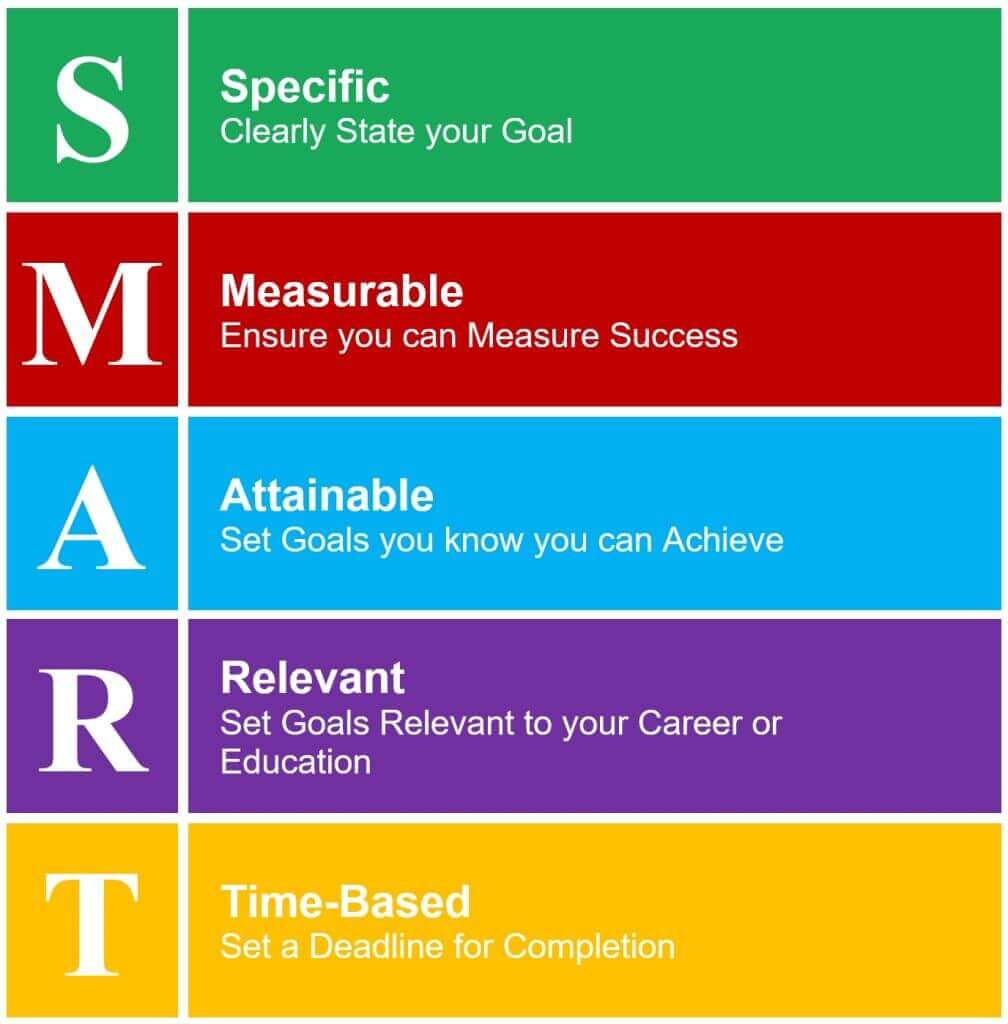
Image from Helpfulprofessor.com
SMART goals are important because they help you to set focused goals with a clear direction and timeframe. By following the SMART framework, your team will be clearer about the deliverables and as a result be more productive. Here is a list of benefits that come with SMART goal-setting:
Helps you set specific and clear goals
Ensures that you set achievable goals
Allows you to track your progress
Helps you set useful goals
Gives you a deadline to work towards
In a nutshell, SMART goals help by ensuring that you don’t set vague and unrealistic goals for yourself. Using the SMART goal framework helps you to set specific goals that are related to the bigger picture within a certain timeframe.
How to Write Smart Goals
SMART goals are easy to set. But what's important is for you to get into the habit of using this framework every time you set a new goal.
Here's how to easily set SMART goals.
List down the SMART acronym (Specific, Measurable, Achievable, Relevant, Timely)
Write down your goal and list down how it satisfies each of these criteria
Specific: Ensure that everyone involved in the project is clear on their role and exactly what they have to achieve
Measurable: Your goals must be measurable so that you can track performance and progress.
Achievable: Setting impossible goals will only hurt morale. Make sure that your goal is realistic.
Relevant: Don't set goals simply for the sake of it. Make sure that this goal has a direct benefit to your business.
Timely: Set realistic deadlines so that your team can work with a deadline in mind.
Use a free SMART goals template to get a headstart in effective goal-setting.
Best Examples of SMART Goals
Now that you understand what the SMART acronym stands for, here are some of the best examples of goals that follow the SMART framework.
Example 1
Goal: I want to write 2 articles per month in order to publish 24 articles this year for my blog.
Specific: Writing 2 articles per month.
Measurable: Check if I’m on track to finish 2 articles this month.
Achievable: Being a freelance writer, this goal is achievable.
Relevant: I own my own blog, so writing 24 articles is a relevant goal for my blog.
Timely: I’ve set a deadline to publish 24 articles by this year.
Example 2
Goal: I want to increase my advertising budget by $100 per week so that I can sell 1000 tickets to my event in 2 months.
Specific: Increasing my ad spend by $100 per week to sell 1000 tickets in 2 months.
Measurable: Track if I’ve sold at least 500 tickets halfway through the campaign.
Achievable: I know the conversion rates for online advertisements based on a similar previous campaign, making this an achievable goal.
Relevant: Selling more tickets would mean that more attendees would be present for my event.
Timely: I’ve set a deadline to sell 1000 tickets in 2 months.
What Are Some Tips for Writing Better Smart Goals?

Now that you’ve grasped the concept of how to write SMART goals, it's important that you keep this in mind every time you start on a new project.
Writing goals that are SMART helps you aim for that sweet spot of setting goals that are not impossible to achieve and at the same time not too easy. The next time you start on a new project, write out the SMART acronym and list down how your goals satisfy each of the categories.
Even though this may seem like an additional step to take, it helps you ensure that you're setting reasonable goals for your project team to achieve.
SMART Goals vs. Other Goal-Setting Frameworks
| Framework | Best For | Structure | Taskade Support |
|---|---|---|---|
| SMART | Clear, measurable objectives | Specific, Measurable, Achievable, Relevant, Time-bound | SMART Goals Template |
| OKR | Ambitious team alignment | Objectives + Key Results | Board view for tracking |
| BHAG | Long-term vision | Big Hairy Audacious Goal | Mind Map view for brainstorming |
| Eisenhower Matrix | Daily prioritization | Urgent/Important quadrants | Eisenhower Template |
| WOOP | Habit formation | Wish, Outcome, Obstacle, Plan | AI agents for planning |

Track your SMART goals across multiple project views, automate progress tracking with AI agents, and collaborate with your team in real-time. Explore productivity templates or browse community apps.
Workspace DNA: Turn SMART Goals Into Self-Tracking Systems
Setting SMART goals is step one. Keeping them on track without constant manual check-ins is where most teams struggle. Taskade's Workspace DNA framework — Memory, Intelligence, and Execution — transforms goal-setting from a one-time exercise into a self-reinforcing system.
Memory stores your goals, milestones, key results, and supporting documents in persistent projects. Every update, comment, and revision is preserved so you can measure progress over time across multiple project views including Gantt charts for timelines and Board views for status tracking. Intelligence amplifies your planning through AI agents with built-in tools and frontier models from top AI labs. These agents can break ambitious goals into measurable sub-tasks, suggest realistic timelines, and flag when objectives drift from being Achievable or Time-bound.
Execution keeps goals moving. Automations with 100+ integrations and durable execution can send weekly progress digests, escalate overdue milestones, and update dashboards without anyone lifting a finger. Memory feeds Intelligence, Intelligence triggers Execution, and Execution creates new Memory — so your goals stay alive and accountable.
You can also build custom goal-tracking apps with Taskade Genesis by describing what you need in plain language. Over 150,000 apps have been built this way, from OKR dashboards to team accountability boards. Explore the community for inspiration, with plans starting at Free, then $10/mo (Pro) and $25/mo (Business), billed annually.
Sign up and set smarter goals with Taskade AI! 🤖
🤖 Custom AI Agents: Configure AI agents to assist in creating, tracking, and achieving SMART goals across your personal and team projects.
🪄 AI Generator: Describe your aspirations to generate SMART goals that are clear, attainable, and aligned with your timeline and resources.
✏️ AI Assistant: Use frontier AI models integrated into the project editor to define SMART goals, prioritize tasks, and clarify objectives.
🗂️ AI Prompt Templates Library: Choose from hundreds of AI prompt templates to structure and drive your projects and workflows.
💬 AI Chat: Discuss goals, productivity strategies, or the obstacles you're facing using Taskade AI's conversational interface.
📄 Media Q&A: Analyze business and personal documents to clarify points, discover patterns, or turn your files into projects in an instant.
And much more...

🔗Resources
- McClelland, David C., The Achieving Society (1961). University of Illinois at Urbana-Champaign's Academy for Entrepreneurial Leadership Historical Research Reference in Entrepreneurship, Available at SSRN: https://ssrn.com/abstract=1496181
Frequently Asked Questions
What are SMART goals and what does each letter stand for?
SMART is an acronym for Specific, Measurable, Achievable, Relevant, and Time-bound. The framework was introduced by George T. Doran in 1981 to help organizations write meaningful objectives. Each criterion ensures your goal is clearly defined (Specific), trackable (Measurable), realistic (Achievable), aligned with broader objectives (Relevant), and has a deadline (Time-bound).
How do I write a SMART goal? Can you give an example?
Start with a vague goal and refine it through each SMART criterion. For example, instead of 'increase sales,' write: 'Increase monthly recurring revenue by 15% (Specific, Measurable) by optimizing the onboarding funnel (Achievable, Relevant) within the next quarter (Time-bound).' Break the goal into smaller milestones and track progress weekly using a project management tool like Taskade.
What tools can help track SMART goals effectively?
Use a project management tool that supports multiple views for tracking progress. Taskade offers project views (List, Board, Calendar, Table, Mind Map, Gantt, Org Chart) so you can break SMART goals into tasks on a Board, set deadlines on a Calendar, track milestones on a Gantt chart, and brainstorm sub-goals on a Mind Map. AI agents can also help generate actionable steps from your high-level goals.
Why do people fail to achieve their goals even when using the SMART framework?
Common reasons include setting goals that are too ambitious (violating the Achievable criterion), not breaking goals into daily or weekly action items, failing to review progress regularly, and not adjusting goals when circumstances change. The most successful goal-setters combine SMART planning with a consistent review habit, such as a weekly check-in, and use tools that make progress visible and measurable.