






What is Natural Language Processing (NLP)? Complete Guide (Updated 2026)
Have you ever wondered how Siri or Alexa understand your requests? Why is ChatGPT so good at decoding the nuances of Shakespearean sonnets? Or how your bank's c...
On this page (18)
Have you ever wondered how Siri or Alexa understand your requests? Why is ChatGPT so good at decoding the nuances of Shakespearean sonnets? Or how your bank’s chatbot can sympathize with your financial woes? The answer is Natural Language Processing (NLP).
NLP is one of the core technologies that power modern AI systems and tools. In most cases, it works behind the scenes, translating the nuances of human language into something that machines can understand. But what is NLP and how exactly does it work?
Here’s everything you need to know! 👇
🍰 The Basics of NLP
NLP, or Natural Language Processing, is a branch of artificial intelligence (AI) that deals with the interaction between computers and humans. It’s also a set of techniques and algorithms that “help” computers understand, interpret, and generate human language.

.
Part of NLP’s magic is its ability to help AI systems “understand” natural language — think online conversations, articles, customer reviews, or emails — and turn it into structured, formatted data. This gives AI systems the power to transform a bizarre sentence like:
“Encompassed within the finance department's precincts, an individual named John Smith diligently amassed a considerable sum of $60,000 as his rightful remuneration.”
into a formatted output:
| Employee ID | Name | Department | Salary |
|---|---|---|---|
| 001 | John Smith | Finance | $60,000 |
Natural Language Processing (NLP) has a long history too. Its roots reach as far as the 1950s and 1960s and the early days of machine translation.(1) In fact, ELIZA, the first chatbot that spawned a breed of emotionless banking chatbots, was created at MIT in the mid-1960s.(2)
💡 Between Language and Technology: Linguistics provides the foundational knowledge and theoretical frameworks for NLP. Linguistic theories and models help in understanding the structure, meaning, and syntax of natural language, which is then leveraged by machine learning algorithms to analyze and generate human-like text.
Over the years, the technology developed thanks to advances in computer science, and what’s not so obvious, linguistics. Noam Chomsky's work, particularly his ideas on generative grammar and syntax, laid the groundwork for a deeper understanding of language within NLP.(3)
“Ok, so where is NLP used today?”
The short answer? It’s everywhere. A slightly longer answer is that NLP is used in marketing where it’s used for sentiment analysis. It powers speech recognition for voice assistants like Siri or Alexa, supports machine translation, and even helps Google understand search queries.
Of course, this is only part of what NLP can do, but, we’ll get to that in a moment.
⚙️ How Natural Language Processing Works: A Technical Breakdown
As it’s the case with the most groundbreaking technologies, NLP extends beyond the scope of a single task. You should think of it as a combination of tools and techniques, some of them universal and others unique to specific use cases like voice recognition or text generation.
That said, there are a handful of universal steps that underpin most NLP systems.
One of the key NLP tasks is tokenization. This is where AI takes a string (sequence of text) and breaks it down into smaller bits called tokens. This is also the stage where stop words (frequent, insignificant tokens) are removed as part of the semantic analysis.
“The quick brown fox jumps over the lazy dog.”
“quick,” “brown,” “fox,” “jumps,” “over,” “lazy,” “dog.”
Next up is stemming. At this stage, NLP derives word stems from tokens, which effectively reduces inflected or derived words to their stem or root forms.
- “jumps” “jump” “jumped” “jump” “jumping” “jump”
Not every word can be reduced to its stem through stemming alone. For example, words like “argument” or “arguing” can’t be broken down into a meaningful stem this way.
This is where lemmatization comes into play. Lemmatization is an NLP task that reduces words to their root form, which is linguistically correct, based on the context and part of speech.
- “arguing” / “argument” ➡ “argue”
Part-of-Speech (POS) tagging is the next crucial step in the analysis that involves statistical methods to categorize words into different parts of speech:
“The” (Determiner)
“quick” (Adjective)
“brown” (Adjective)
“fox” (Noun)
Finally, during Named Entity Recognition (NER), NLP algorithms also use statistical methods to identify and organize proper nouns into a set of categories:.
“Apple Inc.” (Organization)
“San Francisco” (Location)
“July 1st, 2023” (Date)
Of course, this is just a thin slice of an NLP process and it may differ depending on desired outcomes. Advanced deep learning models like BERT or GPT take this concept a step further with contextual embeddings that allows AI systems to capture even more linguistic complexity.
⚡️ Real-World Applications of NLP
Voice Assistants
“What's the weather like today?"
If you’ve been using voice assistants, chances are this is the first thing you “ask” your phone each morning. All AI assistants rely on NLP technology to process and reply to similar requests. NLP also allows you to use a conversational interface for executing tasks like:
🌐 "Search for nearby Italian restaurants."
🎵 "Play the Beatles on Spotify."
🗓️ "Schedule a meeting for 3 PM tomorrow."
📝 "Take a note, buy milk on the way home."
Thanks to NLP, voice assistants can handle different languages as well as variations in pronunciation, accent, and speech pattern. Well, most of the time at least.
Chatbots
Ever found yourself reaching out to your bank’s customer rep, only to end up talking to a robot? With a little bit of luck, you might even have been able to solve your problem.
The finance, e-commerce, and healthcare industries have been using chatbots since the late 2000s. And while the first tools of this kind were only capable of rudimentary responses, today’s chatbots powered by NLP are remarkably sophisticated (and a tad more helpful).
Earlier this year, OpenAI released a series of plugins that allow businesses to integrate their flagship tool ChatGPT with commercial services. One of the plugins integrates the chatbot with Instacart and helps shoppers create shopping lists using an intuitive conversational interface.
Machine Translation
The history of natural language processing runs parallel to the history of machine translation. And it all started in 1954 when the IBM 701 computer, equipped with a 250-word Russian to English vocabulary, translated 60 pre-selected Russian sentences into English.
But a lot has changed since then.
Modern translation services like Google Translate, DeepL, Alexa Translations, or Bing Translator use NLP algorithms to translate between hundreds of languages with a significantly expanded vocabulary and comprehension of the cultural nuances of the original text.
A key element in these modern systems is Neural Machine Translation (NMT), and end-to-end machine learning approach for automated translation between languages. NMT models not only decode the literal phrases but also capture the essence of the context.
Sentiment Analysis
“What are people saying about my business on social media?”
“How do customers feel about my products/services?”
"Are my marketing efforts resonating with my target audience?"
If you’re a business owner, chances are you’re asking yourself those questions several times a day. But running manual searches and browsing social media for brand mentions doesn’t make much sense with the amount of user-generated content flooding the web each day.
Social media monitoring tools like Hootsuite, Brandwatch, Sprout Social, or Brand24 use NLP to automatically analyze social media conversations and understand customer sentiment.
For example, NLP lets brands aggregate thousands of tweets and posts to conduct sentiment analysis, breaking down the overall feeling or emotion behind these online interactions.
Productivity Applications
Do you know what text auto-correction, calendar tools, and email clients have in common (apart from using NLP)? They all help save a ton of time and make your life a little less chaotic.
There are thousands of AI-powered productivity tools that leverage NLP to automate and streamline repetitive tasks that normally require a significant investment of time and effort.
Voice assistants use speech recognition technology for taking notes, scheduling appointments, sending messages, or performing actions on the device. File search leverages NLP to locate elusive documents buried deep in your digital archives. And email clients use it to organize your inbox, filter SPAM, and suggest smart responses based on the context of the conversation.
At Taskade, we use artificial intelligence and NLP to power a range of productivity features, including a writing assistant, smart due dates, AI task management, and more. So you can focus on the creative stuff while Taskade AI takes does the heavy lifting in the background.
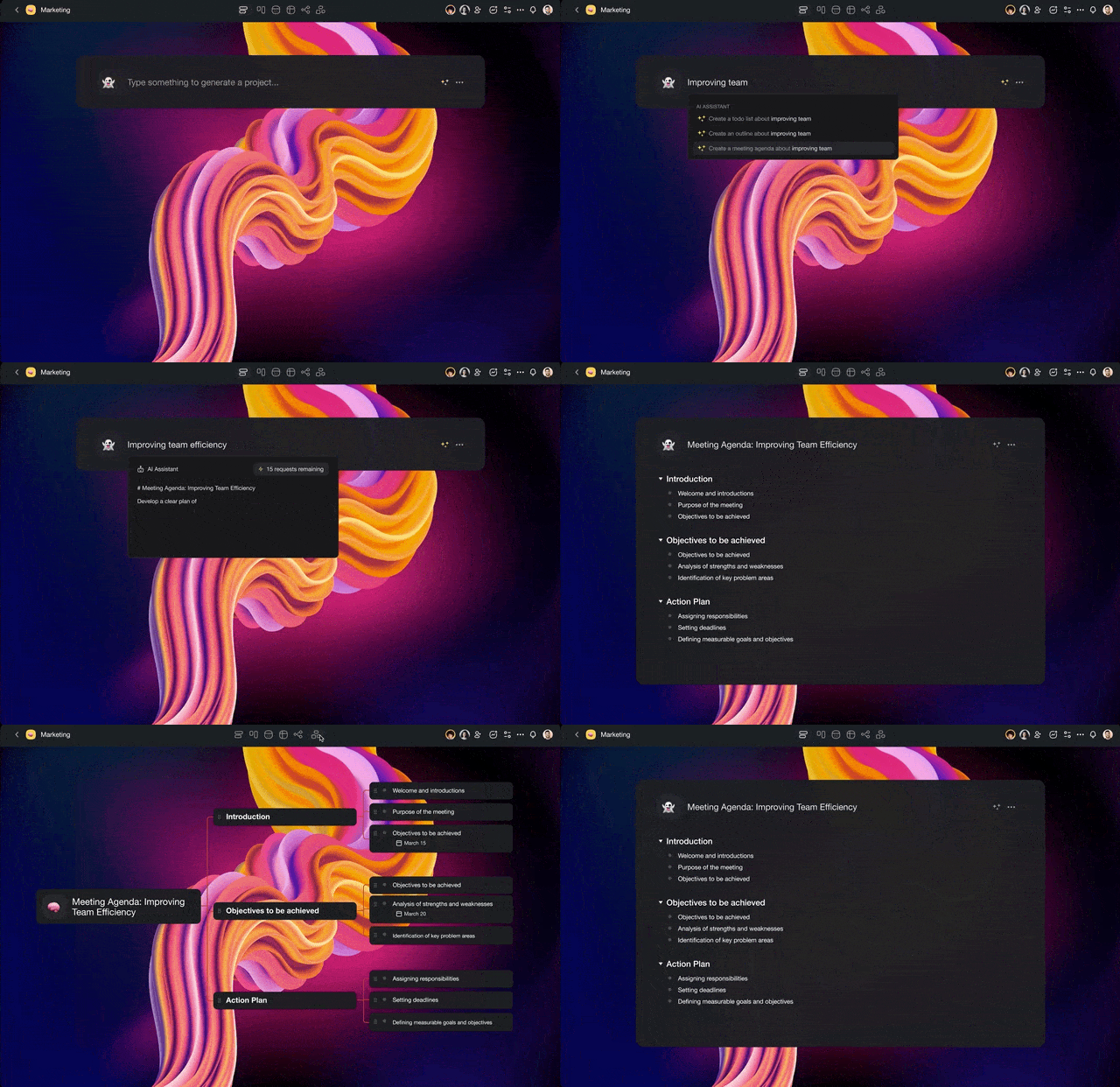
Give Taskade’s AI app a try and let us know what you think!
📈 📉 Benefits and Challenges
According to IBM’s Global AI Adoption Index, the top use cases for NLP in 2022 were customer care (38%), security (36%), business development (32%), sales (30%), and marketing (29%). That’s hardly surprising given the benefits of implementing AI at a scale.(4)
NLP allows companies to extract vast amounts of information and transform it into structured data that can be easily analyzed, manipulated, and transformed. But it doesn’t end there.
The biggest international businesses use NLP to automate IT operations, customer service interactions, and real-time inventory management, just to name a few. That frees up a ton of resources for other tasks that require creativity and strategic decision-making.
Of course, NLP also improves the transition from collecting data to making data-driven decisions. All that shortens feedback loops and improves operational efficiency.
“So, are there any caveats?”
Unfortunately, NLP is only as good as the large language models (LLMs) it’s a part of.
All commercial and open-source LLMs still suffer from significant hallucinations (instances when AI output includes inaccurate or misleading information). That can lead to:
❌ Misinterpretation of context
❌ Trust and reliability Issues
❌ Bias amplifications
❌ Legal and regulatory challenges
❌ Wasted computation resources
The same IBM report we mentioned earlier cites costs as another significant obstacle. Over half of IT professionals (54%) say AI systems are still too expensive to roll out at a scale.
So, what are the solutions?
Businesses considering the use of AI are facing a dilemma of whether to integrate commercial LLMs or develop their own machine learning models, neither of which is exactly cheap. Privacy and data ownership are also a concern, but that’s a topic for another discussion.
🚀 The Future of NLP
There is no doubt that AI technologies, NLP included, will play a critical role in the coming years. A recent report published by MarketsandMarkets predicts that the NLP market will grow from USD 15.7 billion in 2022 to USD 49.4 billion by 2027.(5)

When ChatGPT launched in November 2022, it kickstarted a small revolution and pushed AI into the spotlight. But conversational AI is only part of a larger picture.
Google has been using NLP for years to better understand user queries, and deliver more relevant search results as part of its BERT model. According to Elizabeth Reid, Google's VP of search, we’re likely to see increased integration of AI into web search in the near future.
“When searching for a product, you’ll get a snapshot of noteworthy factors to consider and products that fit the bill. You’ll also get product descriptions that include relevant, up-to-date reviews, ratings, prices and product images.”
Elizabeth Reid, Vice President and General Manager, Search(6)
While Google’s own chatbot launch was a flop, the company is making good progress in the field of machine translation and NLP. Last year alone, Google Translate got another 24 "under-resourced" languages, in addition to the 100 it can already translate.(7)
With OpenAI doubling down on ChatGPT plugins, it seems we’re heading toward increased integration of commercial AI models into existing platforms. There are over a dozen first-party plugins, and we’re likely to see more developers jump on the bandwagon this year.
But integrating commercial solutions can only go as far. In an attempt to democratize AI, open-source deep learning models like LLaMA are taking the lead. By extension, this can help advance NLP technology thanks to broader access and collective innovation.
🤖 Concluding Our Exploration of NLP
NLP may not be getting the same kind of attention as commercial LLMs or even more niche
developments like autonomous task management. But it’s still one of the fundamental technologies that power modern AI tools (so ChatGPT can tell hashtags from a hash brown).
Ok, let's get serious for a moment and recap what we learned today.
Natural Language Processing (NLP) is a core technology that powers AI systems.
It helps machines with natural language generation and comprehension.
NLP is an interdisciplinary field that combines computer science and linguistics.
The roots of NLP go back to the 1950s and early attempts at machine translation.
The NLP process involves steps like tokenization, stemming, lemmatization, Part-of-Speech (POS) tagging, and Named Entity Recognition (NER).
Computers use NLP techniques to transform human language into structured data.
Do you want to learn more about artificial intelligence concepts like machine learning methods and neural networks? Want to compare the best AI tools around? Check these resources next!
⚒️ A list of top AI project management tools
🤖 The role of AI in project management
Embrace the future of productivity with Taskade AI! 🤖
🤖 Custom AI Agents: Deploy teams of AI agents to automate tasks and amplify productivity across all your projects, powered by GPT-5.
🪄 AI Generator: Describe what you're working on, and Taskade AI will structure your projects for you, one paragraph at a time.
✏️ AI Assistant: Use the AI Assistant for NLP-driven editing, summarization, and content generation inside the project editor.
🗂️ AI Prompt Templates Library: Explore an expansive catalog of AI prompts designed to speed up project planning and execution.
💬 AI Chat: Leverage AI Chat's excellent content comprehension to brainstorm ideas, solve problems, and amplify your workflow.
📄 Media Q&A: Use Taskade AI's conversational interface to unlock valuable insights and patterns hidden in your documents and spreadsheets.
And much more...

💬 Frequently Asked Questions About Natural Language Processing
What is natural language processing and examples?
Natural Language Processing (NLP) is a field of artificial intelligence that focuses on the interaction between computers and human language. It involves the ability of machines to understand, interpret, and generate human language in a meaningful way. Examples of NLP applications include language translation, text classification, chatbots, voice assistants, and sentiment analysis.
Does ChatGPT use NLP?
Yes, ChatGPT uses Natural Language Processing (NLP) techniques to understand and generate human-like text responses. NLP enables ChatGPT to comprehend user input, extract relevant information, and generate coherent and contextually appropriate responses.
What is the difference between Natural Language Processing and Machine Learning?
Natural Language Processing (NLP) is a subfield of artificial intelligence that focuses on the interaction between computers and human language. It encompasses a range of techniques and approaches, including Machine Learning (ML), to process and understand natural language. Machine Learning, on the other hand, is a broader field that deals with the development of algorithms and models that enable computers to learn and make predictions or decisions based on data.
What are some real-world applications of Natural Language Processing?
Natural Language Processing (NLP) has many real-world applications across various domains. It is widely used in sentiment analysis, where it analyzes public opinion from social media posts or customer reviews. Another application is machine translation, which involves translating text or speech between different languages. NLP also powers chatbots and virtual assistants, enabling them to interact with users in natural language. Information extraction is another important application, where NLP helps extract relevant information from unstructured text data such as news articles or research papers.
How is Natural Language Processing used in AI?
Natural Language Processing (NLP) plays a crucial role in various aspects of artificial intelligence (AI). NLP techniques are used to enable machines to understand and generate human language, allowing them to comprehend and respond to user queries or commands. NLP is used in tasks such as language translation, sentiment analysis, text classification, information retrieval, and speech recognition, contributing to the development of intelligent systems that can process and interact with human language.
What is sentiment analysis in the context of NLP?
Sentiment analysis, in the context of Natural Language Processing (NLP), is a technique used to determine the sentiment or emotional tone expressed in a piece of text. It involves analyzing text data to identify whether the expressed sentiment is positive, negative, or neutral. Sentiment analysis is commonly used to gauge public opinion, monitor brand perception, assess customer feedback, and understand user sentiment in social media posts, product reviews, or surveys.
How do voice recognition systems use NLP?
Voice recognition systems leverage Natural Language Processing (NLP) to convert spoken language into written text. NLP techniques are employed to process and interpret the acoustic signals received from the user's voice, transforming them into meaningful words and sentences. These systems use speech recognition algorithms combined with language models to understand and transcribe spoken language accurately. By incorporating NLP, voice recognition systems enable hands-free control, voice search, transcription services, and voice-activated virtual assistants.
🧬 2025-2026: From NLP to Vibe Coding
NLP has evolved from academic research to the foundation of vibe coding — building applications through natural language.
The NLP Evolution
| Era | NLP Capability | What You Could Do |
|---|---|---|
| 2000s | Keyword matching | Basic search |
| 2010s | Statistical models | Sentiment analysis |
| 2018 | Transformers (BERT) | Context understanding |
| 2022 | LLMs (GPT) | Text generation |
| 2025+ | Agentic NLP | Build complete apps |
Vibe Coding: NLP for Everyone
Taskade Genesis applies NLP to let anyone build AI applications:
How it works:
- You describe — "Build a customer support system"
- NLP understands — Intent, entities, requirements
- Genesis creates — AI agents, workflows, databases
This is vibe coding — NLP-powered app creation.
NLP Features in Genesis AI Agents
| NLP Feature | How Genesis Uses It |
|---|---|
| Intent recognition | Understands what you want to build |
| Entity extraction | Identifies data structures needed |
| Sentiment analysis | AI agents analyze feedback |
| Summarization | Agents condense information |
| Translation | Multi-language support |
Example: "Build a system that monitors customer reviews, categorizes sentiment, and alerts the team for negative feedback."
Genesis applies NLP to:
- Extract "monitor," "categorize," "alert" as actions
- Understand "sentiment" as analysis type
- Create automations for the workflow
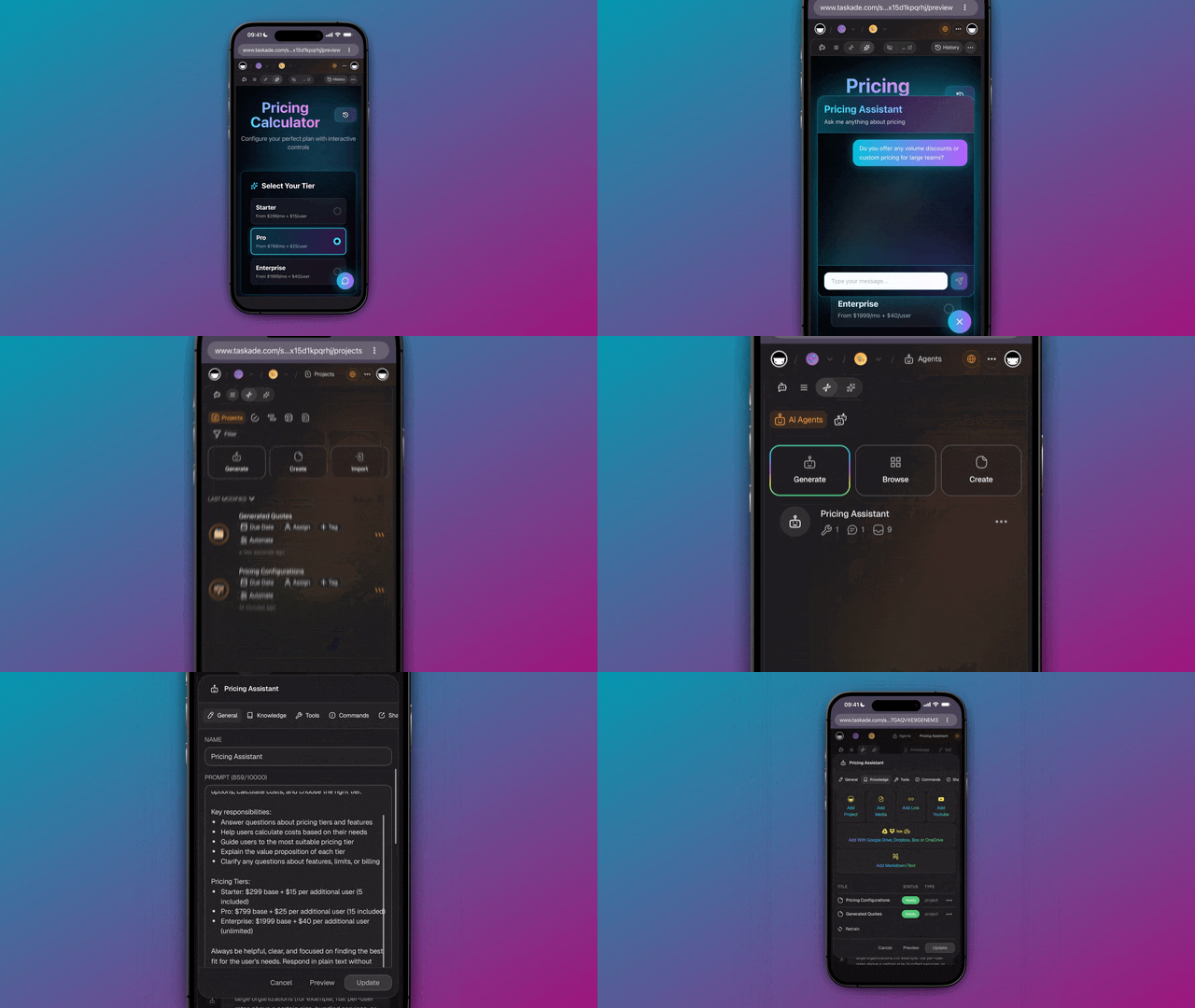
Build NLP-Powered Systems
Clone these NLP applications:
- Sentiment Analyzer — Feedback categorization
- Multi-Language Agent — Content translation
- Research Summarizer — Document analysis
Learn more:
- What is Generative AI? — Foundation of modern NLP
- AI Prompt Engineering — Communicating with LLMs
- What Are AI Agents? — NLP in action
👉 Build NLP applications with Genesis
🔗 Resources
https://www.researchgate.net/publication/336734161_A_Brief_History_of_Chatbots
https://cs.stanford.edu/people/eroberts/courses/soco/projects/2004-05/nlp/overview_history.html
https://www.marketsandmarkets.com/Market-Reports/natural-language-processing-nlp-825.html
https://ai.googleblog.com/2022/05/24-new-languages-google-translate.html