






How to Foster Remote Workplace Camaraderie
Workplace camaraderie among distributed teams... An urban legend? A mythical creature? Building a culture of companionship and solidarity is a dream come true f...
On this page (19)
Workplace camaraderie among distributed teams... An urban legend? A mythical creature? Building a culture of companionship and solidarity is a dream come true for leaders in distributed organizations.
🔥 Is it *really* possible to instill a spirit of companionship in a fully distributed team?
🤝 Can remote employees form long-distance friendships?
🌍 What should leaders do to encourage social interactions across time zones?
In this article, we set out on a quest to answer these questions. You’ll learn how workplace camaraderie can make employees happier, more engaged and satisfied with their work. You’ll also see what happens when companionship wanes or, worse still, never develops.
🧐 What’s Workplace Camaraderie?
camaraderie
/ˌkaməˈrɑːd(ə)ri,ˌkaməˈrad(ə)ri/
“mutual trust and friendship among people who spend a lot of time together.”
There’s a fairly common belief that workplace camaraderie is synonymous with watercooler conversations. After all, casual chit-chats and insider jokes give employees a much-needed break from the daily grind. They also help people to open up and bond on a more personal level.
But that’s only part of the story.
While social interactions are important, they’re often an appetizer to what real teamwork tastes like. Remote or not, the ultimate purpose of teamwork is to get *work* done, right?
Here’s what Andrew Carnegie said about companionship:
“Teamwork is the ability to work together toward a common vision. The ability to direct individual accomplishments toward organizational objectives. It is the fuel that allows common people to attain uncommon results.”
With that in mind, we can say that camaraderie takes place when teams:
🤝 Willingly collaborate to get work done
🛶 Paddle in the same direction
🎯 Share similar goals and values
💭 Have meaningful, focused conversations
🥳 Celebrate successes and failures together
Workplace camaraderie means loyalty towards your employer and colleagues. It’s a sense of belonging and commitment that binds a seemingly unrelated bunch of people. It’s the glue that keeps businesses and organizations together.
So, what about distributed teams? Does it make sense to foster a sense of belonging among people who are a thousand miles apart? If so, where should the initiative come from?

🌗 Camaraderie Across Time Zones
Let’s make one thing clear.
A remote workplace is *still* a workplace. Just like a regular, cubicled office, distributed organizations have their own mesh of social interactions, unwritten rules, power plays, intrigues, friendships, alliances, and… yeah, gossip.
Similarly, the camaraderie that binds remote employees is no different from the one that ties co-located teams. Sure, it’s much more difficult to build and maintain, but its benefits are powerful enough to warrant the effort.
It Makes Employees Happy and Engaged
A study by Gallup found that people with fast workplace friendships are seven times more engaged in their work. The same study also reported that buddying employees are 50% more satisfied with their work compared to their lone-wolf colleagues.
people with fast workplace friendships are 7x more engaged in their work
This is great news for all the managers who have a hard time getting their distributed teams on board. Once those friendships start to form, it’s much easier to elicit solidarity, mutual support, and engagement across the entire team. And let’s not forget that those workplace friendships are also a compelling reason to stick with one employer for longer.
It Fosters a Sense of Belonging
Anybody who’s ever been the “new” fella at the office knows that things are always a bit awkward at first. It takes time—and plenty of brofists—to break the ice and acclimatize to the new environment.
But distributed teams don’t have the benefit of direct interactions. Save for the occasional company BBQs, face-to-face meetups are rare. That’s why many remote hires can feel stranded and clueless when it comes to interacting with their peers.
Remote teams that “get” camaraderie right are much more accessible and open to forming social connections. They have emotional intelligence, sympathize with newcomers, and nurture a sense of belonging from day one.
It Can Be Competitive, in a Positive Way
Imagine that you just aced a (remote) job interview. You’re enthusiastic and excited to jump right into the action. Except, when the first day at work starts, you feel something’s not right…
🧱 It’s each to their own, and nobody really cares about collaboration
🥱 Virtual meetups feel like a pesky routine rather than a team incentive
⁉️ Everybody’s too busy to answer your "silly" questions
Sound familiar?
When your remote team has no drive as a whole, it’s difficult to keep the slack from affecting individual employees. After all, “why should I care when nobody else does?”
Camaraderie helps keep morale high. It bolsters participation, rewards engagement, and encourages solidarity in getting work done. And when teams get into gear to reach a shared goal, work becomes a friendly competition where everybody wins.

Camaraderie Helps Diffuse Conflict
Even the most fine-tuned teams face friction once in a while. Small quibbles are inevitable and come as part of office life. Most of the time, all you need is a friendly pat on the back and a shrug saying, “hey, let’s not kill each other over a trifle.”
But distributed teams have much more limited means of diffusing conflict. A disagreement over project details or a misguided chat remark may plant a seed of resentment. This, in turn, can escalate into an internal conflict that can hurt team integrity.
Solidarity among remote employees helps put out small fires before they get out of hand. Does that mean they won’t happen? Heck no. But your team will be more likely to dismiss them and settle arguments in a civil manner.
It Battles Workplace Inequality
Studies show that remote employees are often subject to workplace inequality that goes beyond what their co-located colleagues experience. They feel marginalized, struggle to build rapport with their peers, and don’t feel they get the recognition they deserve.
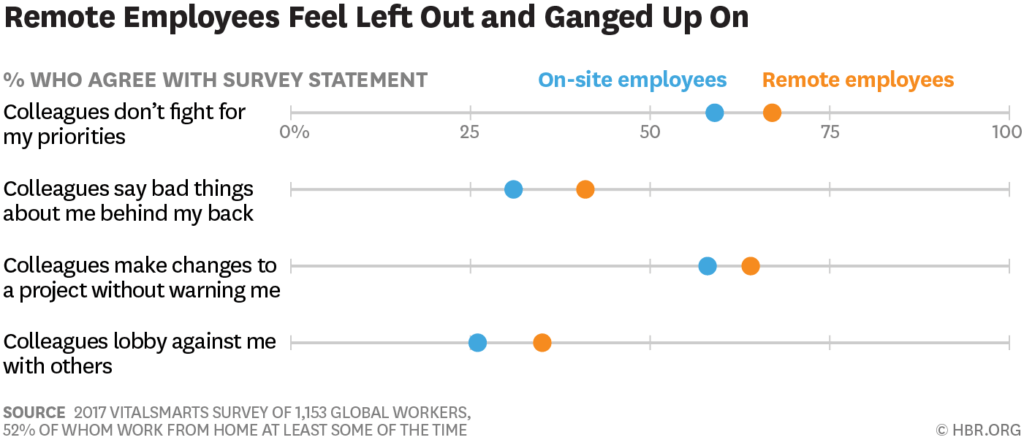
Remote workplace inequality via HBR
Conversely, teams with a strong internal culture encourage dialogue, understanding, and acceptance. They voice concerns, express appreciation, reward contribution, and understand that there would be no teamwork without the individual.
It Alleviates WFH Isolation
Remote work is great, once you get used to it. But for many people who escape the traditional 9-5, the first weeks or months of WFH may seem pretty lonely.
While you’re technically still part of a team, the daily goofing around, office pranks, and coffee breaks are not there anymore. Suddenly, the wonderful experience of working from a home office starts to feel a bit like solitary confinement.
Everybody needs somebody to talk to once in a while, and a culture of camaraderie makes that possible. Distributed teams who embrace kinship:
🎉 Are more likely to engage in spontaneous, organic interactions
🤗 Enjoy spending time together, even if it’s mostly during online meetups
⏰ Communicate and interact even after they clock out

❌ The Pitfalls of Watercooler Chit-Chats
So, what about virtual watercoolers? Should your remote team discuss non-work stuff when on the job? How do you find the right balance between chitter-chatter and *meaningful* conversations?
First things first, watercooler chit-chats are an important part of building team camaraderie. There’s no doubt about that. While it’s impossible to fully replicate the natural vibe of a physical office, your team should have space where they can engage in more personal conversations.
But building camaraderie solely through watercooler spaces is not the way to go. Putting too much effort into leisure activities takes the focus away from what remote work is all about. It makes work collateral.
How many times have you tried to focus and get work done only to get repeatedly interrupted by a pesky e-mail or a barrage of chat notifications? Now, how many of those interactions were real work and not off-topic?
Think about that the next time a cat meme lands in your inbox 😿
🏛 3 Pillars of Workplace Camaraderie
Want to encourage a culture of camaraderie in your team? Good. Trust, communication, and transparency will be your companions for the joy ride. These are the three prerequisites that make remote work possible in the first place.
Let’s tackle them one by one.
Trust
No conversation about remote work would be complete without putting trust in the show notes. It’s the foundation of every successful business and personal relationship. The only problem? It’s hard to earn and very easy to lose.
According to Zapier’s Co-Founder and CEO Wade Foster:
“Getting things done tends to be a by-product of trust. Because there is an implicit trust in your teammates and because there is no other way to measure results in a remote team, the team inherently evaluates each other on what was completed that week. We do this by sharing weekly updates on our internal blog (Async) every Friday—I bet you can imagine how it would feel to be the only one with nothing to show. That feeling creates a desire to finish something important each week.”
Here’s how trust should work for distributed teams:
👉 Employers trust that their remote employees will work diligently, respect deadlines, and keep the quality of their work up to scratch
👉 Remote employees trust that their employer cares about their wellbeing, provides honest feedback on their work, and sends a paycheck for a job well done
👉 Members of remote teams trust that their colleagues will be honest, supportive, and equally invested in the projects on which they collaborate
Workplace camaraderie thrives when trust and confidence extend both vertically (management) and horizontally (employees). And that can only happen in a culture that rewards accountability, fairness, and credibility.
Communication
This is a no-brainer. Imagine a football team trying to field-test a new strategy or formation without discussing the details first. You get the picture.
Remote camaraderie is only as effective as the amount of *meaningful* conversations that happen around it. In other words, distributed teams that have mastered the art of communication perform the best in the field.
Here are a couple of pointers that will get you started:
Transparency
"If someone shows up in the morning dressed appropriately and isn’t drunk or asleep at his desk, we assume he's working. If he's making spreadsheets and to-do lists, we assume he's working really hard. Unfortunately, none of this gets at what an employee actually creates during the day,"
Matt Mullenweg via Harvard Business Review
So, how do you define transparency?
Is it a simple chain of command where everybody knows their place on the totem pole? No BS feedback employees receive from their supervisors? Or is it the ability to openly voice concerns and dissatisfaction without facing consequences?
It’s all of those things, and much more.
Building camaraderie through transparency means that very few things are left unsaid. Instead of sweeping problems under the rug, tight-knit remote teams put all cards on the table. It’s better to over-communicate and say the same thing twice than pave it over and leave room for misunderstandings.
🐑 Foster Remote Camaraderie with Taskade
Our goal at Taskade is to bring distributed organizations together. We want to enable frictionless collaboration across time zones and help teams have meaningful, productive conversations.
Here’s how we do it.
Watercooler vs. Meeting Room
Unlike other collaboration tools, Taskade encourages *meaningful* conversations focused around specific activities. Every interaction, whether it involves chatting, video conferencing, or regular calling, is contained within a project space to make sure discussions are outcome-based.
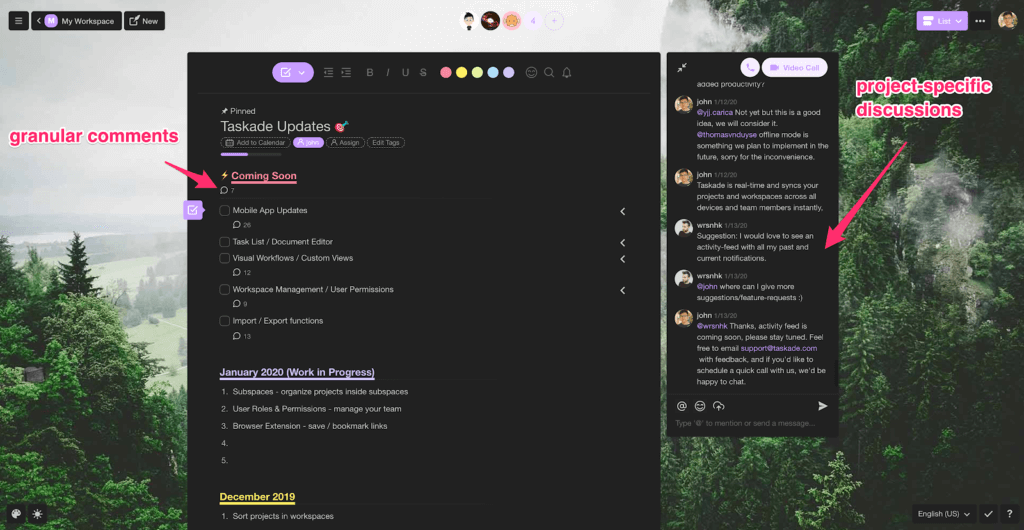
Taskade is a digital meeting room
In that sense, Taskade is more like a meeting room than a watercooler. It’s a place where conversations have a purpose and become a tangible, hands-on experience.
It’s OK to Go Offline
Many companies expect their remote employees to be available 24/7. Late-night calls? Sure. A barrage of notifications during lunch break? Bring it on. But... it’s not very productive, is it?
In the spirit of peer camaraderie, Taskade lets you turn off or limit push notifications across Workspaces, individual Projects, or by channel (email, mobile, browser). This way, remote employees can opt out of the daily buzz and focus on deep, solitary work when they need it.
Asynchronous communication gives your team the ability to throttle the amount of information they receive without missing the important stuff. Introducing an intentional "lag" into the communication channels makes it much easier to digest the information before hitting reply.
Communication is important, but not to the point of burnout 🔥
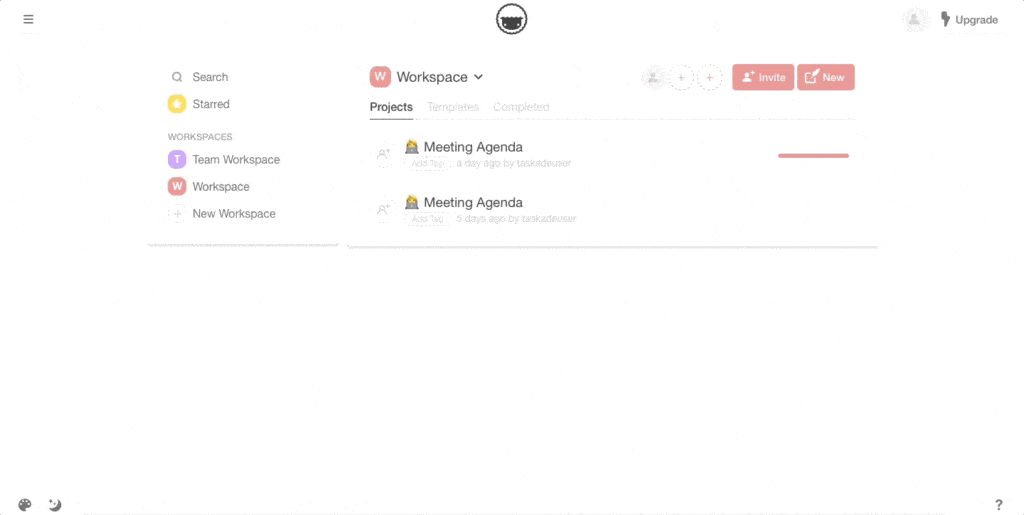
Going offline with Taskade is easy!
Involve Everybody in the Discussion
Every meeting room needs a whiteboard, right?
With our Mindmap and Kanban Board views, remote teams can brainstorm and visualize ideas collaboratively, as if they were sitting in a room together. Everybody can contribute their food for thought via chat integrated into the Project space or by adding comments directly on the project.
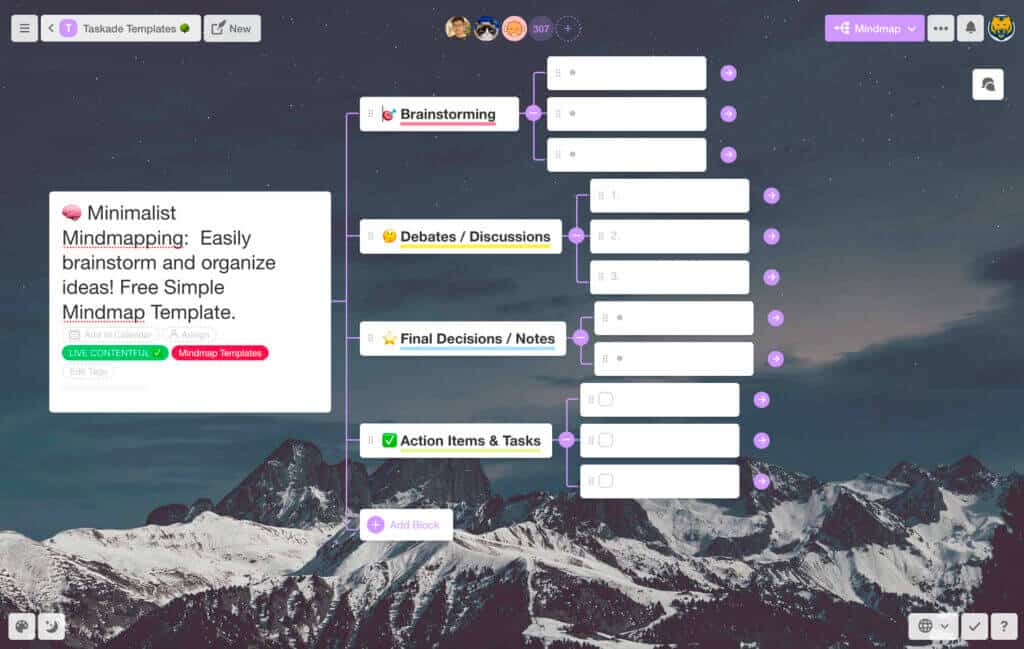
Taskade collaborative mind map view (free template)
👋 Parting Words
The recent pivot to telecommuting has made one thing clear. Remote work is much more than sending your employees home and expecting great results.
Do you want your distributed team to collaborate (almost) without friction and get work done? It won’t happen unless you start cultivating a culture of camaraderie and solidarity. A culture built on trust, communication and transparency.
Workplace camaraderie doesn’t just “happen” overnight. Nurturing a spirit of companionship is more like a marathon than a sprint. It’s a conscious effort that requires *willing* participation and engagement across the board.
'Till next time! 👋
Hungry for more educational content? Grab some popcorn and watch YC Partner Kevin Hale give a speech on how to collaborate with class 🍿
How to Work Together by Kevin Hale.
Frequently Asked Questions
How do you build camaraderie in a remote team?
Build remote camaraderie through virtual social events, dedicated non-work chat channels, regular one-on-ones, peer recognition, and shared rituals like weekly standups or team retrospectives. The key is creating intentional opportunities for informal connection that happen naturally in an office but must be designed for remote teams.
Why is workplace camaraderie important for distributed teams?
Camaraderie drives trust, collaboration quality, and employee retention. Remote workers who feel connected to their teammates are more engaged, communicate more openly, and are less likely to experience isolation or burnout. Strong team bonds also lead to better problem-solving and faster conflict resolution.
What activities help remote teams bond?
Effective activities include virtual coffee chats, online game sessions, collaborative brainstorming in shared workspaces, show-and-tell meetings, and async social threads where team members share personal updates. Tools like Taskade make it easy to create dedicated social spaces alongside work projects.
Can remote teams have as strong a culture as in-office teams?
Yes, but it requires intentional effort. Remote culture is built through consistent communication norms, shared values, transparent decision-making, and regular social touchpoints. Teams that invest in culture-building activities and use collaborative tools effectively often report stronger bonds than traditional office teams.