







The Connection Between Seemingly Unrelated Trends 📌
Remote work and climate change are staple topics for anyone paying attention to the news. Talking heads just love debating how the two are shaping our immediate and more distant future.
But did you know that climate change and a preference for working remotely are not just running in parallel tracks? In fact, they can influence each other in a meaningful way. 💡
A recent Gallup poll found that two-thirds of Americans would prioritize protecting the environment over economic growth. While this "readiness" alone doesn't exactly translate to results, it shows that we're willing to adjust our lifestyles to help the planet.
In this Taskade article, we'll take a peek at the current state of remote work and explore if and how working from home can save the world (not kidding). 🐑
So, without further ado, let's start with...

Remote Work: What the Data Says 🤔
In 2019, the consulting firm Global Workplace Analytics (GWA) pulled together data points and came up with a comprehensive picture of the remote work in the U.S.
Here's what they learned:
📈 Regular work-from-home opportunities have grown by 173% since 2005. That's 11% faster than the growth of the overall workforce
🖥 Compared to five years ago, 40% more employers offer some telecommuting options for full-time employees
🤝 50% of the U.S. workforce holds a job that, to some degree, can be performed remotely
🙋🏻♂️ Between 80% and 90% of the U.S. workforce would like to commute at least part-time
🥝 An average telecommuter works remotely for 50% of their time
Now, let's spice things up a bit.
💰 GWA also calculated that if all employees who can telecommute went remote for just 50% of the total work time, national savings could amount to $700 billion a year:
Businesses would save around $11,000 per year for every employee that telecommutes half of their time
Employees now working remotely 50% of the time would save between $2,000 and $7,000 annually, depending on their salary
🟢 Sounds impressive, doesn't it? While we're not quite in the "eco" zone yet, data shows remote work offers substantial cost-saving opportunities. And that seems like a good start for finding funds to support worthy environmental initiatives.
But before we can tap into those resources, we need to discuss the essential ingredient that makes remote work possible in the first place.
The Importance of the Internet 📱
A reliable and fast connection to the internet is perhaps the most important prerequisite for converting to remote work.
⚡️ These days, speed isn't a problem. In fact, according to Nielsen's Law of Bandwidth, internet bandwidth grows an average of 50% every year. And data tracked between 1983 and 2019 neatly fits on that growth line.
Of course, that speed increase only matters if access to the internet exists in the first place. And we're on the right track.
As of January 2020, there were over 4.5 billion active internet users around the globe. And that's 59% of the world population who can work, communicate and interact with others regardless of their location.
According to the International Telecommunications Union, the percentage of internet users around the world shapes as follows (2019):
86.6% of residents in developed
47% of residents in developing
19% of residents in the world's least developed countries
📈 And these numbers seem to be improving by leaps and bounds. In 2014, only 32% of developing nations and 6% of the world's least developed countries had active access to internet services.
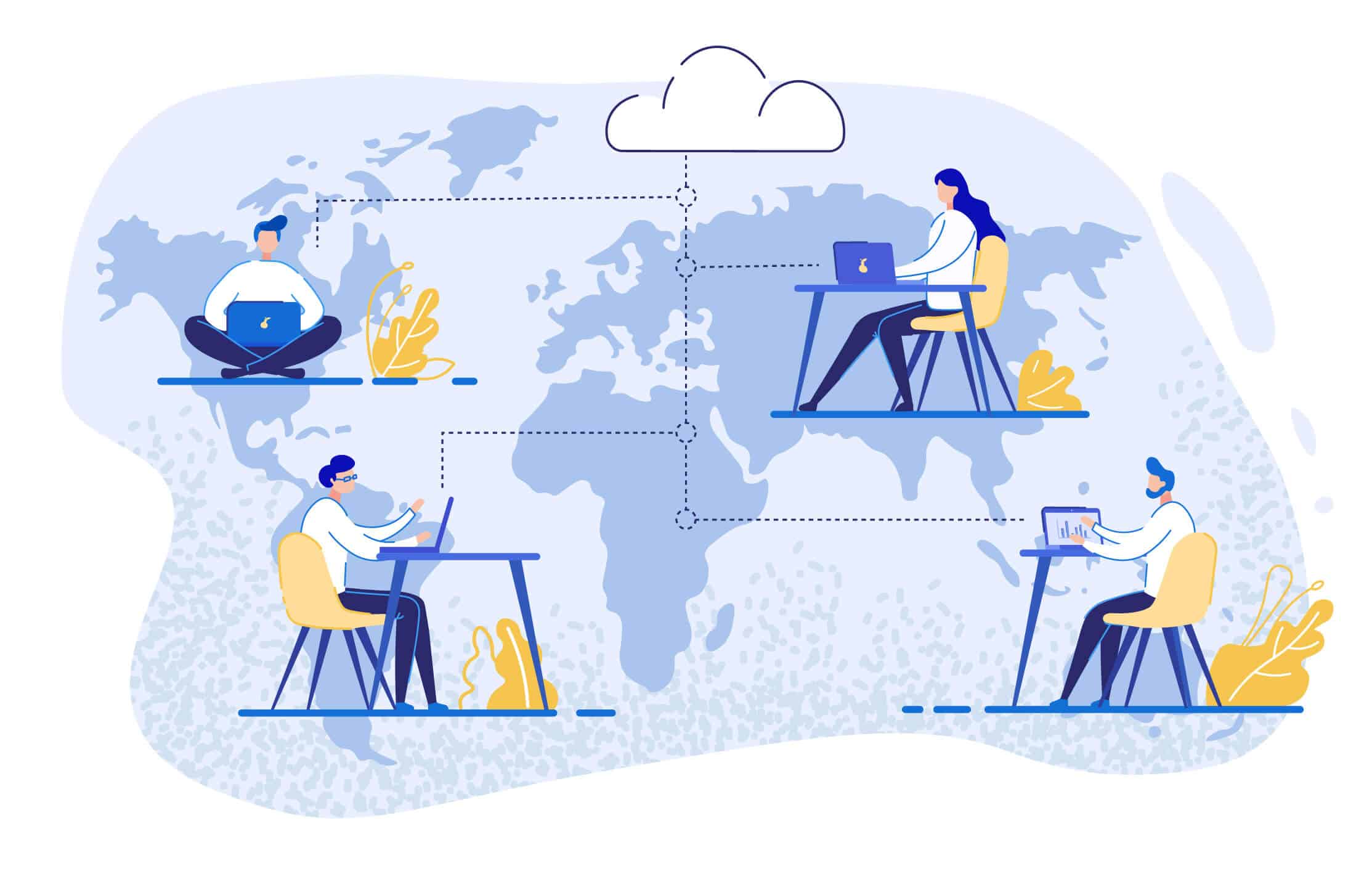
Improving internet coverage is an important step towards fully embracing remote work. And with stable and fast connections available in almost every part of the world, more people can tap into the environmental benefits of remote work ↘️
Connecting the Dots: Remote Work and Climate Change 👩💻👨💻 + 🌦
Remote work is cool. Not only does it make employees truly happy, but it also offers a number of quantifiable benefits.
But can it *really* help overcome climate change? Let's see...
🚙 For starters, telecommuters don't rely on cars or public transportation on a daily basis. While they might want to leave cozy home offices once in a while (recommended!), they don't clock in as many miles as co-located employees.
⚡️ The second "green" aspect of remote work is limited reliance on office utilities. Regular office spaces consume vast amounts of gas, water and electricity. But when employees go remote, they simply tap into the resources they already use at their homes.
Perhaps that's why GWA concluded that the benefits of telecommuting are far more than just financial. In fact, under the same scenario we mentioned above, with all able and willing U.S. employees working remotely for 50% of the time,
The greenhouse gas reduction would be the equivalent of taking the entire New York State workforce permanently off the road.
To clarify, that's a labor force of about 8.3 million workers in the state's private sector alone. Considering that transportation is the single biggest contributor to carbon emissions, that's nothing to sneeze at.
A Xerox Case Study 🔖
In 2015, Xerox explored the positive impact of its remote workforce on the environment. With over three decades of remote work under their belt, the company boasted the following results:
💡 About 8,000 of Xerox's 27,000 total employees worked 100% remotely at that time. Per year, these 8,000 teleworkers drove 92 million fewer miles, saving 4.6 million gallons of gas and reducing carbon dioxide emissions by nearly 41,000 metric tons annually.
While Xerox is, by all means, a substantial business, it's still just one out of many companies that drive similar environmental initiatives. When more like-minded organizations join the cause, these numbers stack up quickly.
Estimating the Environmental Impact of Remote Work ♻️
In 2017, FlexJobs partnered with Global Workforce Analytics to estimate the environmental impact of the 3.9 million telecommuters who spent at least 50% of their time working remotely.
According to the report, going remote contributed to:
530 million fewer vehicle trips and 7.8 billion fewer miles traveled
$498 million in savings thanks to fewer traffic accidents
Almost $1 billion in oil savings due to the decrease in gas consumption
💨⃕🌲The decrease in CO² emission alone was equivalent to planting 91.9 million trees or almost 540,000 homes powered by electricity for a full year.
What if... 🤔
The positive impact of remote work becomes even more drastic when we get into hypotheticals.
The estimates above are based on the 2017 data so it's easy to extrapolate what those numbers would be based on the statistics quoted in the first section:
As of 2019, about 130 million people worked full-time in the U.S.
If 50% held jobs viable to telecommuting, there could be around 65 million full-time telecommuting jobs in the U.S
Given that 85% are willing to switch to telecommuting, it yields
a remote workforce of 55 million peopleAnd if those 55 million would work remotely about 50% of the time, the full-time equivalent of remote work would be about 27.5 million people
🌱 Even in a conservative estimate (not counting full-time remote or part-time employees), these numbers translate to a 7x multiplier compared to the 3.9 million from the 2017 study quoted above. That means a potential decrease in the production of greenhouse gases by a whopping 21 million metric tons.

Is Remote Work a Viable Climate Change Solution? 🌎
Ok. The numbers look promising. So, is there anything that can stop the global workforce from going 100% remote?
1️⃣ We need to remember that the growth of telecommuting is largely dependent on the ability of the workforce to work and collaborate without friction. In other words, employers still expect effectiveness that's on par with co-located teams.
But that's not all.
2️⃣ Unless we find a clever way to enable drivers, retail clerks or craftspeople to telecommute, we won't be able to reap the full environmental benefits of remote work. Many industries still require a pretty much hands-on approach and there are no signs it's going to change soon.
Apart from that, we have plenty to look forward to. 🔭

The Remote Work Solution 🖥 ➕ 🌱
As the world's becoming increasingly connected, more businesses are adopting remote work and moving away from the traditional model of employment. And for good reasons.
Employees love telecommuting because it gives them ultimate flexibility, something that 9-5s don't offer. Employers, on the other hand, see it as the most hassle-free way of running a business. Others (including Taskade!) simply believe telecommuting is the future of workforce. 🔮
Regardless of the motives, remote work has the potential to positively impact our environment. And in the atmosphere (pun intended) of ecological crisis, adjusting our lifestyle a bit to reduce carbon footprint doesn't seem like a big sacrifice. 🤔
Redefine remote work with Taskade AI! 🤖
🤖 Custom AI Agents: Deploy custom AI agents to navigate the nuances of remote work, from managing resources to automating routine tasks.
🪄 AI Generator: Generate comprehensive guides, strategies, and entire workflows for successful team collaboration.
✏️ AI Assistant: Research, outline, write, prioritize tasks, and organize projects with smart insights powered by OpenAI GPT (frontier models).
🗂️ AI Prompt Templates Library: Tap into a comprehensive range of AI prompt templates for specific projects or general productivity.
💬 AI Chat: Consult Taskade AI for immediate assistance with remote work challenges to keep your remote team focused and connected.
📄 Media Q&A: Analyze documents and team communications to extract valuable insights using Taskade AI's conversational interface.
And much more...

Frequently Asked Questions
How does remote work help reduce carbon emissions?
Remote work eliminates daily commutes — one of the largest sources of individual carbon emissions. Studies show that if everyone who could work remotely did so half the time, it would reduce greenhouse gas emissions by the equivalent of taking millions of cars off the road each year, primarily by cutting transportation fuel consumption.
What is the environmental impact of commuting to an office?
The average American commute produces significant CO2 emissions from vehicle use, and office buildings consume enormous amounts of energy for heating, cooling, and lighting. Remote work reduces both of these environmental costs, especially when workers use energy-efficient home setups.
Can remote work actually make a difference for climate change?
Yes. While individual impact may seem small, the cumulative effect is massive. Reduced commuting, lower office energy consumption, decreased demand for commercial real estate, and fewer business flights all contribute to measurable reductions in greenhouse gas emissions at scale.
How can remote teams minimize their own environmental footprint?
Remote teams can further reduce their footprint by using energy-efficient devices, consolidating digital tools to reduce server load, choosing green energy providers, and minimizing unnecessary video calls. Using an all-in-one platform like Taskade instead of multiple separate apps also reduces the overall digital energy footprint.