Ever felt like you're working your butt off but only seeing minimal results? You're not alone. What if I told you that 20% of your actions might be responsible for 80% of your results? Intrigued? The Pareto Principle, the 80/20 rule, or the "viral few and trivial many" is the secret sauce you've been missing.

🌾 Origin of the Pareto Principle
Back in the late 19th century, an Italian economist named Vilfredo Pareto made an astonishing observation. He noticed that a mere 20% of the people in Italy owned a whopping 80% of the land.
This pattern struck a chord with Pareto, who realized that this uneven distribution wasn't just a quirk of Italian land ownership — it was a principle that could be applied to various domains.
The observation's impact didn’t stop there. Joseph M. Juran, a notable figure in the field of quality management, later expanded on Pareto’s ideas. He introduced the concept of “the vital few and the trivial many,” highlighting that a small number of causes are responsible for a large percentage of effects.
Fast forward a few decades and the 80/20 rule is one of the most popular productivity methods. Not because of its catchy name (although that certainly helps), but because it just works.
Let's dig a little deeper. 👇

⚙️ Understanding the Pareto Principle
Imagine you’re trying to get in shape. Your roadmap likely includes a mix of exercise, diet, sleep, and supplementation. But here’s the kicker: not all of these activities contribute equally to your goal.
So, what would task prioritization look like in this case?
That could mean that a few key exercises, like squats and deadlifts, offer the most benefit. Or maybe switching up your diet to incorporate new foods delivers far better results than any fancy supplement.
(disclaimer: this is not professional health advice!)
But let’s not stop at fitness.
The Pareto Principle can transform every aspect of your life. Whether it’s your career, relationships, or business efficiency, the 80/20 rule helps zero in on what really moves the needle.
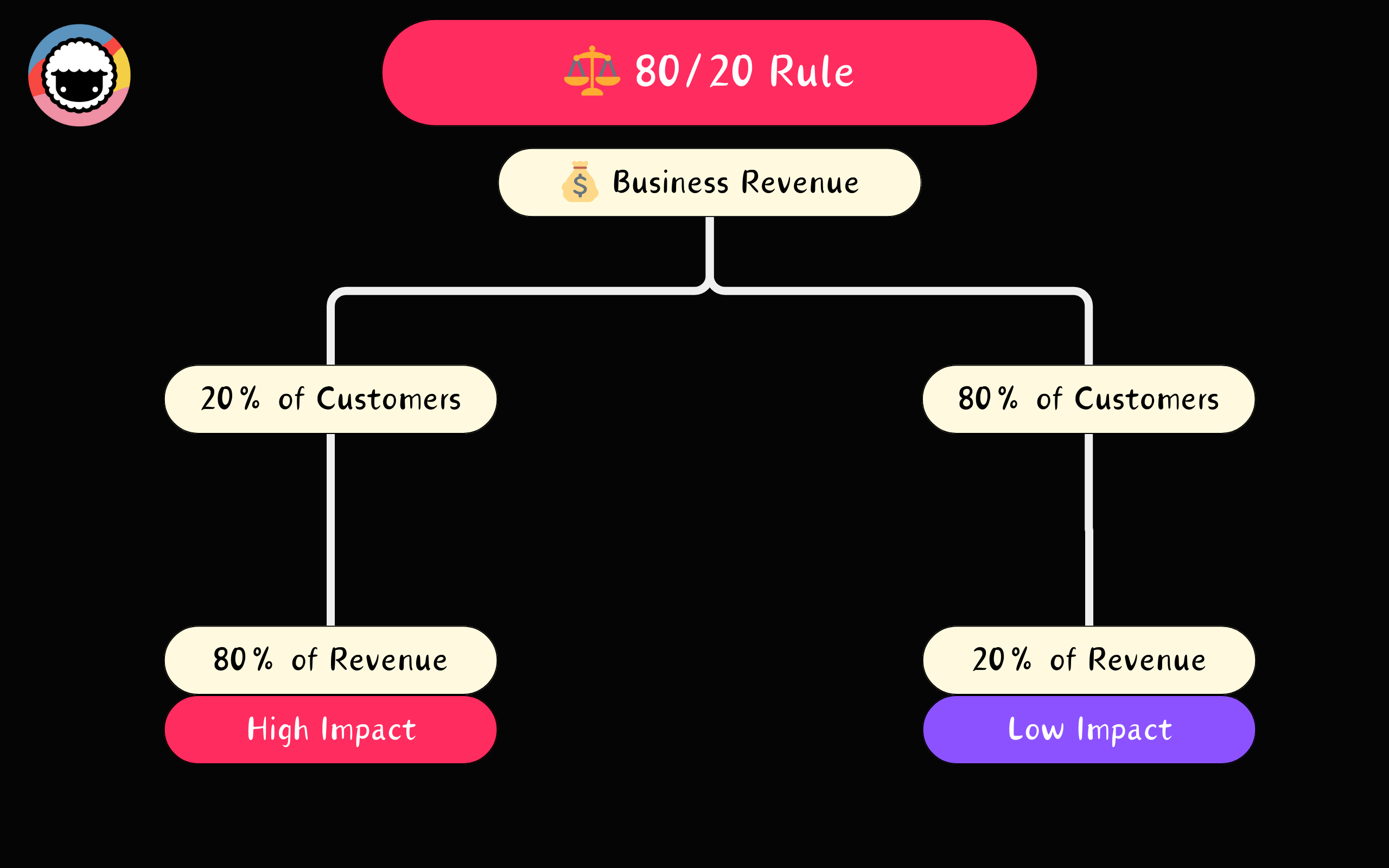
In business, 20% of your clients might generate 80% of your revenue.
For a project, 20% of the tasks might account for 80% of its success.
When learning a new skill, 20% of the practice might yield 80% of the improvement.
With Taskade’s AI automations, you can automate tasks and projects, saving 80% of your time.
(ok, we’ll get to that last part in a bit)
Keep in mind that the principle is merely an observation. Sometimes, the ratio might be 70/30 or even 90/10, but the core idea remains: a small portion of inputs often leads to the majority of results.
🚥 Practical Applications of the Pareto Principle
Business Efficiency
Meet Mark. Mark is a project manager at a construction firm. He’s constantly juggling deadlines, budgets, and an endless list of tasks. Every day feels like a race against time.
With the Pareto principle, Mark can focus on the tasks that would have the most significant impact.
Securing permits, coordinating with subcontractors, ensuring critical materials were delivered on time…
The exact lists of priorities will differ depending on the line of business. But by focusing on the 20% of tasks that are most impactful, teams can ensure they are always working on what matters most.
🐑 Implement the 80/20 rule with Taskade:
That crucial 20% — those high-stakes tasks — will always need your attention. But with Taskade, you can ensure that everything else — the stuff that clutters up your day — is handled for you.
You can build smart automations to streamline the tiny tasks or entire workflows.
Set up an automation that compiles data from various sources and tools into a weekly summary.
When survey results or customer feedback come in, automatically analyze the data.
Automatically generate a meeting agenda in Taskade whenever a meeting is scheduled.
Every Friday, compile all your upcoming meetings, deadlines, and project updates into a single.
Planning a get-together? Automatically generate a task list in Taskade when people RSVP.
And much more…
Watch the video below to see how it works or create a Taskade account to get started instantly!
Build your first automation! 👈
Time Management
Now, let’s consider a different scenario.
Emily is a marketing manager at a tech company. Her role involves campaign planning and content creation. Her days are packed, and she often feels overwhelmed by the sheer volume of tasks.
If Emily decided to apply the Pareto Principle to her daily task list, she would identify the 20% of tasks that yield the highest returns on her productivity and career growth. For Emily, this would mean prioritizing strategic planning sessions and content formats with the best ROI.
You can extend this to your personal time too.
For instance, instead of responding to every notification, dedicate a specific time to checking emails and messages. Prioritize tasks like meal prepping, which will save you a ton of time throughout the week, or set aside uninterrupted time blocks for deep work or personal projects.
Psst... Looking for more time management strategies? Check the AI Productivity category on the blog.
Quality Control
Alex is the leader of a software development team. His job is to ensure that the software they release is free from bugs and meets the highest standards of quality.
If Alex decided to apply the Pareto Principle to his quality control process, he’d focus on the 20% of testing that catches 80% of the bugs.
For example, instead of conducting exhaustive tests on the entire codebase, the team could implement additional, more rigorous tests on the user authentication module.
By doing this, Alex ensures that his team’s efforts are concentrated where they matter the most.
Sales and Marketing
Meet Sarah, who leads a dynamic sales and marketing team at a growing tech firm. Her team is responsible for driving sales and ensuring that marketing efforts convert into actual revenue.
If Sarah decided to apply the Pareto Principle to her sales and marketing efforts, she’d start by identifying the 20% of marketing channels that generate 80% of the qualified leads.
Reviewing past campaign data, Sarah might realize that a significant portion of their high-quality leads come from just a few channels — perhaps targeted LinkedIn ads and webinars.
🟢🔴 Advantages and Limitations of the Pareto Principle
So, what’s the upsides of the 80/20 method?
First, unlike many other “miracle” techniques pushed by productivity gurus, the Pareto principle is really simple. At least once you figure out which parts of your work to prioritize.
You don’t need any fancy tools or special prep. All you need is a bit of observation and common sense. Look at your tasks or data, and spot the few key activities or factors that make the biggest impact.
This is a no-brainer. What may surprise you, though, is that the Pareto principle also helps avoid burnout.
A study among physicians found that the professionals who spent at least 20% of their time on activities they found most meaningful had a burnout rate of roughly half that of those who didn’t.
By focusing on the most important tasks, you can achieve more with less effort, which leaves you with more energy and time for other things. Plus, it makes decision-making easier.
So, does the 80/20 method have any pitfalls? Yes, but they are more about poor execution.
The common misconception is that you can ignore the other 80% entirely. While it’s true that lesser tasks might not be as impactful, they still need some attention. Here’s an example.
Let’s say you're a freelance writer. Writing new articles (your 20%) brings in the most income. But what about responding to emails, invoicing clients, and marketing your services? These might fall into the 80%, but without those, things your business will go belly up faster than you can say "writer's block."
Another downside? If you misidentify the crucial 20%, you might end up wasting a ton of time.
And let’s be honest, it takes practice to get it right.
As with anything in life, the Pareto Principle isn't a magic bullet. It's a tool, and like any tool, its effectiveness hinges on how well you use it. So, remember that balance and good judgment are key.
You’ve got this!
Frequently Asked Questions
What is the Pareto Principle (80/20 rule)?
The Pareto Principle states that roughly 80% of results come from 20% of efforts. Named after economist Vilfredo Pareto, it applies across business, productivity, and time management — identifying the vital few inputs that drive most of your output so you can focus there.
How do I apply the 80/20 rule to task management?
Identify which 20% of your tasks produce 80% of your results. Prioritize those high-impact tasks first each day. Delegate, automate, or eliminate the remaining low-impact tasks. AI task managers can help by analyzing your work patterns and highlighting which activities drive the most value.
What are examples of the Pareto Principle in business?
Common examples: 20% of customers generate 80% of revenue, 20% of bugs cause 80% of crashes, 20% of features get 80% of usage, and 20% of products drive 80% of sales. Identifying these patterns helps teams allocate resources to maximum effect.
Can the Pareto Principle be used with other productivity methods?
Yes. The Pareto Principle pairs well with Eat the Frog (tackle your highest-impact task first), the Eisenhower Matrix (prioritize by importance), and time blocking (dedicate focused blocks to your vital 20%). Use it as a lens for deciding what goes on your to-do list.
Final Thoughts: Leverage the Pareto Principle for Optimal Results
Alright, time to wrap this up.
You now know what the Pareto principle is, how it works, and where you can apply it in your personal and work routines. So, give it a try, and you might just find yourself getting more done with less stress.
But before you ride off into the sunset, let's recap some key takeaways about the Pareto method:
⭐️ Simplicity is key: The Pareto Principle is one of the most effective prioritization techniques.
⭐️ Focus on high impact: It helps you zero in on the 20% of tasks that yield 80% of the results.
⭐️ Reduce overwhelm: Focusing on fewer, high-impact activities can help alleviate stress.
⭐️ Increase productivity: The Pareto Principle lets you get more done with less.
⭐️ Clarify priorities: The 80/20 rule forces you to identify and prioritize what truly matters.
⭐️ Versatility: The Pareto principle can be applied to work and personal obligations.
So, what are you waiting for?
Experiment with the Pareto Principle and see how it can transform your productivity and well-being. And when you need more help getting your work priorities in order, join the Taskade family.
Sign up for Taskade AI, and stay on top of your game! 👈
🤖 Custom AI Agents: Build smart, autonomous AI agents to get all the help you need 24/7 across workspaces, folders, and projects. Tailor agents with custom knowledge and connect them to your favorite tools in a few clicks.
👥 AI Teams: Group your AI agents into specialized teams based on their expertise. Seamlessly collaborate with your AI teams to enhance productivity and achieve better results by leveraging their collective intelligence.
⚡️ Smart Automations: Set up powerful automations with ready-made blocks. Automate your tasks with customizable triggers and actions and connect your account to apps like Gmail, HubSpot, or Slack for even more possibilities.
🪐 One App to Rule Them All: Manage your work in one place. With Taskade, you can master workflow management by consolidating all your tasks and projects. Get rid of unnecessary tools and work more efficiently.
And much more...