





Taskade for Agencies
If you're new to Taskade or want to maximize its potential for your team, you've come to the right place.
Taskade is flexible and can cater to your workflow effortlessly. Your setup depends on your workflow. We'll detail two methods in this guide.
One Workspace for Each Department. Separate Folders for Specific Functions.
One Workspace for your Entire Team. Separate Folders for Each Department.
One Workspace for your Entire Team. Separate Folders for Each Function.
One Workspace for Each Team Member.
📘 Note: These are not the only setups for Taskade—they're the most common ones we've seen.
Quick Review
Before we dive in, let's review some key terminology we use:
Workspaces: Collection of Folders, Projects, Templates, and Users.
Folders: Separate Projects, Templates, and Users collection within a Workspace.
Projects: Collaborative documents where you can organize and track tasks, notes, and other information with your team.
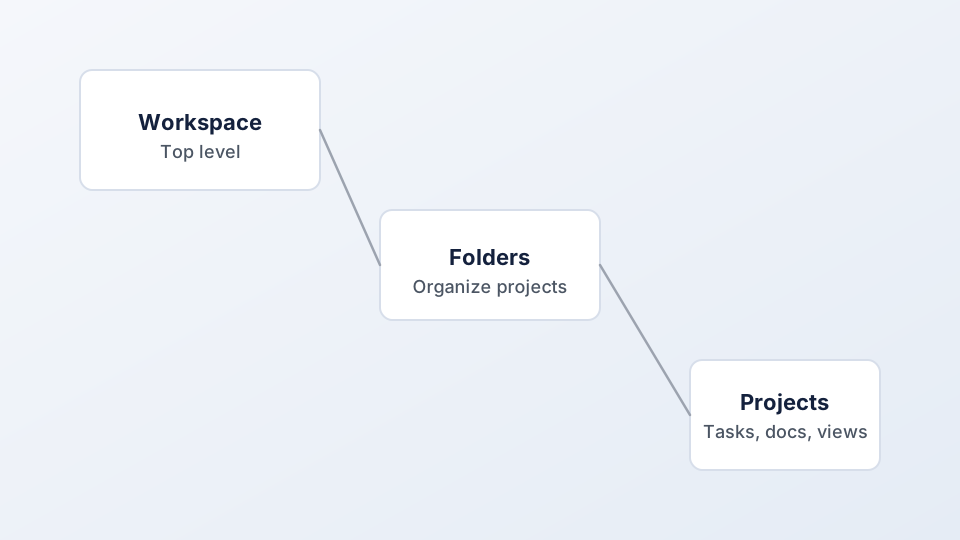
It's helpful to understand Taskade's hierarchy structure. Here's a quick breakdown:
Workspaces have Folders. Every workspace has a home folder by default.
Folders contain Projects.
Projects have Tasks.
You can think of the structure as a funnel with Workspaces capturing everything and going down to tasks.
Workspaces → Folders → Projects → Tasks → Sub-Tasks
Workspaces
Folders
Projects
Tasks
- Sub-Tasks
Here's an image of our structure:
Now that that's out of the way, let's dive into the setups.
Method 1: One Workspace for Each Department. Separate Folders for Specific Functions.
In this setup, you're going to do the following:
Create a separate workspace for each department.
In each workspace, create folders for functions within that department.
Invite each team member into their respective workspaces and folders.
Create projects related to the functions of each folder.
Invite team members from different departments to a project if you need to collaborate with them.
Example:
I have four departments in my team: Marketing, Human Resources, Accounting, and Engineering. I'd create a workspace for each one and create folders for each of their functions. So, Marketing gets a workspace, as does Human Resources, Accounting, and Engineering.
So when you set it up, it'd look something like this:
Marketing
Home Folder (Default)
Meetings
Marketing Campaigns
Brand Guide
Designs
Human Resources
Home Folder (Default)
Performance Reviews
Recruitment and Hiring
Training and Development
Compliance
Accounting
Home Folder (Default)
Accounts Payable
Accounts Receivable
Payroll
Budgeting
Records
Engineering
Home Folder (Default)
Meetings
Sprints
Documentation and Support
Bug Reports
Testing and Quality Assurance
Ideal For
Medium to Large Organizations
Specialized Teams
Functional Organizational Structures
Divisional Structures
When to Use This Setup
Team members don't collaborate with team members from other departments
Team functions are unique to each department
Team roles and responsibilities don't overlap
Method 2: One Workspace for your Entire Team. Separate Folders for Each Department.
In this setup, you'll do the following:
Create one workspace for your entire team.
Create folders for each department.
Invite each team member into their respective folders.
Create projects related to the functions of each folder.
Invite team members from a different department to a project if you need to collaborate with them.
Method 3: One Workspace for your Entire Team. Separate Folders for Each Function.
Create one workspace for your entire team.
Create folders for each function.
Set the proper permission levels for each folder.
Create projects related to the functions of each folder.
Invite team members from a different department to a project if you need to collaborate with them.
Taskade Is the Best Project Management Tool for Agencies
Building marketing strategies, juggling creative and complex projects, and fostering client relationships on top of that can be a challenge. Especially when you're working with multiple clients across diverse verticals.
We understand your pain, and Taskade is here to help you and your agency work faster, smarter, and more efficiently.
How to Manage Client Projects With Taskade
Taskade is designed to help agencies organize their workflows, keep track of active projects, and stay in touch with clients in the same window, in the same app. Here's how it works.
Workspaces, Folders, and Projects
Taskade uses a simple, three-tier hierarchy that divides the workflow into Workspaces, Folders, and Projects. Combined, the three levels give you the freedom to organize work, group clients, and categorize projects any way you want. Let's learn how each of those elements fit into the productivity puzzle.
If you’re an agency that works with multiple clients, you can easily use Taskade as a central hub to organize your projects and set them up for team collaboration.
Workspaces
A Workspace represents your business or organization. It includes all your projects, folders, and templates and gives you a high-level overview of all business activities. Each Workspace is billed separately.
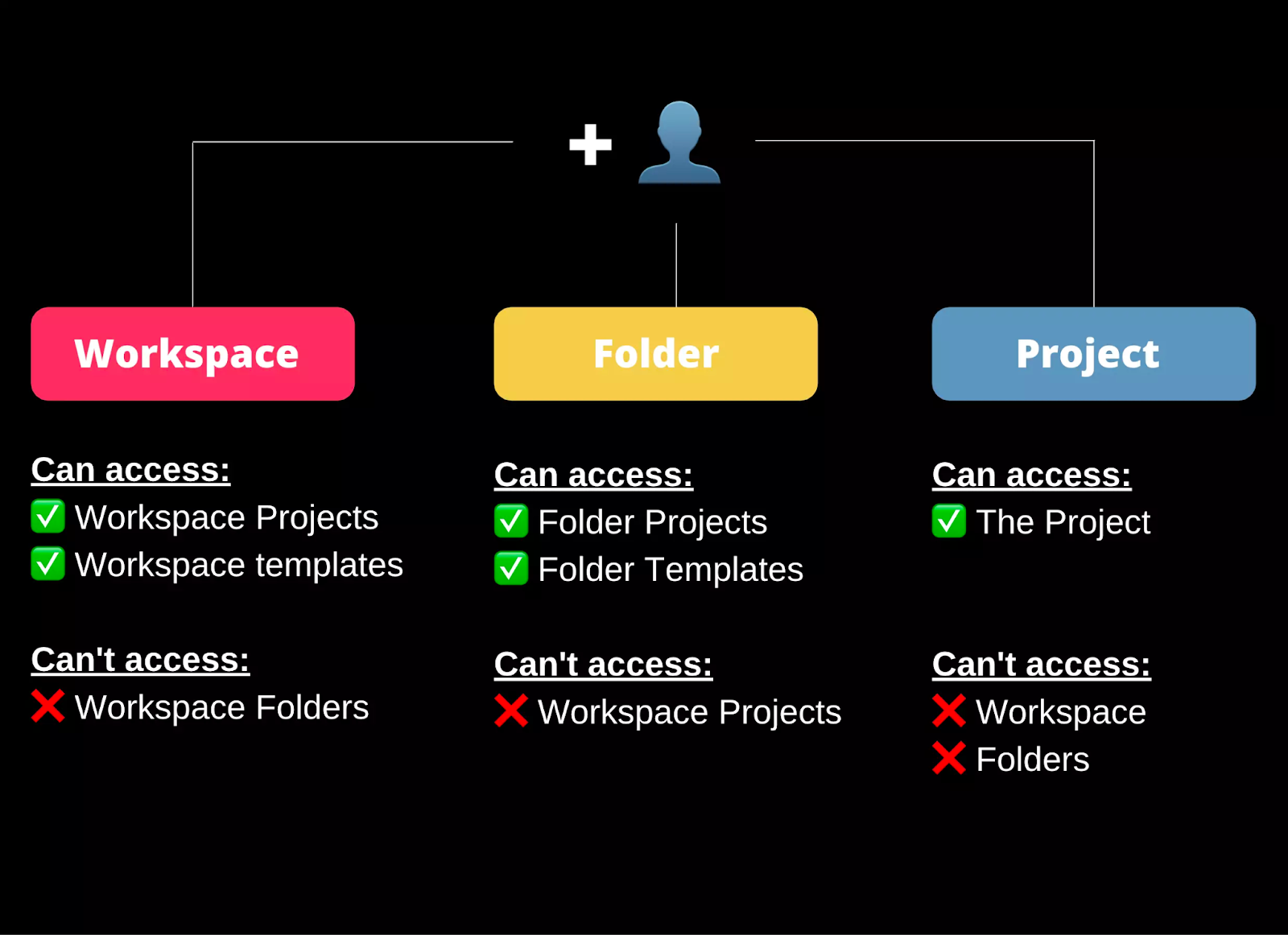
Do note that sharing a Workspace with a team member does not automatically grant them access to Folders within the Workspace.
Instead, it gives them access to Workspace Projects and templates only (Yes you can have projects within a workspace as well).
You have the ability to invite as many team members as you’d like into your respective folders.
Folders
Folders are "nested" inside a Workspace and can contain their own sets of projects and templates, separate from the parent Workspace.
Every Folder in Taskade is private by default, which means that only users you invite can access it.
You can create an unlimited number of Folders to manage your clients or individual projects. You can also use Folders to group users within your agency into teams or departments.
For an agency, you can create one folder per client to separate your work. You can also create personal folders to organize your personal work, and folders for your team and departments so that they can have a common space to work together.
Folders are private by default so they're perfect for working with different clients/groups of people within one Workspace.
Projects
Taskade Projects are small but mighty. A single Project can be like a page in a notebook or a highly organized collaboration hub where you’ll chat and collaborate with your team and clients in real time.
Your agency can use Projects to:
Write and collaborate on briefs.
Manage individual projects.
Brainstorm ideas and solve problems.
Communicate with clients in real time.
Organize team calls and video conferences.
Keep track of tasks and check progress.
And more!
Click on this link to find out more about how to use Taskade Projects.
Manage Multiple Clients With Ease
It’s easy to work with different clients and your team via Taskade. In this example, assume you’re a small agency working with 3 different clients.
Here’s an example of how you can set up your Workspace on Taskade:
Client Work (Workspace)
Client 1 (Folder)
Project A
Project B
Client 2 (Folder)
Project A
Project B
Client 3 (Folder)
Project A
Project B
In this example, you will host separate client folders in a workspace dedicated to client work. Each folder is invite-only by design and includes a unique set of projects and templates that are only visible to folder members.
This means that the team from the ‘Client 1’ folder won’t be able to see the contents of other folders unless you send them an invitation.
By using this structure, you'll be able to maintain different custom workflows between your clients simply by categorizing them into folders respectively.
Key Taskade Features for Working With Clients
Taskade is an agency project management tool that is loaded with features. An agency has many moving parts, therefore clarity is essential when collaborating with your team to get work done for your clients.
Here are some key features that can help:
6 powerful project views
Assign tasks and set deadlines
Assign tags to set task progress
Unlimited tasks and subtasks
Built-in chat and video calls in every project
User roles and permissions
500+ customizable templates
And more!
Taskade’s Project Views
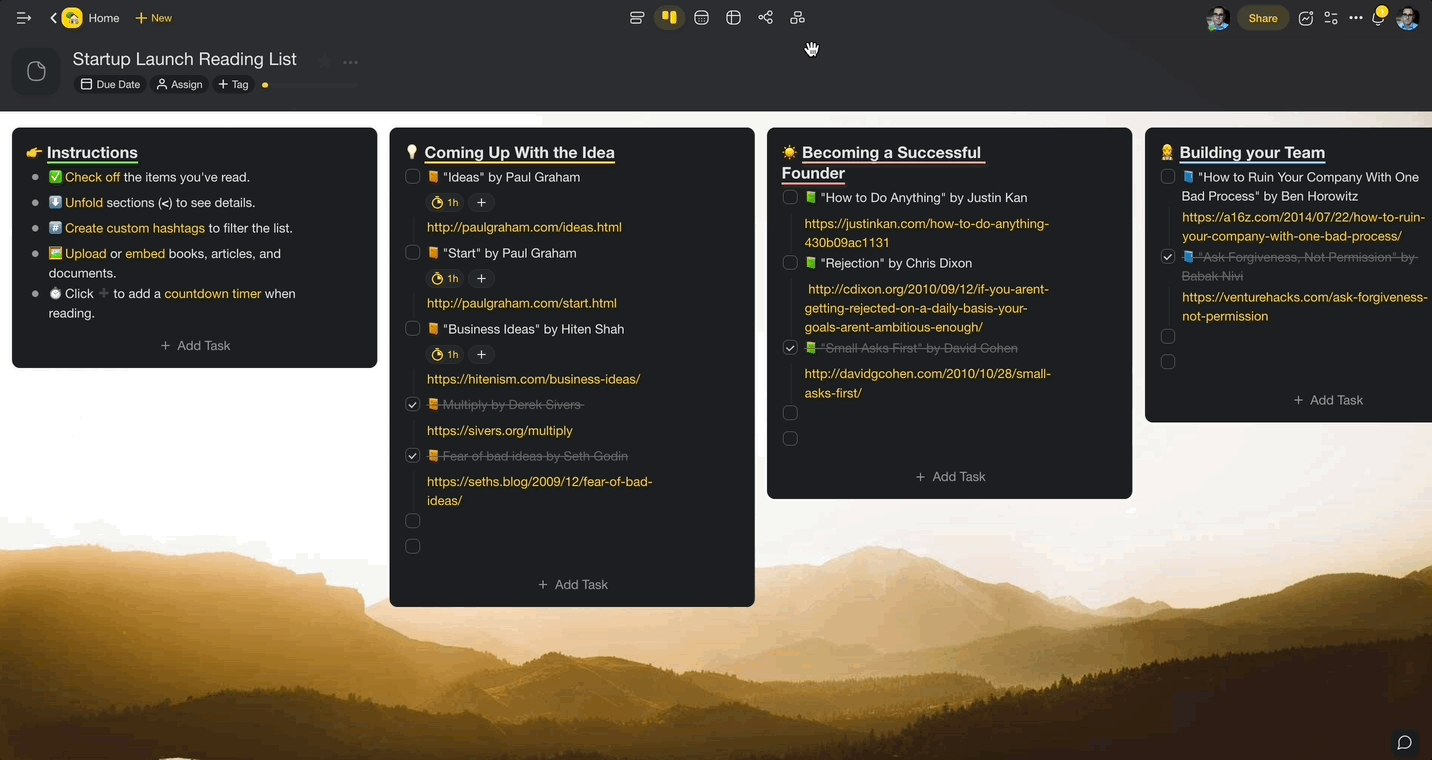
Taskade features 8 powerful project views — List, Board, Calendar, Table, Mind Map, Gantt, and Org Chart. All views are available so you can switch between workflows without limitations. Toggle between views to visualize your projects the way you want.
Collaborate and Communicate To Get Work Done On Taskade
One of the killer features that Taskade has is the ability for you to chat and host video calls within your project.
Our unlimited chat and video conferencing feature is built into every project you create so you can communicate with your clients and get work done with your team in the same window, via the same app.
Invite as many clients and guests to your project, get on a call and take notes within the same project.
Get a Headstart on Client Management With Taskade
Client management can get pretty hectic. To be good at it, you’ll need all the help you can get.
Our library of over 500+ templates means that you can choose from a wide range of templates to help you get a head start on your client projects. The best part? It’s completely free.
Here are some templates that your agency can use for a start:
Pricing for Agencies
Taskade offers a free plan to get started, with paid plans scaling for teams:
| Plan | Price (annual) | Best For |
|---|---|---|
| Free | $0 | Solo consultants, evaluation |
| Pro | $10/mo (10 users included) | Growing agencies |
| Business | $25/mo | Multi-client agencies |
| Enterprise | Custom | Large agencies with compliance needs |
All plans include AI agents, Genesis app building, automations, and 100+ integrations. See full pricing →
Scale Your Agency With Genesis
Stop building client tools from scratch. Describe what you need — a client portal, a project dashboard, a feedback collection system — and Genesis builds it in minutes with AI agents, automations, and your workspace data.
150,000+ apps built. Your agency is next. Start building →
📚 Resources & Getting Started
Ready to transform your agency with AI? Explore these resources:
🚀 Get Started
- Taskade Genesis — Build AI-powered apps, websites, and tools from one prompt
- Create Your First App — Step-by-step tutorial
- Community Templates — Browse and clone apps, dashboards, and tools
🧬 Understand the DNA
- How Genesis Works: Workspace DNA — Your workspace becomes your backend
- 🤖 Custom AI Agents — The Intelligence Pillar
- 🧠 Projects & Databases — The Memory Pillar
- ⚡ Automations & Workflows — The Execution Pillar
📖 Related Articles