






Introduction
TL;DR: Perplexity AI grew from a 2022 startup to a $20B company with $200M ARR, pioneering citation-based AI search. The Sonar API ($1/M tokens) and agentic search make it the developer-friendly alternative to Google, with management targeting $656M revenue by end of 2026. Try AI search in Taskade →
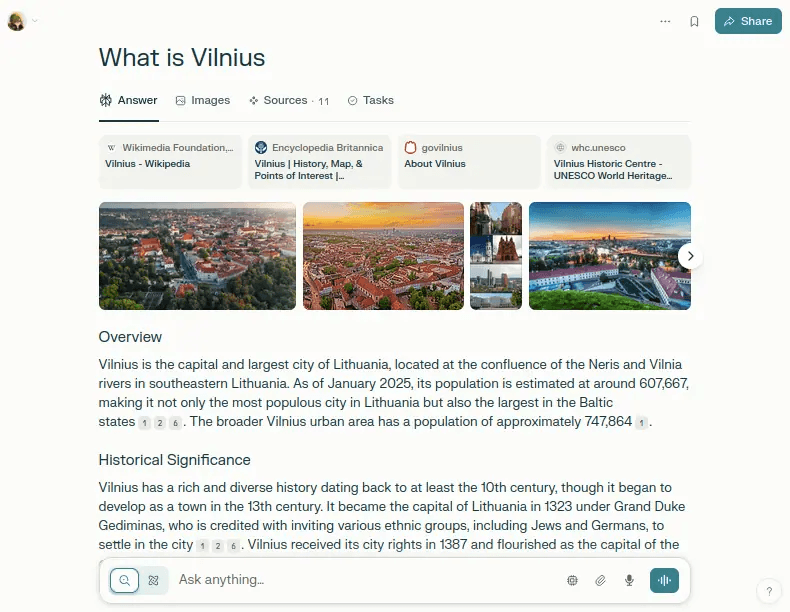
Perplexity AI burst onto the scene in December 2022 with a radical premise: what if search engines didn't just find links, but actually answered your questions with verifiable sources? Founded by Aravind Srinivas and a team of AI engineers from OpenAI, Meta, and Databricks, Perplexity pioneered the "answer engine" category—a conversational search interface that retrieves real-time web data, ranks relevant sources, and generates concise responses with citations. In just over three years, Perplexity has grown from an experimental project to a $20 billion company processing hundreds of millions of monthly queries, challenging Google's search dominance and attracting 45 million active users. But the story of Perplexity is not a simple tale of disruption—it is also a story about timing, economics, distribution, and what happens when tech giants wake up. This article explores the complete history of Perplexity AI, from Bird SQL to the Comet browser, from publisher lawsuits to hardware partnerships, and asks the question everyone is thinking: can an answer engine really beat Google?
What Changed Since March 2026?
The history above was written on March 5, 2026, and this section was added on September 23, 2026. Perplexity's growth accelerated past the targets cited above in the months since — figures below are as reported by funding trackers and industry analysts, not a Perplexity press release, so treat them as reported rather than official:
| Date | What changed (reported) |
|---|---|
| 2026-01-09 | Perplexity closed a Series E-6 round reported at a $23B valuation, up from $20B in September 2025 |
| Feb 2026 | Perplexity launched Perplexity Computer, a cloud-based AI agent for automating computer tasks |
| Aug 2026 | Perplexity's annualized revenue reportedly reached about $750M, already past the $656M full-year target in this article's original TL;DR |
| Late summer 2026 | Nvidia was reportedly in talks to invest at a valuation above $30B; no round had closed as of this writing |
How Do I Get Cited Web Search Like Perplexity Inside Taskade?
Taskade agents can search the web with citations and then act on the results inside your workspace — turning a finding directly into a task, a document, or a project update, instead of a separate answer-engine tab. Start here: AI apps overview.
- Search plus action in one place: an agent searches the web, cites sources, and can turn a finding into a task or document without switching tools.
- Persistent memory keeps earlier research in the agent's context across sessions, unlike a one-off chat.
- Free plan: 1 AI agent with 1 knowledge item, no credit card required.
- Automations re-run a research task on a schedule and route results across 100+ integrations.
Try AI search and agents free →
🔍 What Is Perplexity AI?
Perplexity AI is an AI-powered answer engine that combines conversational search with real-time web retrieval and source citations. Unlike traditional search engines that return ranked lists of links, Perplexity synthesizes information from multiple sources and presents a coherent answer—complete with numbered citations you can verify.
As CEO Aravind Srinivas explained on the Lex Fridman podcast: "You ask it a question, you get an answer, except the difference is all the answers are backed by sources. This is like how an academic writes a paper." The principle is borrowed directly from academic research, where every sentence must be backed by a citation from a peer-reviewed paper or an experimental result—anything else is just opinion.
The platform uses retrieval-augmented generation (RAG), meaning answers are grounded in actual web pages rather than purely generated from language model training data. This approach dramatically reduces hallucinations (AI-generated false information) while ensuring answers reflect current information rather than training data cutoffs.
Srinivas prefers to call Perplexity a "knowledge discovery engine" rather than a search engine. As he put it: "The journey doesn't end once you get an answer. The journey begins after you get an answer." This is reflected in Perplexity's interface, where related questions appear at the bottom of every answer, encouraging deeper exploration—embodying the search bar's tagline: "Where knowledge begins."
Key achievements that define Perplexity AI:
- $20 billion valuation (September 2025), up from $540 million in January 2024
- 45 million active users as of late 2025, growing 20 million in just one year
- 780 million monthly queries in May 2025, growing 20%+ month-over-month
- ~$200 million annualized revenue as of September 2025, up from $63M at end of 2024
- 300+ publisher partnerships with revenue-sharing for cited sources
- Citation transparency with every answer backed by verifiable sources
- 3,000 queries on day one (December 2022) to 30 million queries per day (mid-2025)
Perplexity's mission is simple: provide the most accurate, up-to-date answers to any question, with full transparency about where that information comes from. In an era of AI hallucinations and misinformation, this citation-first approach has resonated powerfully with researchers, students, professionals, and anyone who values factual accuracy over conversational flair.
📜 The History of Perplexity AI
🌱 The Pre-Perplexity Search Landscape (2020-2022)
Before Perplexity, search was dominated by two paradigms: traditional keyword-based search (Google, Bing) and early conversational AI (ChatGPT's GPT-3). Both had fundamental limitations.
Traditional search engines:
- Required keyword expertise (knowing how to phrase queries)
- Returned 10 blue links requiring manual synthesis
- Struggled with complex, multi-part questions
- No conversational follow-up or context retention
- Dominated by SEO games, sponsored placements, and content written for algorithms instead of humans
Early conversational AI (GPT-3, 2020-2022):
- Generated fluent text but often hallucinated facts
- No grounding in real-time data (training cutoffs)
- No source attribution or verification
- Optimized for plausibility, not accuracy
Aravind Srinivas saw the gap firsthand. After earning his B.Tech in Electrical Engineering from IIT Madras and a PhD in Computer Science from UC Berkeley (advised by renowned robotics professor Pieter Abbeel), Srinivas worked at the very institutions shaping modern AI. He interned at Google DeepMind in London in 2019, where he experienced the AGI-focused research culture. He then worked at OpenAI in its early days, gaining deep expertise in large language models. He understood search, he understood LLMs, and most importantly, he understood where things were breaking.
The opportunity was clear: combine the real-time retrieval of search engines with the conversational synthesis of large language models. The result would be an "answer engine"—a tool that didn't just find information or generate text, but intelligently retrieved sources and synthesized verified answers.
🎯 Founding and Launch (August-December 2022)
In August 2022, Perplexity AI, Inc., was founded by a team of AI veterans:
- Aravind Srinivas — CEO. IIT Madras → UC Berkeley PhD → DeepMind → OpenAI. Former research scientist who studied representation learning for perception and control.
- Denis Yarats — CTO. AI researcher from Meta and NYU, with deep expertise in reinforcement learning and generative models.
- Johnny Ho — Chief Strategy Officer. Former Quora ML engineer and quantitative trader at Tower Research Capital.
- Andy Konwinski — President. Co-founder of Databricks, the enterprise data analytics platform.
The founding team brought deep expertise in large language models, information retrieval, and distributed systems—exactly the skills needed to build a real-time answer engine at scale.
The health insurance moment:
The origin story of Perplexity is surprisingly human. As Srinivas told Lex Fridman, he was a complete novice as a founder-CEO. He didn't even take health insurance for himself ("I'm all in on this company. If it doesn't work, who cares?"). His co-founders were married and covered by their spouses. But their first employee asked for health insurance—and suddenly Srinivas needed to understand providers, co-insurance, deductibles, and plan options.
He turned to Google. But insurance is one of Google's highest-paying ad categories. "Google has literally zero incentive to tell you which plan to pick or which provider to go for," Srinivas explained. The search results were dominated by ads and affiliate content, not direct answers. So the team built a Slack bot that plugged GPT-3.5 into web search and answered the question directly. It worked—except the answers weren't always accurate.
That's when Srinivas and Yarats remembered their academic roots. "What is one way we stop ourselves from saying nonsense in a peer-reviewed paper?" Srinivas recalled. "We always make sure we can cite what we write—every sentence." They realized this was literally how Wikipedia works: every edit needs a notable source. They applied the same principle to AI-generated answers, and Perplexity was born.
Bird SQL — Perplexity's first product:
Before the main search engine, Perplexity's first public product was Bird SQL, launched on December 15, 2022—eight days after the core answer engine. Bird SQL was a Twitter search interface that used OpenAI's Codex to translate natural language questions into SQL queries, letting anyone search through Twitter's massive dataset conversationally instead of using Twitter's limited native search.
The demo caught the attention of Twitter co-founder Jack Dorsey, signaling early product-market fit. But when Twitter announced in February 2023 that it would discontinue free API access, the team faced a critical pivot point. Rather than fighting for a shrinking platform, they doubled down on the broader answer engine—a decision that proved transformative.
Initial vision:
The founders recognized that ChatGPT (launched November 2022) would make conversational AI mainstream, but they bet on a different value proposition: accuracy over creativity. While ChatGPT optimized for helpful, engaging responses, Perplexity would optimize for factual, verifiable answers. An early seed investor—a former Googler—actually told Srinivas the approach was wrong: "The reason ChatGPT is going viral is because people want to laugh at AI's mistakes. Your product is designed to not make mistakes. I don't think this will work." Srinivas didn't listen.
Perplexity CEO Aravind Srinivas explains to Lex Fridman how the answer engine works, the academic citation principle behind it, and why knowledge discovery begins after you get an answer.
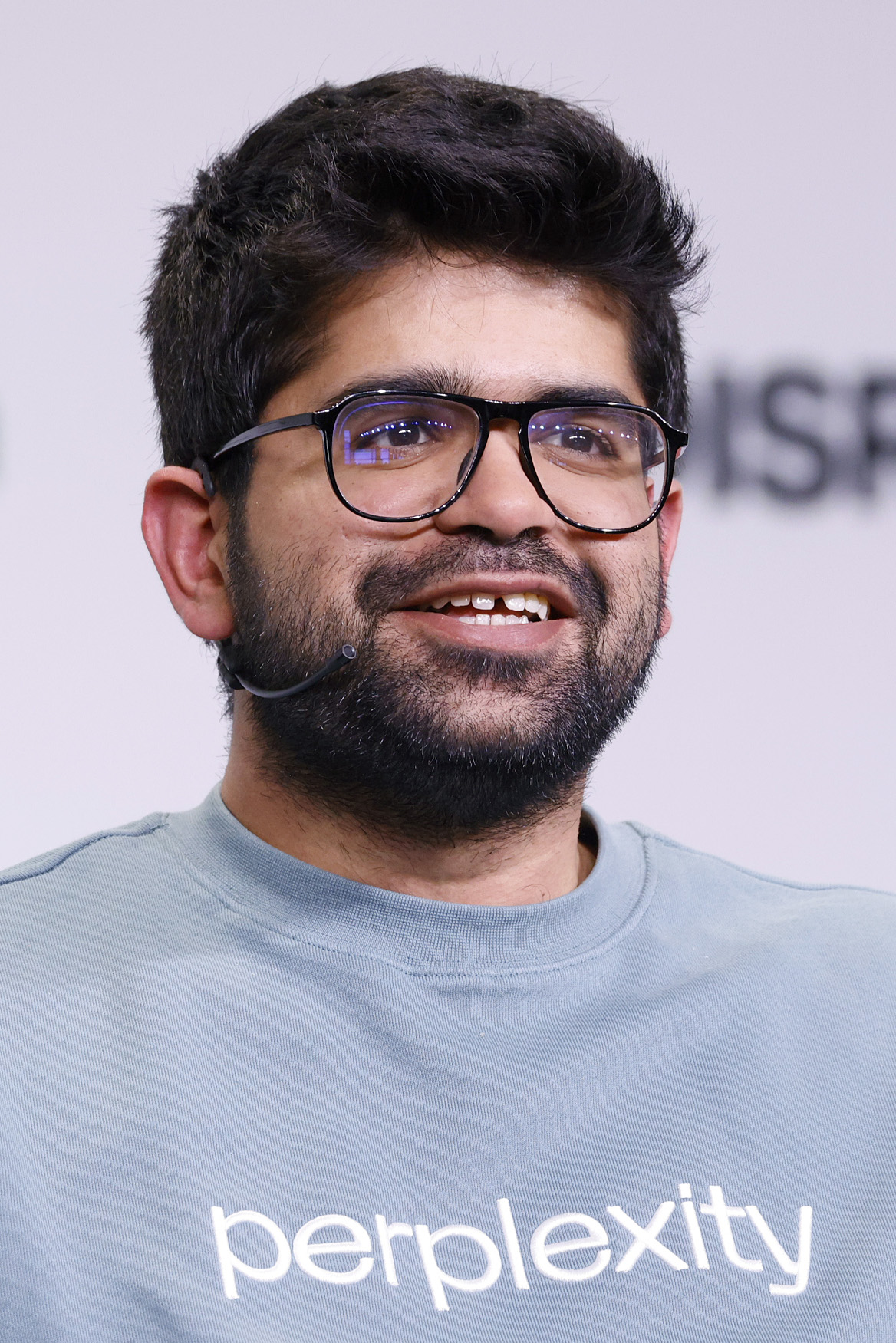
Aravind Srinivas, Perplexity AI CEO and co-founder. IIT Madras → UC Berkeley PhD → DeepMind → OpenAI → building the answer engine that challenged Google.
On December 7, 2022, Perplexity launched its main search engine to the public. On that first day, it processed just 3,000 queries. The initial product was simple:
- Ask any question in natural language
- Receive a synthesized answer with numbered citations
- Click citations to verify sources
- Follow up with contextual questions
The response was immediate. Researchers, students, and professionals frustrated with ChatGPT's hallucinations flocked to Perplexity for fact-checking and information discovery.
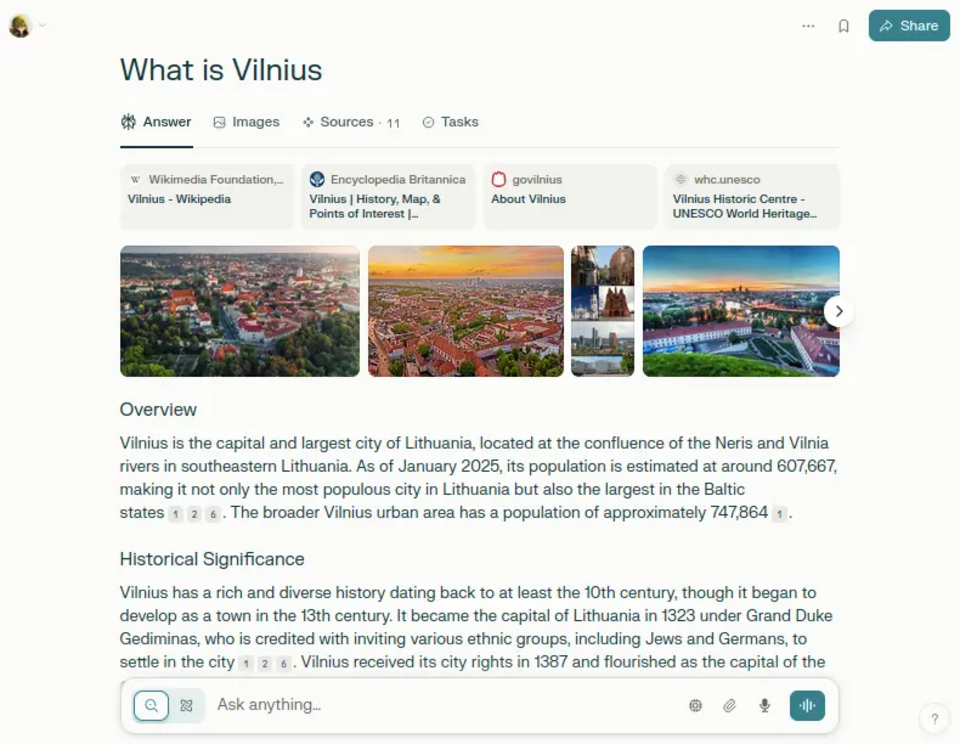
The Perplexity AI answer engine in action — synthesized answers with numbered inline citations and source verification.
📈 Rapid Growth and Market Validation (2023)
2023 was Perplexity's year of explosive growth and product iteration:
January 2023: Launched mobile apps for iOS and Android, recognizing that search is increasingly mobile-first. The apps brought citation-based search to smartphones, enabling on-the-go research with source verification.
February 2023: Reached 2 million unique visitors—remarkable for a product with zero marketing spend. Then Twitter announced the end of free API access, killing Bird SQL but confirming the team's pivot to general search.
April 2023: First major funding round at $121 million valuation. Early investors included NEA and prominent angels who saw the answer engine category emerging.
Key product improvements (2023):
- Collections: Save and organize searches into topic-based collections with custom AI instructions
- Pro Search: Advanced mode using frontier AI models for deeper, multi-step analysis
- Chrome extension: Search from any webpage with a keyboard shortcut
- Copilot mode: Interactive follow-up questions to refine answers
- Voice search: Speak questions instead of typing
- Focus modes: Narrow sources to academic papers, social media, news, or videos
User growth metrics (2023):
- 10 million monthly active users by mid-2023
- 50 million queries per month by August 2023
- Average session duration of 3.5 minutes (vs Google's ~1 minute)
- 40% week-over-week retention (unusually high for search products)
The data validated the founders' thesis: users wanted accurate answers with citations, not just links or conversational responses. Perplexity carved out a distinct niche between Google (links) and ChatGPT (generation).
💰 Funding Surge and Valuation Explosion (2024)
2024 was Perplexity's breakthrough year, marked by astronomical valuation growth and growing controversy.
January 2024: $540 million valuation in Series A extension
April 2024: $1 billion valuation (unicorn status), up from $121 million just 12 months prior
June 2024: $3 billion valuation following SoftBank Vision Fund 2 investment
December 2024: $9 billion valuation after a $500 million round led by Institutional Venture Partners (IVP)
This 74x valuation increase in 24 months ($121M → $9B) represented one of the fastest-growing enterprise valuations in tech history.
Investor roster (2024):
- Jeff Bezos (Amazon founder, personal investment)
- Nvidia (GPU manufacturer, strategic investment)
- Samsung (strategic investment, later leading to partnership talks)
- SoftBank Vision Fund 2 (Masayoshi Son's AI fund)
- IVP (led $500M December round)
- Databricks (enterprise AI platform)
- Tobias Lütke (Shopify CEO)
- Nat Friedman (former GitHub CEO)
The investor profile signaled validation from both tech founders (Bezos, Lütke) and AI infrastructure leaders (Nvidia, Databricks).
But 2024 also brought the first wave of publisher conflicts. In June 2024, separate investigations by Wired magazine and web developer Robb Knight found that Perplexity did not respect the Robots Exclusion Protocol (robots.txt), a standard that allows websites to request web crawlers not scrape their content. This discovery set the stage for the legal battles that would escalate in 2025.
🚀 The $20 Billion Answer Engine (2025-2026)
June 2025: Perplexity closed a $500 million funding round at $14 billion valuation, driven by surging revenue and query growth. The BBC threatened legal action, demanding Perplexity stop scraping its content.
July 2025: Launched the Comet browser for Windows and macOS, initially exclusive to Perplexity Max subscribers ($200/month). Also introduced the Max subscription tier at $200/month.
September 2025: Just three months later, Perplexity raised $200 million at a $20 billion valuation, bringing total funding to approximately $1.5 billion. Annualized revenue reached nearly $200 million.
October 2025: Comet browser released for free worldwide. Reddit filed a copyright lawsuit against Perplexity in federal court, alleging "industrial-scale" data theft.
November 2025: Comet browser launched on Android. Perplexity paused onboarding new advertisers to rethink its entire ad strategy.
December 2025: The New York Times sued Perplexity for copyright infringement, alleging unauthorized scraping of stories, videos, and podcasts after 18 months of failed negotiations.
2026: Management targets $656 million revenue by end of 2026. Sonar API pricing restructured — citations no longer billed separately; Sonar costs $1 per million tokens, Sonar Pro costs $3/$15 (input/output) per million tokens.
Key milestones (2025-2026):
- 45 million monthly active users (late 2025), up from 25 million at the start of 2025
- 170 million monthly visitors globally
- 780 million monthly queries in May 2025, growing 20%+ month-over-month
- ~$200 million annualized revenue (September 2025), up from $63M at end of 2024
- $656 million revenue target for end of 2026
- 85% user retention rate demonstrating sustainable adoption
- 300+ publisher partnerships with revenue-sharing for cited content
- 30 million queries per day — up from 3,000 on day one
- $750M Microsoft Azure commitment (January 2026) — 3-year cloud infrastructure deal
- Snapchat integration (January 2026) — access to nearly 1 billion additional users
Product evolution (2025-2026):
- Deep Research: An autonomous research agent that spends 2-4 minutes conducting multi-step analysis, reviewing hundreds of sources, and synthesizing expert-level reports
- Sonar API: Developer API for adding AI search to apps — Sonar $1/M tokens, Sonar Pro $3/$15 I/O per million tokens (citations no longer billed)
- Sonar and R1 1776: Perplexity's proprietary models based on Llama 3.3 and DeepSeek R1
- Comet browser: AI-native browser Srinivas calls a "cognitive operating system" (see section below)
- Android assistant: Pre-installed on Motorola phones, in talks with Samsung for Galaxy S26
- Max tier ($200/month): Unlimited access to all frontier AI models with no usage restrictions
- Perplexity Pages: AI-generated comprehensive guides on any topic
- Publisher revenue share: Over 300 publishers receive revenue when cited
- Enterprise: AI-powered research using internal docs + live web for teams
- Perplexity Labs: Sandbox environment for developers to test Perplexity's LLMs via API
Perplexity CEO Aravind Srinivas on winning search with AI, why Google can't ship its own answer engine, and the vision for Comet as a cognitive operating system.
🧬 What Makes Perplexity AI Different
1. Answer Engine vs Search Engine
Traditional search engines (Google, Bing) return ranked lists of links. Users must:
- Click through multiple results
- Synthesize information across sources
- Evaluate source credibility manually
- Return to search for follow-up questions
Perplexity's answer engine:
- Synthesizes information from multiple sources automatically
- Presents a coherent answer with numbered citations
- Allows conversational follow-up without re-searching
- Handles complex, multi-part questions in one query
- Suggests related questions to deepen your research
Example comparison:
Google search: "What caused the 2008 financial crisis?"
- Returns 10 links to Wikipedia, Investopedia, news articles
- User must read 3-5 sources to synthesize answer
- Time to answer: 5-10 minutes
Perplexity answer engine: "What caused the 2008 financial crisis?"
- Returns synthesized answer citing subprime mortgages, securitization, regulatory failures, Lehman Brothers collapse
- Includes numbered citations to authoritative sources (Fed reports, academic papers)
- User can immediately follow up: "How did Lehman Brothers fail?"
- Time to answer: 30 seconds
Where Google still wins:
- Navigational queries: If you just want to go to kayak.com or pay a credit card bill, Google is faster
- Real-time widgets: Sports scores, stock prices, weather are displayed in custom UIs instantly (200-400ms) vs Perplexity's ~1,000ms+ answer generation
- Local information: Maps, business hours, reviews
- Media results: Video, image, and shopping results
2. Retrieval-Augmented Generation (RAG)
Perplexity's core technological advantage is RAG: the combination of real-time retrieval with generative AI. As Srinivas explained to Lex Fridman, the process works like this:
How Perplexity's RAG pipeline works:
- Query analysis: Perplexity analyzes your question to identify key entities and intent
- Web retrieval: Searches the web using its own index for the most relevant, up-to-date sources
- Source extraction: Reads the retrieved links and extracts the relevant paragraphs
- Source ranking: Ranks extracted content by authority, recency, and relevance
- LLM synthesis: Feeds the relevant paragraphs plus the original query to a large language model
- Answer generation: The LLM synthesizes a coherent answer grounded in retrieved sources, with instructions to cite every claim
- Citation: Every sentence is linked to a specific source with [1], [2], [3] notation
The defining principle: "You are not supposed to say anything that you didn't retrieve." This is enforced through inline citations linking back to source documents, allowing users to verify every piece of information. Perplexity built its retrieval layer on Vespa.ai, integrating vector search for semantic understanding, lexical search for precision, structured filtering, and machine-learned ranking into a single engine.
Benefits of RAG:
- Reduces hallucinations: Answers must be grounded in actual sources
- Current information: Not limited to training data cutoff dates
- Verifiable: Users can check sources directly
- Transparent: Clear attribution of where information comes from
3. Model-Agnostic Architecture
Unlike ChatGPT (locked to OpenAI models) or Gemini (locked to Google models), Perplexity uses multiple AI models and routes queries intelligently:
Perplexity's model roster (2026):
- OpenAI models (GPT-4o, o3-pro): For complex reasoning and multi-step queries
- Anthropic Claude (3.5 Sonnet, Opus): For nuanced analysis and long-context synthesis
- Google Gemini (2.5 Pro): For broad knowledge retrieval
- Sonar (Perplexity's Llama 3.3-based model): For fast, efficient standard searches
- R1 1776 (Perplexity's DeepSeek R1-based model): For advanced reasoning tasks
This model-agnostic approach means Perplexity can choose the best model for each query type, optimizing for accuracy, speed, and cost. Pro and Max users can manually select their preferred model.
Important caveat: Even though Perplexity offers the same underlying models available in other tools (like ChatGPT or Claude), the experience is different. Perplexity applies its own fine-tuning optimized for accuracy, speed, and search-oriented responses. Selecting "Claude" in Perplexity does not give you the same experience as using Claude directly.
4. Publisher Revenue Sharing
Recognizing that answer engines could disintermediate content creators, Perplexity pioneered publisher revenue sharing — but not before facing significant backlash (see Controversies section below):
- 300+ publisher partnerships as of 2026, including the LA Times
- Publishers receive a share of ad revenue when their content is cited
- Citation links drive traffic to original sources
- The program follows Jeff Bezos' philosophy: "Your margin is my opportunity"—Perplexity argues it doesn't need Google-scale margins and can afford to share revenue
Srinivas has been transparent that AI answer engines will reduce traffic referrals compared to traditional search. But he argues the alternative—Google taking all ad revenue while driving traffic through links—isn't better for publishers either. The future vision includes deep research agents that can access paywalled content when users pay for it, creating a new revenue channel for publishers.
🤔 Is Perplexity Just an AI Wrapper?
One of the most persistent criticisms of Perplexity is the "AI wrapper" label. Since Perplexity doesn't train a massive foundation model from scratch—instead relying on models from OpenAI, Anthropic, Meta, Google, and others—critics ask: is Perplexity actually doing AI, or just building a pretty interface on top of other people's models?
The case for "wrapper":
- Perplexity's core LLM capabilities come from third-party models
- If OpenAI or Anthropic cut off access, Perplexity's product would degrade
- The differentiation (answers with citations) has been copied by ChatGPT, Google, and others
- By 2024, ChatGPT added citations, Google added AI Overviews, and Claude followed—eroding Perplexity's uniqueness
The case against "wrapper":
- Perplexity built its own search index and web crawling infrastructure
- The RAG pipeline—retrieval, ranking, extraction, synthesis, citation—is custom engineering
- Proprietary models (Sonar, R1 1776) reduce dependency on third parties
- The orchestration layer that makes search + LLM work seamlessly is itself a technical achievement
- As Srinivas argues: "The magic is all of this working together in one single orchestrated product"
The honest assessment: The "wrapper" criticism contains a kernel of truth—Perplexity is more dependent on third-party models than OpenAI or Google. But it also undersells the significant engineering in search, retrieval, ranking, and product design that makes Perplexity work. The real question isn't whether Perplexity is a "wrapper" but whether its orchestration layer creates enough defensible value as competitors catch up.
💰 The Economics of AI Search
The economics of AI search represent perhaps Perplexity's most fundamental challenge—one that no amount of product excellence can fully solve.
The cost problem:
Every Perplexity query runs a live web search, invokes a large language model, and synthesizes results in real time. That costs real money every single time. Google doesn't work this way—most Google searches cost fractions of a cent and don't require expensive LLM inference. Even when Google adds AI summaries, it does so selectively, only when it makes economic sense, and at massive scale advantages.
Perplexity is burning compute on every query while competing against a company that has optimized search economics for 25 years. As one analyst noted: "That's not a product problem—that's a physics problem."
The monetization challenge:
Google search has been subsidized by the most profitable ad engine ever created: high-intent queries, clear attribution, massive margins. Perplexity tried to rethink the model with trust-preserving ad formats—sponsored follow-up questions and light brand integrations that didn't interrupt answers.
But the results were challenging. Perplexity's advertising experiments generated modest returns relative to total revenue. In late 2025, Perplexity paused onboarding new advertisers to rethink its entire strategy. The fundamental tension: adding more ads risks user trust, but protecting the experience means accepting weaker monetization.
The subscription bet:
Perplexity's primary revenue engine is subscriptions—Pro at $20/month and Max at $200/month. With ~$200M annualized revenue by September 2025 (up from $63M at end of 2024), the subscription model is working. But the question remains whether subscriptions alone can fund the compute costs of processing billions of queries.
The scale gap:
Google handles tens of billions of searches per day. Even at 780 million monthly queries (Perplexity's May 2025 figure, growing 20%+ month-over-month), Perplexity represents a small fraction of global search volume. Scale matters in search because it drives cost efficiency, advertiser interest, and data network effects.
⚖️ Controversies and Publisher Lawsuits
Perplexity's relationship with publishers has been one of its most challenging issues—threatening to undermine its positioning as the "ethical alternative" to Google.
The robots.txt controversy (June 2024):
In June 2024, Wired magazine and web developer Robb Knight independently discovered that Perplexity's web crawler did not respect robots.txt—the standard protocol that allows websites to request not to be scraped. This revelation damaged trust with publishers and the broader tech community, as robots.txt compliance is considered a basic ethical standard for web crawlers.
The lawsuits:
- The New York Times (December 2025): Filed a copyright infringement lawsuit alleging Perplexity illegally scraped stories, videos, podcasts, and other content to formulate query responses. The Times claimed it spent 18 months negotiating with Perplexity without reaching a licensing agreement.
- BBC (June 2025): Threatened legal action, demanding Perplexity stop unauthorized scraping, delete all retained BBC material, and provide financial compensation.
- Reddit (October 2025): Sued in federal court in New York, alleging "industrial-scale" data theft. Court papers claimed Perplexity "increased the volume of citations to Reddit forty-fold" after receiving a cease-and-desist letter.
Perplexity's response:
Perplexity maintains it aggregates rather than plagiarizes, and has launched a publisher revenue-sharing program with 300+ partners. But the perception damage is real. Google can negotiate with publishers from a position of power—it drives significant traffic to publisher sites. A startup doesn't have that leverage. Instead of being seen as the ethical alternative to Google, Perplexity started looking like another platform built on other people's work.
The ongoing legal battles will likely shape how all AI search companies interact with publishers. The outcome could establish precedent for whether RAG-based answer engines constitute fair use or copyright infringement.
📱 Perplexity as Android Assistant
In early 2025, Perplexity made a strategic bet beyond the browser: becoming the default AI assistant on Android phones.
The Motorola partnership (April 2025):
Perplexity announced a global partnership with Motorola to pre-install its answer engine and AI assistant on new-generation Motorola smartphones worldwide. The integration goes beyond a simple app install:
- Custom optimizations for Motorola's Razr external display (works when the phone is folded shut)
- Full assistant capabilities: send emails, set reminders, play media, book reservations
- Invokable via gesture or action button for instant voice queries
Samsung negotiations:
Perplexity is in active talks with Samsung to become a default AI assistant option on Galaxy S26 devices, set to launch in the first half of 2026. Samsung previously invested in Perplexity in 2024 and is reportedly considering additional investment.
Google's pushback:
These partnerships haven't gone unnoticed by Google. Srinivas has publicly stated that "Google has given us an extremely hard time. Every time we were very close to signing a deal, some calls from Mountain View were being made." The DOJ's ongoing antitrust case against Google could potentially open up Android's default assistant market—Perplexity has advocated for a more open Android ecosystem where users can choose their preferred AI assistant.
The distribution lesson:
The hardware partnerships reflect a key lesson from the Microsoft-Bing precedent. In early 2023, Microsoft integrated ChatGPT directly into Bing with default placement on Windows, exclusive GPT-4 access, and billions in marketing spend. Yet years later, Bing's search market share barely moved. Browsers and search are sticky—people don't switch unless the improvement is overwhelming, not incremental. Perplexity's bet on being pre-installed as a native assistant, rather than asking users to switch browsers, may prove a smarter distribution strategy.
❓ Can Perplexity Beat Google?
This is the question that attracted billions in investment, millions of users, and comparisons to Netflix disrupting Blockbuster. The honest answer is nuanced.
What Perplexity gets right:
Perplexity genuinely solved a real problem. For complex research questions—"What caused the 2008 financial crisis?" or "Which health insurance plan should I choose?"—Perplexity delivers a better experience than Google's 10 blue links. The citation model is more trustworthy than ChatGPT's tendency to hallucinate. The conversational follow-ups are more natural than re-searching on Google. For power users who value accuracy and synthesis, Perplexity is the best tool available.
Why replacing Google was never realistic:
Distribution: Google is embedded in every Android phone, every Chrome browser, every default search setting. It's not a product—it's infrastructure. Perplexity was trying to replace one brick in a fortress.
Economics: Google has optimized search economics for 25 years. Its ad engine is built, battle-tested, and embedded into how the internet works. Perplexity is trying to invent a cleaner version of search economics while competing against the most profitable ad engine ever created.
Feature gap: Google isn't just search—it's Maps, Drive, YouTube, Gmail, Shopping, News, Images. When Google added AI summaries in 2023, it did so within an ecosystem of dozens of interconnected products. Perplexity is competing with an entire castle, not just one tower.
Google's strategic paralysis—Perplexity's real advantage: Paradoxically, Google's biggest weakness is its biggest strength. Google has the technology to build what Perplexity built. But it cannot ship a full answer engine without cannibalizing its $175+ billion annual ad revenue. This is why the same AI search feature has been renamed three times—Search Generative Experience (2023), AI Overviews (2024), AI Mode (2025)—without being fully rolled out to all users. As Srinivas observed: "They have all the models, the best index, the best infrastructure, their own hardware. So why not just change Google.com? Because you lose all the ad revenue."
The realistic outcome:
Perplexity didn't die, collapse, or vanish. But it also didn't replace Google or redefine search for the mainstream. Instead, it became something valuable but different from the original vision: a powerful research tool, a niche product for power users, a feature that incumbents copied and absorbed, and a company that proved the answer engine category is real. That's still impressive—just not revolutionary in the way early investors hoped.
The real lesson, as one tech analyst summarized: "Perplexity's mistake wasn't the product. It was believing that being better was enough. In tech, timing matters, distribution matters, and economics matter. When giants are asleep, startups look like killers. But when giants wake up, the game changes."
💡 Potential Benefits of Perplexity AI
For Researchers and Students
✅ Citation transparency: Every fact is backed by a verifiable source
✅ Time savings: 5-10x faster than traditional search + synthesis
✅ Follow-up questions: Conversational interface for deep research
✅ Collections: Organize research into topic-based folders with custom AI instructions
✅ Academic sources: Focus mode restricts searches to scholarly papers and journals
✅ Deep Research: Autonomous agent conducts multi-step analysis across hundreds of sources
For Professionals
✅ Real-time data: Information is up-to-date, not limited to training cutoffs
✅ Fact-checking: Quickly verify claims with cited sources
✅ Competitive research: Synthesize information across competitors
✅ Report generation: Export answers as formatted reports
✅ API access: Integrate answer engine into workflows (Enterprise tier)
✅ Mobile assistant: Voice-activated research on Motorola and Android devices
For General Users
✅ Natural language: Ask questions conversationally, no keyword expertise needed
✅ Accuracy: RAG reduces hallucinations compared to pure generative AI
✅ Visual answers: Tables, charts, and structured data when relevant
✅ Mobile-first: Native iOS and Android apps for on-the-go research
✅ Voice search: Speak questions naturally
✅ Comet browser: Browse the web with AI built into every page
📊 Perplexity AI Pricing (2026)
Free Tier:
- Limited Pro Searches per day
- Unlimited standard searches
- Access to Collections
- Mobile apps (iOS/Android)
- Chrome extension
- Basic citation support
Perplexity Pro ($20/month or $200/year):
- 600 Pro Searches per day
- Access to frontier AI models (GPT-4o, Claude, Gemini 2.5 Pro, o3-pro)
- 500 Deep Research queries per day
- Unlimited file uploads (PDFs, documents)
- Advanced image analysis
- API access
- Priority support
Perplexity Max ($200/month or $2,000/year):
- Everything in Pro
- Unlimited access to all frontier AI models
- No usage restrictions on volume or frequency
- First access to new features (Comet was initially Max-exclusive)
- Highest Deep Research limits
Perplexity Education Pro (Free for 12 months):
- Full Pro features for verified students
- Designed for academic research and coursework
Perplexity Enterprise Pro ($40/seat/month or $400/seat/year):
- Team workspaces and collaboration
- Identity-provider login (SSO) and admin controls
- Shared Spaces for team research
- All Pro features
Perplexity Enterprise Max ($325/seat/month or $3,250/seat/year):
- Maximum toolset with highest performance
- Increased storage and bandwidth
- Suitable for heavy enterprise workloads
Revenue model:
- Subscriptions: Primary revenue driver (~$200M ARR by September 2025)
- Advertising: Experimental, paused new onboarding in late 2025 to rethink strategy
- Enterprise licenses: Custom pricing for large organizations
- API access: Developer API with usage-based pricing via Perplexity Labs
⚔️ Perplexity AI vs ChatGPT vs Google
Quick Comparison
| Feature | Perplexity AI | ChatGPT | Google Search |
|---|---|---|---|
| Primary Use Case | Research & fact-finding | Content creation & coding | Link discovery & navigation |
| Output Format | Synthesized answer with citations | Conversational response | Ranked links + AI Overviews |
| Current Data | Real-time web retrieval | Limited (training cutoff + browsing) | Real-time indexed pages |
| Citations | Every answer has numbered sources | Optional (with browsing) | No synthesis, just links |
| Accuracy | High (RAG-grounded) | Medium (hallucination risk) | N/A (no synthesis) |
| Response Speed | ~1-3 seconds | ~1-5 seconds | ~0.2-0.4 seconds |
| Follow-up Questions | Contextual + suggested questions | Contextual conversation | New search or AI Mode |
| Creative Tasks | Weak (search-optimized) | Strong (writing, coding, brainstorming) | N/A |
| Cost | Free / $20 Pro / $200 Max | Free / $20 Plus / $200 Pro | Free (ad-supported) |
| Best For | Research, verification, learning | Brainstorming, writing, coding | Quick lookups, navigation, local |
When to Use Each
Use Perplexity when:
- You need accurate, cited information
- You're researching a complex topic
- You want to verify facts or claims
- You need current, real-time data
- You're a student, researcher, or journalist
- You want to narrow sources (academic, social, news, video)
Use ChatGPT when:
- You're writing content or code
- You need creative brainstorming
- You're analyzing data or documents
- You want multimodal interaction (images, audio)
- You need deep reasoning on complex problems
- Accuracy is less critical than helpfulness
Use Google when:
- You want to navigate to a specific website
- You need local information (maps, business hours)
- You want real-time data widgets (sports, stocks, weather)
- You prefer browsing multiple perspectives
- You want video/image/shopping results
🔮 The Future of Perplexity AI
Under Aravind Srinivas' leadership, Perplexity is making several strategic bets:
1. Comet: From Browser to Cognitive Operating System
Comet isn't just another web browser—Srinivas envisions it as a "cognitive operating system" that fundamentally rethinks how humans experience the internet. Launched on July 9, 2025 for Windows and macOS, made free worldwide in October 2025, and expanded to Android on November 20, 2025, Comet is built on Chromium but reimagined with AI at its core.
Key Comet capabilities:
- Every webpage has an "Ask Perplexity" button
- Highlight any text → instant explanation with sources
- AI-powered tab organization
- Sidebar assistant available on every page
- Automate tasks: summarize articles, draft email replies, buy products
- New tab page with personalized research suggestions
The strategic logic follows Google's own history: Sundar Pichai became Google's CEO because he led the Chrome project—the browser that became Google's most powerful distribution weapon. If Perplexity can own the front end through which people experience the internet, it controls the entire search + answer pipeline.
The browser also enables Perplexity's vision for blending navigation, information, and action in one interface. Instead of switching between Google (navigation), Perplexity (answers), and various apps (actions), Comet aims to handle all three. An entire browsing session could be compressed into a single prompt.
2. Deep Research and Research Agents
Perplexity's Deep Research mode transforms the tool into an autonomous research agent. When you ask a complex question, it spends 2-4 minutes conducting multi-step, agentic analysis—reviewing hundreds of sources and employing sophisticated reasoning to synthesize a comprehensive, expert-level report.
This represents an evolution from "better search" to "research operating system":
- Perplexity Pages: Auto-generate comprehensive guides on any topic
- Research agents: AI that conducts multi-step research autonomously
- Tool use: Deep research agents can potentially access paywalled content when users pay, creating new publisher revenue channels
3. Proprietary Models (Sonar and R1 1776)
While Perplexity currently relies on third-party models, the company is investing in proprietary alternatives to reduce dependency and control costs:
- Sonar (Llama 3.3-based): Fast, efficient model for standard queries
- R1 1776 (DeepSeek R1-based): Advanced reasoning for complex analysis
- Both models are available via Perplexity Labs for developer integration
4. Hardware Partnerships and Distribution
The Motorola deal and Samsung negotiations represent Perplexity's most aggressive push for distribution:
- Pre-installed assistant on new Motorola devices worldwide
- Samsung Galaxy S26 integration in talks for early 2026
- Additional OEM partnerships in discussion
- Android assistant that works as a system-level default, not just an app
5. Enterprise AI Research
The Enterprise tier targets organizations needing research at scale:
- Law firms researching case precedents
- Consulting firms analyzing industries
- R&D teams tracking scientific literature
- Investment firms conducting due diligence
Potential challenges ahead:
- Legal uncertainty: Publisher lawsuits (NYT, BBC, Reddit) could set precedent limiting RAG-based answer engines
- Competition: ChatGPT Search and Google AI Mode continue to converge on Perplexity's core value proposition
- Monetization: Balancing ad revenue with user trust remains unresolved
- Unit economics: Every query costs more than Google's, creating structural margin pressure
- Distribution: Despite hardware partnerships, competing with Google's default position across billions of devices remains daunting
- Regulatory scrutiny: EU AI Act, copyright concerns, and DOJ antitrust outcomes could reshape the competitive landscape
Despite these challenges, Perplexity has established itself as the leading independent answer engine—a category it created and continues to define.
🐑 Before you go... Looking for an AI tool that combines research with intelligent automation? Taskade Genesis has you covered!
💬 AI Chat: Need to research and organize information? AI Chat helps you synthesize knowledge, answer questions, and keep your team aligned on project insights.
🤖 AI Agents: Unlike Perplexity's search-focused AI, Taskade AI Agents can research topics, organize findings into projects, and execute workflows—all trained on your workspace data.
✏️ AI Assistant: Research and planning combined. The AI Assistant helps you brainstorm, generate content, organize research findings, and turn insights into actionable tasks.
🔄 Workflow Generator: Building a research workflow? Describe your process and the Workflow Generator creates an automated system with AI agents and integrations.
Want to give Taskade AI a try? Create a free account and start today! 👈
🔗 Resources
https://www.perplexity.ai/hub/blog/introducing-perplexity-max
https://www.youtube.com/watch?v=Q0ncaAwnn-o (Lex Fridman interview)
https://www.youtube.com/watch?v=IsScahXkvMk (Bloomberg Tech Summit interview)
https://www.perplexity.ai/hub/blog/announcing-our-global-partnership-with-motorola
💬 Frequently Asked Questions About Perplexity AI
1. What is Perplexity AI and how does it work?
Perplexity AI is an AI-powered answer engine that combines conversational search with real-time web retrieval and source citations. It uses retrieval-augmented generation (RAG) to retrieve relevant web sources, then synthesizes information using frontier AI models, with every answer including numbered citations to verifiable sources. As founder Aravind Srinivas explains, the principle comes from academic paper writing: "Every sentence you write should be backed with a citation." Learn more about AI agents and autonomous systems.
2. Who founded Perplexity AI and when?
Perplexity AI was founded in August 2022 by Aravind Srinivas (CEO, IIT Madras → UC Berkeley PhD → DeepMind → OpenAI), Denis Yarats (CTO, ex-Meta), Johnny Ho (CSO, ex-Quora), and Andy Konwinski (President, Databricks co-founder). The company launched its public search engine on December 7, 2022, and its first product Bird SQL (a Twitter search tool) eight days later.
3. How much is Perplexity AI worth?
As of September 2025, Perplexity AI is valued at $20 billion following a $200 million funding round. This represents a remarkable 165x increase from its $121 million valuation in April 2023. The company has raised approximately $1.5 billion in total funding from investors including Jeff Bezos, SoftBank, Nvidia, Samsung, and IVP.
4. Is Perplexity AI better than ChatGPT?
It depends on your use case. Perplexity AI is better for research, fact-finding, and verification because every answer includes citations to verifiable sources and uses real-time web retrieval. ChatGPT is better for content creation, coding, creative brainstorming, and conversational assistance — it delivers more creative and relevant outputs for high-brain-power tasks. Perplexity optimizes for accuracy; ChatGPT optimizes for helpfulness and creativity.
5. How much does Perplexity AI cost?
Perplexity AI offers a free tier with limited Pro Searches per day and unlimited standard searches. Perplexity Pro costs $20/month ($200/year) and includes 600 Pro Searches daily, access to frontier AI models, Deep Research, and file uploads. Perplexity Max costs $200/month ($2,000/year) for unlimited access to all models with no restrictions. Education Pro is free for 12 months for verified students. Enterprise tiers range from $40 to $325 per seat per month.
6. What is an "answer engine" vs a search engine?
A traditional search engine (Google, Bing) returns a ranked list of links that you must click through and synthesize yourself. An answer engine (Perplexity) retrieves sources automatically, synthesizes information across them, and presents a coherent answer with numbered citations—all in one response. Answer engines save time by doing the synthesis work for you. Perplexity's founder prefers the term "knowledge discovery engine" — the journey doesn't end with an answer, it begins there.
7. Does Perplexity AI hallucinate like ChatGPT?
Perplexity significantly reduces hallucinations through retrieval-augmented generation (RAG). Because answers must be grounded in actual web sources, the AI cannot invent facts that don't exist in retrieved documents. However, like all AI systems, Perplexity can still make synthesis errors or misinterpret sources, which is why citations are critical for verification. The key difference: you can click Perplexity's citations to check the original source.
8. How many people use Perplexity AI?
As of late 2025, Perplexity AI has 45 million active users, up from 25 million at the start of 2025. The platform processes 780 million queries per month (as of May 2025), with 20%+ month-over-month growth — meaning it could reach a billion queries per week within a year if growth sustains. For context, it processed just 3,000 queries on its first day in December 2022.
9. What AI models does Perplexity use?
Perplexity uses a model-agnostic architecture, choosing the best AI model for each query type. Available models include OpenAI's GPT-4o and o3-pro, Anthropic's Claude 3.5 Sonnet and Opus, Google's Gemini 2.5 Pro, and Perplexity's proprietary models Sonar (Llama 3.3-based) and R1 1776 (DeepSeek R1-based). Pro and Max users can manually select their preferred model.
10. Can I use Perplexity AI for academic research?
Yes, Perplexity is excellent for academic research. The Focus mode can restrict searches to scholarly sources including peer-reviewed journals, academic papers, and institutional research. Every answer includes numbered citations in a format suitable for bibliography creation. The Education Pro tier offers 12 months of free Pro access for verified students. However, always verify citations and use Perplexity as a starting point, not a replacement for critical reading of primary sources.
11. How does Perplexity make money?
Perplexity generates revenue primarily through subscriptions: Pro at $20/month, Max at $200/month, and Enterprise tiers from $40-$325/seat/month. With approximately $200M in annualized revenue by September 2025, the subscription model is working. The company has experimented with advertising but paused new ad onboarding in late 2025 to rethink its strategy. API access via Perplexity Labs provides additional revenue from developers.
12. Is Perplexity AI just an AI wrapper?
This is the most common criticism. Since Perplexity relies on third-party models rather than training its own foundation model, critics call it a "wrapper." However, Perplexity has built its own search index, RAG pipeline, source ranking algorithms, and proprietary models (Sonar, R1 1776). The value lies in the orchestration of search + retrieval + ranking + synthesis + citation into one product. The real question is whether that orchestration creates enough defensible value as competitors replicate the pattern.
13. Can Perplexity replace Google?
Not for all use cases. Google dominates navigational queries (finding websites), local information (maps, hours), and real-time widgets (sports, stocks, weather) — and it does so at fractions of a cent per query. Perplexity excels at complex research questions requiring synthesized, cited answers. The structural barrier is economic: Google has optimized search economics for 25 years, while every Perplexity query requires expensive LLM inference. Perplexity has become a powerful complement to Google for research-heavy tasks, not a replacement.
14. Why can't Google just copy Perplexity?
Google has the technology but not the incentive. Replacing search links with direct answers would cannibalize its $175+ billion annual ad revenue — if users get answers directly, advertisers lose click-through placements. This is why Google has renamed its AI search feature three times (SGE → AI Overviews → AI Mode) without fully shipping it. Perplexity can move faster because it doesn't have legacy ad revenue to protect.
15. Has Perplexity AI been sued?
Yes. The New York Times sued Perplexity in December 2025 for copyright infringement. The BBC threatened legal action in June 2025. Reddit filed a federal lawsuit in October 2025 alleging "industrial-scale" data theft. A 2024 investigation by Wired found Perplexity didn't respect robots.txt standards. Perplexity has responded by launching a publisher revenue-sharing program with 300+ partners, but legal battles remain ongoing.
16. Is Perplexity available as a phone assistant?
Yes. Perplexity is pre-installed on new Motorola smartphones worldwide as of April 2025, with custom integrations for the Razr external display. The company is in talks with Samsung for Galaxy S26 integration in 2026. On any Android phone, you can set Perplexity as your default assistant for voice queries, reminders, emails, and more.
17. What is Bird SQL?
Bird SQL was Perplexity's first product, launched December 15, 2022. It was a Twitter search interface using OpenAI Codex to translate natural language into SQL queries, letting anyone search through Twitter conversationally. It caught Jack Dorsey's attention but was discontinued when Twitter ended free API access in February 2023, prompting Perplexity's full pivot to the general answer engine.
18. What is the Comet browser?
Comet is Perplexity's AI-native browser, launched July 9, 2025 for Windows and macOS, made free in October 2025, and released on Android in November 2025. Built on Chromium, it integrates AI into every aspect of browsing — answer any question from any page, summarize articles, draft emails, organize tabs. Srinivas calls it a "cognitive operating system" rather than just a browser, competing with Chrome, Arc, and Brave.
19. What is Perplexity Deep Research?
Deep Research is an advanced feature that transforms Perplexity into an autonomous research agent. When activated, it spends 2-4 minutes conducting multi-step analysis, reviewing hundreds of sources, and synthesizing comprehensive expert-level reports. It is available to Pro, Max, and Enterprise users with generous daily limits. Think of it as hiring a research assistant who reads hundreds of articles and writes you a briefing.
20. Do publishers support Perplexity AI?
The relationship is mixed. Over 300 publishers have signed revenue-sharing agreements, including the LA Times. But major publishers including The New York Times, BBC, and Reddit have sued or threatened legal action over content scraping. Perplexity has been transparent that AI answer engines will reduce traffic referrals compared to traditional search, but argues revenue sharing creates a more equitable model than Google's approach of driving traffic through links while keeping all ad revenue.
Ready to organize your research with AI? Try Taskade's AI workspace to manage your research projects, train custom AI agents, and collaborate with your team—all powered by Workspace DNA. Build your second brain for smarter research.