# LLM Wiki Explained (2026): Karpathy's Pattern, Google's OKF, and When a Folder Beats RAG
> An LLM wiki is a folder of linked Markdown files that an AI agent writes and maintains. How Karpathy's pattern and Google's OKF work, and when RAG still wins.
- Source: https://www.taskade.com/blog/llm-wiki-explained
- Published: 2026-11-13
- Author: John Xie
On April 4, 2026, Andrej Karpathy posted a text file of about 2,000 words to GitHub and called it [LLM Wiki](https://gist.github.com/karpathy/442a6bf555914893e9891c11519de94f). It contains no code. It describes a folder of plain text files that an AI model writes, links, and keeps current, and it argues that this folder is a better memory for an AI agent than the retrieval pipelines most teams built from 2021 to 2025.
Sixty-nine days later, on June 12, Google Cloud published the [Open Knowledge Format](https://cloud.google.com/blog/products/data-analytics/how-the-open-knowledge-format-can-improve-data-sharing), which it describes as "an open specification that formalizes the LLM-wiki pattern into a portable, interoperable format." A personal note became a vendor standard in one quarter.
This guide explains both from the primary sources: the gist, the specification, and the measurements. It also covers what most explainers leave out. The folder has limits, a field in a file is not a process, and retrieval is not dead.
*Photo: Vannevar Bush at his desk, U.S. Office for Emergency Management, Library of Congress via Wikimedia Commons, public domain.*
> **TL;DR:** An LLM wiki is a folder of linked Markdown files that an AI agent writes and maintains. Karpathy says it works at about 100 sources and hundreds of pages. Google's Open Knowledge Format (June 12, 2026) makes the folder portable. RAG still wins for very large, live, or permissioned data. [Build a knowledge base that agents maintain](https://www.taskade.com/create).
---
## What Is an LLM Wiki?
An LLM wiki is a folder of linked Markdown files that a large language model writes and maintains on your behalf. You add sources and ask questions. The model reads each source once, updates every page that the source affects, and answers later questions from the finished pages. The knowledge is compiled one time and then kept current.
That last sentence is the difference from [retrieval-augmented generation (RAG)](https://www.taskade.com/blog/rag-retrieval-history). In a RAG system the model receives a new set of text fragments for each question and must connect them again. Karpathy's gist states the problem in one line: "the LLM is rediscovering knowledge from scratch on every question. There's no accumulation."
His summary of the working arrangement is the most quoted sentence in the file:
> "Obsidian is the IDE; the LLM is the programmer; the wiki is the codebase."
The division of labor is strict. The person does not write the wiki.
| Job | Who does it | Why |
|---|---|---|
| Choose the sources | Person | Curation is a judgment call |
| Ask the questions | Person | Direction comes from the person's goals |
| Summarize each source | Model | Reading and compressing is cheap for a model |
| Update related pages | Model | One source can touch 10 to 15 pages |
| Keep links and the index current | Model | People stop doing this work, and the wiki dies |
| Check the result | Person | The model can be wrong with confidence |
Karpathy explains why the split works: "Humans abandon wikis because the maintenance burden grows faster than the value." A model does not get bored, and it can change 15 files in one pass.
```mermaid
graph LR
P["Person
sources and questions"] --> A["AI agent
reads, writes, links"]
A --> W["Wiki folder
linked Markdown pages"]
W --> Q["Answers that start
from finished pages"]
style P fill:#1e1e2e,color:#94a3b8,stroke:#475569
style A fill:#2a1225,color:#ff8fa3,stroke:#ff2d60,stroke-width:2px
style W fill:#0d1b2a,color:#7dd3fc,stroke:#38bdf8,stroke-width:1.5px
style Q fill:#0d1a0e,color:#86efac,stroke:#22c55e,stroke-width:1.5px
```
---
## Where Did the LLM Wiki Come From?
The LLM wiki is an 81-year-old idea that waited for a worker. Vannevar Bush described a personal knowledge store with linked trails in July 1945. Ward Cunningham built the first wiki in 1995. Both designs depended on people to do the filing, and people stopped. In 2026 the filing clerk is a language model.
Karpathy names the ancestor himself. The gist says the idea "is related in spirit to Vannevar Bush's Memex (1945)" and adds the sentence that explains the whole pattern: "The part he couldn't solve was who does the maintenance. The LLM handles that."
| Year | Event | What it added |
|---|---|---|
| Jul 1945 | Vannevar Bush publishes [As We May Think](https://www.theatlantic.com/magazine/archive/1945/07/as-we-may-think/303881/) in The Atlantic | The memex: a private store of documents joined by trails |
| Mar 1995 | Ward Cunningham opens [WikiWikiWeb](https://wiki.c2.com/?WikiHistory) | Pages that any reader can edit and link |
| Jan 2001 | Wikipedia launches | Proof that linked pages scale when volunteers maintain them |
| 2004 | John Gruber releases [Markdown](https://www.taskade.com/blog/markdown-history) | A plain-text format that people and machines both read |
| May 2020 | The [RAG paper](https://arxiv.org/abs/2005.11401) (Lewis et al.) | Retrieval at question time gets a name |
| 2021 to 2023 | The [vector database](https://www.taskade.com/blog/vector-databases) boom | Embedding search becomes a managed service |
| Sep 2024 | Anthropic publishes [Contextual Retrieval](https://www.anthropic.com/news/contextual-retrieval) | A note that under 200,000 tokens you can skip retrieval and put everything in the prompt |
| Aug 2025 | Letta publishes [a filesystem memory benchmark](https://www.letta.com/blog/benchmarking-ai-agent-memory/) | An agent with plain files scores 74.0% on LoCoMo |
| Sep to Oct 2025 | Anthropic ships a [file-based memory tool](https://claude.com/blog/context-management) and [Agent Skills](https://claude.com/blog/skills) | Agent memory and agent abilities both become folders of files |
| Apr 2026 | Karpathy posts on X about LLM knowledge bases (Apr 2) and publishes the gist (Apr 4) | The pattern gets a name |
| Jun 2026 | Google Cloud publishes OKF v0.1 (Jun 12) | The folder becomes a specification |
| Jul 2026 | OKF v0.2 (Jul 24) | Fields for who wrote a page, who checked it, and when it expires |
The coding world reached the same design a little earlier, from the other direction. Boris Cherny, who created Claude Code, [wrote on X](https://x.com/bcherny/status/2017824286489383315) in February 2026: "Early versions of Claude Code used RAG + a local vector db, but we found pretty quickly that agentic search generally works better. It is also simpler and doesn't have the same issues around security, privacy, staleness, and reliability." An agent that can list files, search text, and open what it needs did better than a pipeline that guessed in advance. The same lesson shows up in [the history of Claude Code](https://www.taskade.com/blog/claude-code-history) and in every project that keeps its instructions in a plain file. The [AGENTS.md](https://agents.md/) site says more than 60,000 open-source projects use that one file name.
```mermaid
graph LR
M["1945
Memex
trails, no worker"] --> K["1995
Wiki
people do upkeep"]
K --> R["2020
RAG
retrieve per question"]
R --> F["2025
Agents read files
search beats pipeline"]
F --> L["Apr 2026
LLM wiki
model does upkeep"]
L --> O["Jun 2026
OKF
the folder as a spec"]
style M fill:#1e1e2e,color:#94a3b8,stroke:#475569
style K fill:#1e1e2e,color:#94a3b8,stroke:#475569
style R fill:#1a140a,color:#ffb74d,stroke:#e65100,stroke-width:1.5px
style F fill:#0d1b2a,color:#7dd3fc,stroke:#38bdf8,stroke-width:1.5px
style L fill:#2a1225,color:#ff8fa3,stroke:#ff2d60,stroke-width:2px
style O fill:#0d1a0e,color:#86efac,stroke:#22c55e,stroke-width:1.5px
```
Two older traditions sit behind the same shape. Niklas Luhmann kept about 90,000 linked index cards in his [Zettelkasten](https://www.taskade.com/blog/the-zettelkasten-method-for-distributed-teams), and the modern [second brain](https://www.taskade.com/blog/ai-second-brain-tools) movement rebuilt that habit in apps such as [Obsidian](https://www.taskade.com/blog/obsidian-history). Each one worked for the few people with the discipline to maintain it. The LLM wiki keeps the structure and removes the discipline requirement.
---
## How Does Karpathy's LLM Wiki Work?
Karpathy's LLM wiki has three layers and three operations. The layers are the raw sources, the wiki, and a schema file. The operations are ingest, query, and lint. Two special files, `index.md` and `log.md`, let the agent find pages and remember what it did. Nothing else is required.
### The three layers
| Layer | What it holds | Who writes it | Rule |
|---|---|---|---|
| Raw sources | Articles, papers, transcripts, data files | Person collects | Immutable. The agent reads and never edits |
| The wiki | Summaries, entity pages, concept pages, comparisons | Agent | "You read it; the LLM writes it" |
| The schema | One instruction file, for example `CLAUDE.md` or `AGENTS.md` | Person and agent together | Says how pages are named, linked, and updated |
The schema file is the part people skip, and it is the part that matters most. The gist calls it "the key configuration file" and says it is "what makes the LLM a disciplined wiki maintainer rather than a generic chatbot." It is [context engineering](https://www.taskade.com/blog/context-engineering) in its plainest form: a short, stable set of rules that the agent reads at the start of every session.
```mermaid
graph TD
subgraph S["Layer 1: Raw sources"]
S1["Articles"]
S2["Transcripts"]
S3["Data files"]
end
subgraph W["Layer 2: The wiki"]
W1["index.md"]
W2["Concept pages"]
W3["Entity pages"]
W4["log.md"]
end
subgraph C["Layer 3: The schema"]
C1["CLAUDE.md or AGENTS.md"]
end
S1 --> AG["AI agent"]
S2 --> AG
S3 --> AG
C1 --> AG
AG --> W1
AG --> W2
AG --> W3
AG --> W4
style AG fill:#2a1225,color:#ff8fa3,stroke:#ff2d60,stroke-width:2px
style S fill:#1a140a,stroke:#3a2a1a
style W fill:#0a1420,stroke:#1a2a45
style C fill:#0a1a14,stroke:#1b3d2a
style S1 fill:#1a140a,color:#ffb74d,stroke:#e65100
style S2 fill:#1a140a,color:#ffb74d,stroke:#e65100
style S3 fill:#1a140a,color:#ffb74d,stroke:#e65100
style W1 fill:#0d1b2a,color:#7dd3fc,stroke:#38bdf8
style W2 fill:#0d1b2a,color:#7dd3fc,stroke:#38bdf8
style W3 fill:#0d1b2a,color:#7dd3fc,stroke:#38bdf8
style W4 fill:#0d1b2a,color:#7dd3fc,stroke:#38bdf8
style C1 fill:#0d1a0e,color:#86efac,stroke:#22c55e
```
### The three operations
| Operation | Trigger | What the agent does | Output |
|---|---|---|---|
| **Ingest** | You add a source | Reads it, writes a summary page, updates the index, revises related pages, appends to the log | A source "might touch 10-15 wiki pages" |
| **Query** | You ask a question | Reads the index, opens the relevant pages, writes an answer with citations | An answer, which can be filed as a new page |
| **Lint** | On a schedule, or when you ask | Looks for contradictions, stale claims, orphan pages, missing links | A list of fixes and new questions |
The query step holds the idea that makes the wiki compound. Karpathy writes that "good answers can be filed back into the wiki as new pages." A comparison you asked for on Tuesday is a page the agent can read on Friday. In a chat window that work disappears. In a wiki it becomes part of the record.
```mermaid
sequenceDiagram
participant U as Person
participant A as AI agent
participant R as Raw sources
participant W as Wiki folder
U->>R: Add a new source
U->>A: Ingest this
A->>R: Read the source
A->>W: Read index.md
A->>W: Write the summary page
A->>W: Update related pages
A->>W: Update index.md
A->>W: Append to log.md
A-->>U: Report what changed
U->>A: Ask a question
A->>W: Read index.md, open pages
A-->>U: Answer with citations
A->>W: File the answer as a page
```
### The two special files
`index.md` is a catalog. Each page gets one line with a link and a short summary. The agent reads this file first on every question and then opens only the pages it needs. `log.md` is a diary. Every ingest, query, and lint pass adds a dated line. If each line starts with a fixed prefix, ordinary command-line tools can read the log.
The index is the reason no vector database is needed at first. Karpathy states the limit with care: the index approach "works surprisingly well at moderate scale (~100 sources, ~hundreds of pages) and avoids the need for embedding-based RAG infrastructure."
---
## What Does an LLM Wiki Folder Look Like?
An LLM wiki folder has one directory for raw sources, one for the pages the agent writes, and one instruction file at the top. The gist is deliberately abstract and says the exact structure depends on your domain. The layout below is one working example for a competitor-research wiki.
```text
research-wiki/
├── AGENTS.md the schema: naming, linking, and update rules
├── raw/ immutable sources. The agent never edits these
│ ├── 2026-04-02-pricing-page-acme.md
│ ├── 2026-04-09-earnings-call-transcript.md
│ └── assets/
└── wiki/
├── index.md catalog: one line per page
├── log.md diary: one line per operation
├── overview.md the current synthesis
├── entities/
│ ├── acme-corp.md
│ └── globex.md
├── concepts/
│ ├── usage-based-pricing.md
│ └── seat-compression.md
└── sources/
├── pricing-page-acme.md
└── earnings-call-q1.md
```
A page is ordinary Markdown with links to other pages. Nothing in it needs a special reader.
```markdown
# Usage-based pricing
Charging by work done, not by seat. Three of the five vendors
in this wiki moved to it between January and April 2026.
- Adopted by: [Acme Corp](../entities/acme-corp.md), [Globex](../entities/globex.md)
- Contradicts: the Q1 claim in [earnings call Q1](../sources/earnings-call-q1.md)
that seat revenue grew. See [seat compression](seat-compression.md).
Sources: [pricing page, Acme](../sources/pricing-page-acme.md)
```
The log uses one line per event, with a prefix that tools can search.
```text
## [2026-04-02] ingest | Pricing page, Acme
## [2026-04-09] ingest | Earnings call transcript, Q1
## [2026-04-09] query | Which vendors moved off seat pricing?
## [2026-04-12] lint | 2 contradictions, 1 orphan page, 3 missing links
```
The whole thing is a folder of text, so it works with tools that already exist. Karpathy points out that "the wiki is just a git repo of markdown files," which gives you "version history, branching, and collaboration for free." You can open it in [Obsidian](https://www.taskade.com/blog/obsidian-alternatives) and look at the graph. You can zip it and give it to a different model next year.
---
## What Is Google's Open Knowledge Format (OKF)?
The Open Knowledge Format (OKF) is an open specification from Google Cloud that turns the LLM wiki into a portable file format. It was published on June 12, 2026, by Sam McVeety and Amir Hormati of the Data Cloud team, under the Apache 2.0 license. A bundle is a folder, each file is one concept, and one frontmatter field is required.
The [launch post](https://cloud.google.com/blog/products/data-analytics/how-the-open-knowledge-format-can-improve-data-sharing) links to Karpathy's gist and sums up the design in three short phrases: "Just markdown," "Just files," and "Just YAML frontmatter." The [specification](https://github.com/GoogleCloudPlatform/open-knowledge-format) is short enough to read in one sitting. For every field and rule in it, see [Open Knowledge Format explained](https://www.taskade.com/blog/open-knowledge-format-explained).
| Spec element | Rule | Source wording |
|---|---|---|
| Knowledge Bundle | A directory of Markdown files | "a self-contained, hierarchical collection of knowledge documents" |
| Concept | One file per concept | The file path, minus `.md`, is the Concept ID |
| Links | Standard Markdown links | Links between concepts form the graph |
| Reserved files | `index.md` and `log.md`, both optional | A directory listing and an update history |
| Required field | `type` only | "`type` is the only always-required key" |
A concept file looks like this. It follows the example in the specification.
```yaml
---
type: BigQuery Table
title: Customer Orders
description: One row per completed customer order across all channels.
tags: [sales, orders, revenue]
---
```
### The forgiving reader rule
OKF tells every tool that reads a bundle to accept imperfect input. The specification says consumers "MUST NOT reject a bundle because of" missing optional fields, unknown `type` values, unknown extra keys, broken cross-links, or missing `index.md` files. The first version of the specification gave the reason directly: "This permissive consumption model is intentional: OKF is meant to remain useful as bundles grow, get refactored, and are partially generated by agents."
One detail is often reported wrong. The rule does not cover files that cannot be parsed. A concept file still needs a readable frontmatter block to conform.
### What OKF leaves out
OKF describes one of Karpathy's three layers. It defines the wiki. It does not define the raw sources, the schema file, or the ingest, query, and lint operations. Its list of non-goals includes "Prescribing storage, serving, or query infrastructure."
```mermaid
graph TD
subgraph K["Karpathy pattern"]
K1["Raw sources"]
K2["The wiki"]
K3["The schema file"]
K4["Ingest, query, lint"]
end
subgraph G["OKF specification"]
G1["Bundle = folder"]
G2["Concept = file"]
G3["type field"]
G4["index.md and log.md"]
end
K2 --> G1
K2 --> G2
K2 --> G3
K2 --> G4
style K fill:#0a1420,stroke:#1a2a45
style G fill:#0a1a14,stroke:#1b3d2a
style K1 fill:#1e1e2e,color:#94a3b8,stroke:#475569
style K2 fill:#2a1225,color:#ff8fa3,stroke:#ff2d60,stroke-width:2px
style K3 fill:#1e1e2e,color:#94a3b8,stroke:#475569
style K4 fill:#1e1e2e,color:#94a3b8,stroke:#475569
style G1 fill:#0d1a0e,color:#86efac,stroke:#22c55e
style G2 fill:#0d1a0e,color:#86efac,stroke:#22c55e
style G3 fill:#0d1a0e,color:#86efac,stroke:#22c55e
style G4 fill:#0d1a0e,color:#86efac,stroke:#22c55e
```
It also helps to know where the format comes from. The authors work on BigQuery and data analytics. The launch bundles describe BigQuery public datasets. The reference agent that writes bundles asks for a Gemini key, and the launch post says Google Cloud's Knowledge Catalog can ingest OKF and serve it to agents. The format is open and vendor-neutral on paper. The easiest path today runs through Google's products.
---
## What Changed in OKF v0.2?
OKF v0.2, [announced on July 24, 2026](https://cloud.google.com/blog/products/data-analytics/okf-v0-2-adds-trust-signals), adds fields that record who wrote a concept, who checked it, and when it expires. The new keys are `sources`, `generated`, `verified`, `status`, and `stale_after`. The specification says why: a knowledge corpus is now "continuously written and maintained by agents," so a reader needs trust signals.
Many explainers, including popular videos, describe v0.1 and say OKF has no freshness mechanism. That was true for six weeks.
| v0.2 field | What it records | Example |
|---|---|---|
| `sources` | Where the content came from | A list of resources with author and last-modified date |
| `generated` | Who or what wrote the current text, and when | `by: reference_agent/gemini-2.5-pro`, `at: 2026-06-20T22:53:05Z` |
| `verified` | Who or what confirmed it | `by: human:ahormati`, `at: 2026-06-25T09:00:00Z` |
| `status` | `draft`, `stable`, or `deprecated` | `status: stable` |
| `stale_after` | The instant after which the concept is stale | `stale_after: 2026-09-23T00:00:00Z` |
The reader derives a trust tier from the `verified` field. The specification calls these tiers "advisory signals, not access control."
```mermaid
stateDiagram-v2
[*] --> Unverified: agent writes the page
Unverified --> MachineConfirmed: another agent checks it
Unverified --> HumanReviewed: a person checks it
MachineConfirmed --> HumanReviewed: a person checks it
HumanReviewed --> Stale: stale_after passes
```
A page at any tier becomes stale when its `stale_after` instant passes. The diagram shows the longest path.
The honest limit is still there. `stale_after` is a date in a file. Nothing in the format wakes up on that date, reads the source again, rewrites the page, and asks someone to verify it. A field is not a process. OKF v0.2 tells you which pages expired. Something else has to do the work, and that something is the subject of the team section below.
---
## LLM Wiki vs RAG vs Long Context: What Is the Difference?
RAG, long context, and the LLM wiki differ in when the thinking happens. RAG thinks at question time over fragments. Long context thinks at question time over everything. The LLM wiki thinks at write time and reads finished pages later. OKF is not a fourth approach. It is a file format for the wiki.
| | RAG | Long context | LLM wiki |
|---|---|---|---|
| When the work happens | Every question | Every question | Once per source, at ingest |
| What the model reads | Top matching chunks | The whole collection | An index, then a few pages |
| Storage | Vector index plus source files | Source files | A folder of Markdown |
| Knowledge builds up | No | No | Yes |
| Main failure | The right chunk is not retrieved | Cost, and facts lost mid-prompt | A wrong page is trusted |
A second table shows where each one fits.
| Your situation | Best fit | Reason |
|---|---|---|
| 50 documents, questions that cross them | LLM wiki | Synthesis is done once and reused |
| 20 documents, one-time analysis | Long context | No setup. Read all of it |
| 2 million support tickets | RAG | No index file can list them |
| Prices and inventory that change hourly | RAG or a live query | A compiled page is stale in an hour |
| Each user may see different files | RAG with access filters | A shared page cannot hide a paragraph |
```mermaid
graph TD
subgraph QT["Question time: RAG"]
A1["Question"] --> A2["Embed and search"]
A2 --> A3["Top chunks"]
A3 --> A4["Model connects fragments"]
A4 --> A5["Answer"]
end
subgraph WT["Write time: LLM wiki"]
B1["New source"] --> B2["Agent reads once"]
B2 --> B3["Pages updated and linked"]
B3 --> B4["Question reads index and pages"]
B4 --> B5["Answer"]
end
style QT fill:#1a140a,stroke:#3a2a1a
style WT fill:#0a1420,stroke:#1a2a45
style A1 fill:#1e1e2e,color:#94a3b8,stroke:#475569
style A2 fill:#1a140a,color:#ffb74d,stroke:#e65100
style A3 fill:#1a140a,color:#ffb74d,stroke:#e65100
style A4 fill:#1a140a,color:#ffb74d,stroke:#e65100
style A5 fill:#0d1a0e,color:#86efac,stroke:#22c55e
style B1 fill:#1e1e2e,color:#94a3b8,stroke:#475569
style B2 fill:#2a1225,color:#ff8fa3,stroke:#ff2d60,stroke-width:2px
style B3 fill:#0d1b2a,color:#7dd3fc,stroke:#38bdf8
style B4 fill:#0d1b2a,color:#7dd3fc,stroke:#38bdf8
style B5 fill:#0d1a0e,color:#86efac,stroke:#22c55e
```
For the wider ladder that puts these next to agents and multi-agent systems, see [LLM vs RAG vs AI agent vs agentic AI](https://www.taskade.com/blog/llm-rag-agent-agentic). For the choice between retrieval and training, see [fine-tuning vs RAG](https://www.taskade.com/blog/fine-tuning-vs-rag).
---
## Why Does a Folder Beat RAG for Many Agent Tasks?
A folder beats RAG for many agent tasks because current models are good at building their own context. An agent that can read an index, search text, and open files finds what it needs more reliably than a pipeline that picks fragments before the model sees the question. Four independent sources point the same way.
**The coding agents.** Cherny's statement about Claude Code is the clearest: early versions used RAG and a local vector database, and agentic search "generally works better." Thariq Shihipar, then an engineer on the same team, went further in a [2026 talk](https://www.youtube.com/watch?v=O-1VXHRlH54). He said that RAG for context search is "maybe an anti-pattern" for coding agents and that current models read and write memory well through files.
**The benchmark.** In August 2025, Letta gave an agent only simple file tools (text search, file search, and open) and tested it on the LoCoMo memory benchmark. The filesystem agent scored 74.0%. Letta compared that with the 68.5% that Mem0 had reported for its best graph-memory variant.
```mermaid
xychart-beta
title "LoCoMo accuracy as reported by Letta, August 2025"
x-axis "Memory approach" [Mem0 graph memory, Agent with plain files]
y-axis "Accuracy in percent" 0 --> 100
bar [68.5, 74.0]
```
Read that chart with care. It is one benchmark, run by a vendor, on conversation memory, and Letta's file search tool is itself semantic. The result does not prove that files always win or that search is useless. It shows that a specialized memory system did not beat the plainest design.
**The retrieval vendor's own advice.** Anthropic's Contextual Retrieval post reported that adding context to each chunk cut retrieval failures by 49%, and by 67% with reranking. The same post says that if your knowledge base is under 200,000 tokens, about 500 pages, you can skip retrieval and put all of it in the prompt.
**The author of the pattern.** Karpathy's claim is the most modest of the four. He says the index file works "at moderate scale" and avoids embedding infrastructure. He does not say retrieval is obsolete.
| Evidence | Source | What it supports | What it does not support |
|---|---|---|---|
| Agentic search beat RAG in Claude Code | Boris Cherny, on X | Files plus search for codebases | The same result for every data type |
| 74.0% vs 68.5% on LoCoMo | Letta, Aug 2025 | Plain files are a strong baseline | A general ranking of memory systems |
| Under 200,000 tokens, use the prompt | Anthropic, Sep 2024 | Small collections need no pipeline | Large collections |
| Index works to hundreds of pages | Karpathy, Apr 2026 | The index-first design | Any size past that |
The reason behind all four is the same. The model changed. A 2023 model needed someone to choose its reading for it. A 2026 model can read a table of contents and make that choice. Scaffolding that helped the older model now gets in the way, which is the argument behind [thinner agent harnesses](https://www.taskade.com/blog/agent-harness-explained).
---
## When Does RAG Still Win?
RAG still wins when the collection is too large to list in an index, when the data changes faster than an agent can rewrite pages, when each user may see different documents, or when the question is an exact lookup. The LLM wiki does not remove these cases. Many production systems use both.
```mermaid
graph TD
Q1{"More than a few
thousand documents?"} -->|Yes| RAG["Use RAG or hybrid search"]
Q1 -->|No| Q2{"Does the data change
daily or faster?"}
Q2 -->|Yes| LIVE["Query the live system"]
Q2 -->|No| Q3{"Per-user access
to documents?"}
Q3 -->|Yes| ACL["Use RAG with access filters"]
Q3 -->|No| Q4{"Do questions need
synthesis across files?"}
Q4 -->|Yes| WIKI["Build an LLM wiki"]
Q4 -->|No| LONG["Put the files in the prompt"]
style ACL fill:#1a140a,color:#ffb74d,stroke:#e65100,stroke-width:1.5px
style RAG fill:#1a140a,color:#ffb74d,stroke:#e65100,stroke-width:1.5px
style LIVE fill:#1a0d24,color:#ce93d8,stroke:#6a1b9a,stroke-width:1.5px
style WIKI fill:#2a1225,color:#ff8fa3,stroke:#ff2d60,stroke-width:2px
style LONG fill:#0d1b2a,color:#7dd3fc,stroke:#38bdf8,stroke-width:1.5px
style Q1 fill:#1e1e2e,color:#94a3b8,stroke:#475569
style Q2 fill:#1e1e2e,color:#94a3b8,stroke:#475569
style Q3 fill:#1e1e2e,color:#94a3b8,stroke:#475569
style Q4 fill:#1e1e2e,color:#94a3b8,stroke:#475569
```
| Case | Why the wiki struggles | What to use |
|---|---|---|
| Millions of documents | The index is longer than the context window | Embedding search with reranking |
| Live operational data | A compiled page is a snapshot | A direct query to the system of record |
| Per-user permissions | A synthesized page mixes sources with different access | Retrieval with access filters |
| Exact-match lookups | A summary can drop the one number you need | Keyword search over the raw sources |
| Legal or audit records | A rewritten page is not the original | The raw document, cited |
The irony is worth noting. The tool Karpathy suggests for a wiki that outgrows its index is [qmd](https://github.com/tobi/qmd), a local search engine with "hybrid BM25/vector search and LLM re-ranking." A large LLM wiki brings retrieval back. The difference is the position: search becomes a tool the agent calls over clean, linked pages, and it stops being a pipeline that runs before the agent thinks. The [history of RAG](https://www.taskade.com/blog/rag-retrieval-history) calls this shift agentic retrieval.
---
## How Much Does an LLM Wiki Cost to Run?
An LLM wiki costs more tokens per question than RAG and far fewer than loading every source. Its real saving is that synthesis is paid for once. The worked example below uses stated assumptions, so you can replace the numbers with your own. It counts tokens, since prices per token change every few months.
**Assumptions.** 100 sources of 5,000 words each. A token is about three quarters of an English word, a common rule of thumb (newer tokenizers can produce more). The wiki has 300 pages of 600 words. Each index line is 25 words. A RAG chunk is 800 tokens.
| Quantity | Calculation | Tokens |
|---|---|---|
| All raw sources | 500,000 words ÷ 0.75 | about 667,000 |
| The index file | 300 lines × 25 words ÷ 0.75 | about 10,000 |
| One wiki page | 600 words ÷ 0.75 | about 800 |
| One ingest | Source 6,700 + index 10,000 + 12 pages read and rewritten 19,200 | about 36,000 |
| Approach | Tokens read per question | One-time cost |
|---|---|---|
| RAG, top 5 chunks | about 4,000 | Embedding the sources |
| LLM wiki, index plus 5 pages | about 14,000 | About 3.6 million tokens to ingest 100 sources |
| Long context, everything | about 667,000 | None |
Two results stand out. Against long context, the wiki pays back its whole ingest cost after about 6 questions. Against RAG, the wiki never wins on tokens per question. It reads more.
What you get for those extra tokens is the quality of what the model reads. RAG gives the model five fragments and asks it to work out how they connect. The wiki gives it five pages where the connections, the contradictions, and the summary are already written. For a lookup, that work is wasted. For a question that crosses ten documents, it is the answer.
The index is also the part that sets the size limit. Its length grows with every page, and the agent reads it before every answer.
```mermaid
xychart-beta
title "Index tokens an agent reads before each answer"
x-axis "Pages in the wiki" [100, 300, 1000, 3000, 10000]
y-axis "Thousand tokens" 0 --> 350
bar [3, 10, 33, 100, 333]
```
At 300 pages the index is a small cost. At 10,000 pages it is larger than many whole prompts, and reading it before every question makes no sense. That curve is the practical reason for the limit in the next section. For more on what fits in a prompt, see the [history of the context window](https://www.taskade.com/blog/context-window-history).
---
## How Big Can an LLM Wiki Get?
An LLM wiki with only an index file works to roughly 100 sources and a few hundred pages. That figure is Karpathy's own. Past it, the wiki needs search over its pages. Past a few thousand pages, it needs sub-indexes and a retrieval tool. No primary source supports a hard ceiling, and claims of one exact limit are guesses.
| Wiki size | What the agent uses to find pages | Notes |
|---|---|---|
| Under 100 pages | `index.md` alone | The whole wiki may fit in one prompt |
| Hundreds of pages | `index.md` plus text search | Karpathy's stated comfort zone |
| A few thousand pages | Per-folder indexes plus a search tool | OKF allows an `index.md` in each directory |
| Tens of thousands | Hybrid retrieval over the pages | The wiki is now the corpus that RAG searches |
OKF's per-directory `index.md` is a direct answer to this growth. The agent reads the top index, picks a folder, reads that folder's index, and opens one file. Each step is short. Agent skill files use the same idea: a model sees a short description first and loads the full file only when it needs it. An [agent harness](https://www.taskade.com/blog/agent-harness-explained) calls this progressive disclosure.
One public field report matches Karpathy's number. Michael Tuszynski [ran the pattern at scale](https://www.mpt.solutions/karpathys-llm-wiki-works-heres-what-broke-when-i-ran-it-at-real-scale/) and wrote in August 2026 that lint drift became a problem at about 300 pages, and that the index stopped fitting once the wiki passed roughly 100,000 tokens beside his session logs and archives. He added a Postgres vector index over the whole corpus. That is the last row of the table, reached in practice.
Size is not the only limit. A wiki written by one person about one subject stays coherent for a long time. A wiki written by five agents for forty people about a whole company meets other problems first.
---
## What Goes Wrong With an LLM Wiki?
An LLM wiki fails in ways that a RAG system does not. The main risk is that the model writes a wrong claim into a page, and every later answer treats that page as fact. A stale database looks like ignorance. A stale wiki looks like confident misinformation. Seven failure modes account for most problems.
| Failure mode | What happens | Mitigation |
|---|---|---|
| Error compounding | A wrong summary becomes the source for later pages | Keep raw sources immutable, and cite them on every page |
| Staleness | A page describes last quarter as the present | A scheduled lint pass and an expiry date per page |
| Invented links | The agent links to a page that does not exist | A link check in the lint pass |
| Type drift | One page says "table," another "BigQuery table" | A closed list of types in the schema file |
| Self-reference | Pages cite other pages, and nobody reads the sources | Rules that force a source link for each claim |
| Write conflicts | Two agents edit one page, and a plain folder has no lock | Version control and one writer per page at a time |
| No access control | Everyone who can read the folder reads everything | Split folders by audience, or use a system with roles |
```mermaid
graph LR
E1["Agent misreads
one source"] --> E2["Wrong claim
on a summary page"]
E2 --> E3["Concept page
repeats the claim"]
E3 --> E4["Answer cites
the concept page"]
E4 --> E5["Answer is filed
as a new page"]
style E1 fill:#1a140a,color:#ffb74d,stroke:#e65100,stroke-width:1.5px
style E2 fill:#1a0d0d,color:#ef9a9a,stroke:#b71c1c,stroke-width:1.5px
style E3 fill:#1a0d0d,color:#ef9a9a,stroke:#b71c1c,stroke-width:1.5px
style E4 fill:#1a0d0d,color:#ef9a9a,stroke:#b71c1c,stroke-width:1.5px
style E5 fill:#1a0d0d,color:#ef9a9a,stroke:#b71c1c,stroke-width:1.5px
```
The feature that makes the wiki compound, filing answers back as pages, is the same feature that spreads an error. The defense is the first layer. Because raw sources are never edited, any page can be rebuilt from them. Karpathy stays involved for this reason. He writes that he prefers "to ingest sources one at a time and stay involved," and to read each summary as it is written.
### What popular explainers get wrong
The topic moved fast, and several claims that circulate do not match the primary sources.
| Common claim | What the sources say |
|---|---|
| An LLM wiki stores embeddings in a vector database | The gist says the index "avoids the need for embedding-based RAG infrastructure" |
| OKF has no freshness mechanism | True of v0.1. v0.2 added `stale_after`, `verified`, and `status` |
| Google changed the spec to forgive messy files | The permissive rule is in the first version of the specification |
| OKF readers must accept files they cannot parse | Parseable frontmatter is required for conformance |
| OKF is many times more token-efficient than RAG | Google's posts contain no benchmark |
| A folder replaces the vector database | The spec leaves search to the consumer. Large wikis add search back |
---
## Why Does a Free-Form Type Field Need an Ontology?
The one field that OKF requires, `type`, is a free-form label, and the specification says type values "are not registered centrally." Two teams can write valid bundles that no shared agent can combine, because one calls a thing a "table" and the other a "relational asset." A shared list of types and rules, which is an ontology, fixes this.
OKF standardizes the container. It says nothing about the meaning inside. That is a reasonable choice for a version 0 format, and it moves the hard problem to the people who write the bundles.
The problem is old and well understood. Frank Coyle of UC Berkeley made the case in [a 2026 talk on agents and ontologies](https://www.youtube.com/watch?v=Sir59K8ZDPU): a probabilistic model needs a formal description of the domain to check its output against. A line from Frank Coyle's talk sums it up: "Pydantic at the door, ontology at the ledger." Type checks catch malformed input. Domain rules catch a second refund on one order.
A field example comes from a company that had to solve it. The founders of Lassie, which automates billing for dental offices, [told a16z](https://www.youtube.com/watch?v=Fpg_8aiBxx4) that they had to "build an ontology to make sure that everybody in this whole ecosystem is on the same page about an insurance claim," because each system they connect to defines a claim in a slightly different way.
| Layer | Question it answers | Example |
|---|---|---|
| Format (OKF) | Is this a valid concept file? | It has frontmatter and a `type` |
| Vocabulary | Is this type one we agreed on? | `type` is in the list of 12 allowed values |
| Rules | Is this content possible? | An invoice links to exactly one customer |
| Review | Did someone confirm it? | `verified` names a person |
The practical rule follows from this table. Be forgiving when you read and strict when you write. Reading a messy page costs a retry. Writing a wrong fact into the record costs every answer after it. The full argument is in [why AI agents need an ontology](https://www.taskade.com/blog/agent-ontology-explained), and the graph version is in [knowledge graphs for AI agents](https://www.taskade.com/blog/knowledge-graph-agents).
---
## Can a Team Share One LLM Wiki?
A team can share one LLM wiki when someone owns the upkeep. Karpathy lists the business case in his gist: "an internal wiki maintained by LLMs, fed by Slack threads, meeting transcripts, project documents, customer calls." He adds a caution in the same line: "Possibly with humans in the loop reviewing updates."
The design assumes one owner. A reader who [went through all 1,061 comments on the gist](https://omiid.me/notebook/66/i-read-all-1-061-comments-on-karpathy-s-llm-wiki-gist) put it this way: "Almost every architecture decision in the gist assumes a single human with a single agent." The same review notes that "plain markdown has no answer to permissions."
The single-owner version works because the owner is the scheduler. Karpathy opens the folder, adds a source, and asks for a lint pass. On a team, that job belongs to nobody. The wiki then goes stale for the same reason every company wiki went stale before 2026. The model made upkeep cheap. It did not make upkeep happen.
| Need | Personal wiki | Team wiki |
|---|---|---|
| Who triggers ingest | The owner, by hand | An automation, when a source arrives |
| Who runs lint | The owner, when they remember | A schedule, every week |
| Who can edit | One person | Roles: some write, some read |
| How errors are caught | The owner reads each summary | Review steps and a named verifier |
| What happens on conflict | Does not occur | Version history and page owners |
The missing piece is a runner: something that starts the agent without a person asking. The Claude Code team shows what that looks like. In a [2026 talk](https://www.youtube.com/watch?v=qyPCVqFUyDo), Boris Cherny said the team runs 20 to 30 scheduled routines a day that maintain its own code, including one that removes dead code and one that merges duplicate abstractions. A wiki needs the same thing: a weekly routine that reads `stale_after`, rebuilds the expired pages from the raw sources, and asks a named person to verify them.
```mermaid
graph TD
T["Schedule fires
every Monday"] --> L["Agent runs lint"]
L --> X{"Pages past
their review date?"}
X -->|No| D["Log the pass"]
X -->|Yes| R["Agent rebuilds each page
from raw sources"]
R --> H["Page owner reviews"]
H --> V["Mark as verified,
set the next review date"]
V --> D
style T fill:#1a140a,color:#ffb74d,stroke:#e65100,stroke-width:1.5px
style L fill:#2a1225,color:#ff8fa3,stroke:#ff2d60,stroke-width:2px
style R fill:#2a1225,color:#ff8fa3,stroke:#ff2d60,stroke-width:2px
style H fill:#0d1b2a,color:#7dd3fc,stroke:#38bdf8,stroke-width:1.5px
style V fill:#0d1a0e,color:#86efac,stroke:#22c55e,stroke-width:1.5px
style D fill:#1e1e2e,color:#94a3b8,stroke:#475569
style X fill:#1e1e2e,color:#94a3b8,stroke:#475569
```
This is where a folder on one laptop stops being enough. A team wiki needs storage, an agent, a schedule, roles, and a review step in one place. You can assemble those from a git host, a coding agent, and a job scheduler. You can also use a workspace that already has them, which is the design behind [the workspace as a runtime](https://www.taskade.com/blog/workspace-as-runtime).

---
## Which Tools Build an LLM Wiki?
LLM wiki tools fall into four groups: a plain folder with a coding agent, a note app with plugins, a packaged open-source project, and a team workspace with agents built in. The pattern needs no special software, so the choice depends on who will use it and who will keep it running.
| Approach | Examples | Best for | Limit |
|---|---|---|---|
| Folder plus a coding agent | Any agent that reads `AGENTS.md` or `CLAUDE.md`, with git | One technical person | You are the scheduler |
| Note app as the viewer | [Obsidian](https://obsidian.md) with the graph view and Web Clipper | Reading and browsing the result | No agent of its own |
| Packaged projects | [qmd](https://github.com/tobi/qmd) for search, [llm_wiki](https://github.com/nashsu/llm_wiki) as a desktop app, [llm-wiki-agent](https://github.com/SamurAIGPT/llm-wiki-agent) | A fast start on your own machine | Single user by design |
| OKF tooling | Google's [reference agent and spec](https://github.com/GoogleCloudPlatform/open-knowledge-format) | Data teams that document tables and metrics | Early, and closest to Google Cloud |
| Team workspace with agents | [Taskade](https://www.taskade.com/ai/workspaces) | A shared knowledge base with roles and schedules | Not a folder of files on your disk |
Community interest is real and easy to measure. On November 12, 2026, the gist had more than 5,000 stars, qmd had about 31,100, llm_wiki about 21,600, and Google's OKF repository about 1,500. The [Hacker News thread](https://news.ycombinator.com/item?id=47640875) on the gist reached 296 points.
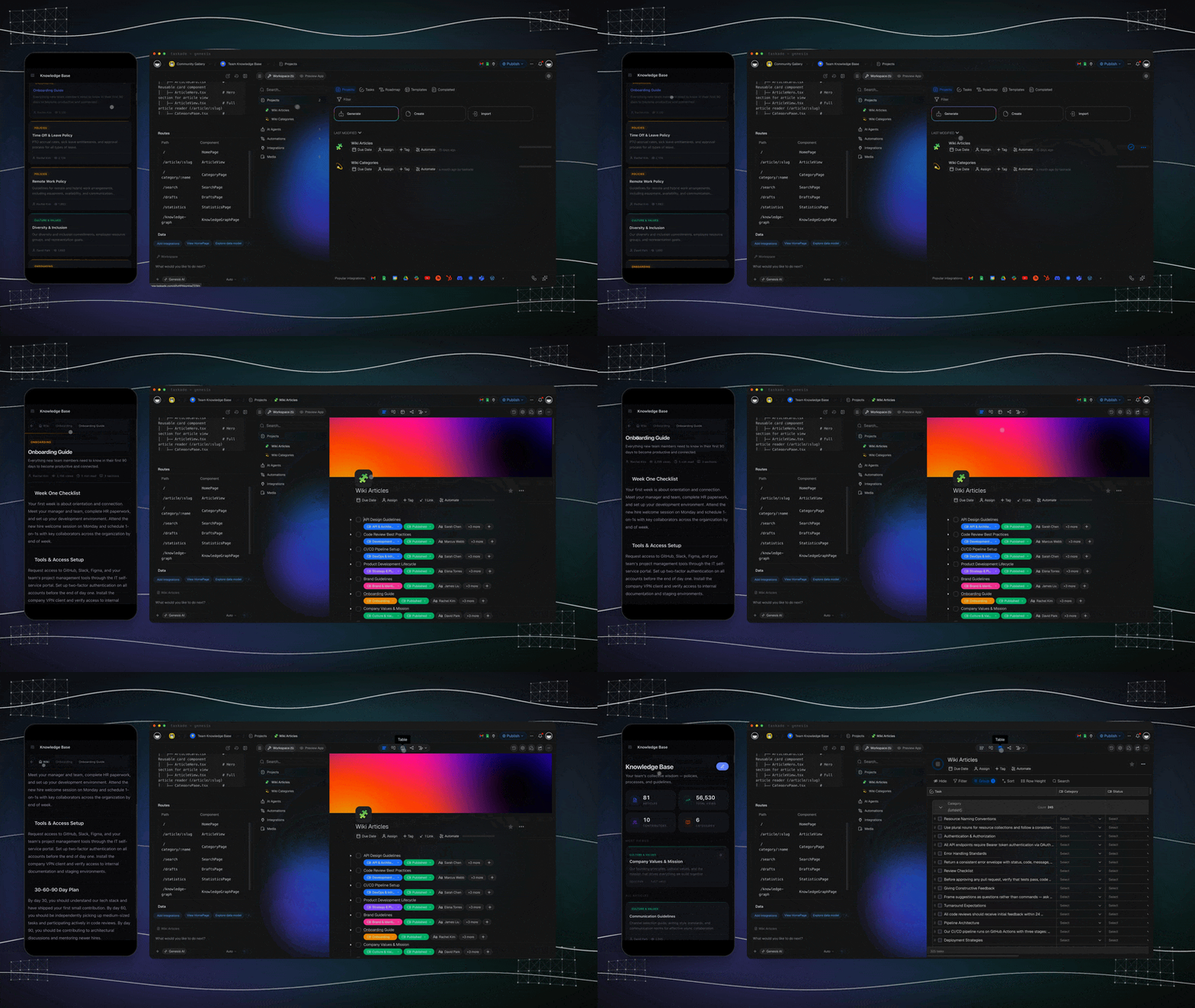
A fair note on the last row. Taskade does not read or write OKF bundles, and it does not store your knowledge as files in a folder you own. It takes the other route to the same goal. Projects are the pages, [AI agents](https://www.taskade.com/agents) use those projects as [knowledge](https://www.taskade.com/learn/agents/knowledge), and [automations](https://www.taskade.com/automate) run the upkeep on a schedule. If a plain folder under version control is what you need, the first three rows are the right choice. For a wider comparison of products, see [the best AI wiki tools](https://www.taskade.com/blog/ai-wiki-tools).
---
## How Do You Build an LLM Wiki in an Afternoon?
You can build a working LLM wiki in an afternoon with a folder, a schema file, and any coding agent. Start with five sources on one topic. Ingest them one at a time and read what the agent writes. The habit of checking each summary matters more than the tool.
### Path 1: A folder and a coding agent
1. **Create the folder.** Make `raw/` and `wiki/`. Add an empty `wiki/index.md` and `wiki/log.md`. Start a git repository.
2. **Write the schema.** Paste Karpathy's gist into your agent and ask it to write an `AGENTS.md` for your topic: page types, naming, link style, and what to do on ingest, query, and lint.
3. **Ingest one source.** Save an article as Markdown in `raw/`. Tell the agent to ingest it. Read the summary page and the diff.
4. **Ask a question that crosses sources.** After three or four ingests, ask something no single source answers. Tell the agent to file the answer as a page.
5. **Run lint.** Ask for contradictions, orphan pages, and missing links. Fix what it finds, then commit.
Give each page a review date in its frontmatter from day one. It costs nothing now, and it is the field a scheduled job needs later.
### Path 2: A workspace, with no terminal
The same loop works without files or a command line. In Taskade the parts map one to one.
| LLM wiki part | In a Taskade workspace |
|---|---|
| Raw sources | Files, links, and documents you add as agent knowledge |
| Wiki pages | Projects, with one topic per project and links between them |
| The schema | The agent's instructions |
| Ingest and query | Chat with the agent, which reads and edits the projects |
| Lint on a schedule | An automation that runs the agent every week |
| Roles and review | Role-based access from Owner to Viewer |
1. **Describe the knowledge base.** Open [Taskade Genesis](https://www.taskade.com/create) and describe it in one prompt: the topic, the page types, and who reviews what.
2. **Add your sources.** Attach documents and links to the agent as knowledge. To bring in Markdown notes as projects, click **Import** in your workspace, then drag the `.md` files into the **Import with AI** tab or paste the text under **Paste Text & Markdown** ([how to import](https://www.taskade.com/learn/import/convert)).
3. **Ask the agent to build the pages.** Have it write one project per concept and link related ones.
4. **Schedule the upkeep.** Add an automation that runs every week, asks the agent to check each page against its review date, and assigns stale pages to their owner.
Automations run on every plan, and agent work uses AI credits, which come with paid plans. Pro is $10 per month, billed annually. You can also start from a working example in the [Taskade App Factory](https://www.taskade.com/apps) and change it. The three parts together are what Taskade calls [Workspace DNA](https://www.taskade.com/learn/genesis/workspace-dna).

Whichever path you choose, the test is the same. Add a sixth source that contradicts one of the first five. A working wiki finds the contradiction and records it on the page. A pile of notes does not.
---
## What Does the LLM Wiki Mean for Vector Databases and RAG?
The LLM wiki moves retrieval from the center of the design to the edge. Vector search remains useful for large collections. What ended in 2026 is the assumption that every AI memory project starts with an embedding pipeline. The new default for small and medium collections is plain text that an agent reads.
Three shifts follow from that.
**Memory became a writing problem.** From 2021 to 2025 the question was how to retrieve the right fragment. In 2026 the question is how to write knowledge down so that a model can use it: what the pages are, how they link, who checks them. That is closer to editing than to search engineering, and it is why [agent memory](https://www.taskade.com/blog/ai-agent-memory) discussions now sound like library science.
**The format became portable.** A folder of Markdown has no vendor. You can read it with any model, move it between tools, and keep it for ten years. OKF adds a shared shape on top. This matters for the same reason [MCP](https://www.taskade.com/blog/mcp-servers) matters: MCP standardizes how an agent reaches a tool, and a knowledge bundle standardizes what the agent reads when it gets there.
**The record became the asset.** Models improve every few months, and instructions written for one model are often deleted for the next. The pages that describe your customers, your products, and your decisions do not expire with the model. In a year when [software teams delete most of their scaffolding](https://www.taskade.com/blog/context-engineering) at each model release, the written record is the part that keeps its value.
| Still true | Changed in 2026 |
|---|---|
| Large collections need search | Small collections do not need a pipeline |
| Embeddings find similar text | An agent with an index often finds the right page first |
| Sources must be kept and cited | Synthesis can be stored, and reused |
| Someone must keep knowledge current | A model can do the upkeep, if something schedules it |
---
## Frequently Asked Questions
### What is an LLM wiki?
An LLM wiki is a folder of linked Markdown files that a language model writes and maintains for you. Andrej Karpathy published the pattern on April 4, 2026. You supply sources and questions. The model reads each source once, updates the pages it affects, and answers later questions from the finished pages.
### Is an LLM wiki better than RAG?
An LLM wiki is better when questions need synthesis across many documents and the collection is small enough to index in plain text, which Karpathy puts at about 100 sources and hundreds of pages. RAG is better for very large or fast-changing collections, per-user permissions, and exact lookups. Many production systems use both.
### Is RAG dead in 2026?
No. Retrieval-augmented generation is still the right tool for millions of documents, live data, and strict access control. What changed in 2026 is the default for small and medium collections: an agent that reads a plain-text index and opens files often beats an embedding pipeline, and retrieval became one tool the agent can choose.
### What is Google's Open Knowledge Format (OKF)?
The Open Knowledge Format is an open specification from Google Cloud, published on June 12, 2026, that turns the LLM wiki pattern into a portable format. A bundle is a folder, each Markdown file is one concept, the file path is the concept ID, and the only required frontmatter field is type. The license is Apache 2.0.
### Is OKF the same as an LLM wiki?
No. OKF standardizes the wiki layer only: the folder, the files, and the frontmatter. Karpathy's pattern also includes the raw sources, a schema file that tells the agent how to work, and three operations (ingest, query, lint). OKF leaves storage, search, and upkeep to whoever uses the bundle.
### Does OKF replace RAG or vector databases?
No. The OKF specification lists storage, serving, and query infrastructure as non-goals, so a large bundle can still be embedded and searched. Google's launch post does not mention RAG or vector databases. OKF defines how knowledge is written down. It does not define how an agent finds the right file.
### Do I need a vector database to build an LLM wiki?
No, not at a moderate size. In Karpathy's pattern the agent reads a plain-text index.md file first and then opens the pages it needs. He writes that this works at about 100 sources and hundreds of pages. Beyond that he suggests adding a local search tool, which can include vector search.
### How big can an LLM wiki get?
Karpathy's own figure is about 100 sources and hundreds of pages with an index file alone. Past that size the index becomes too long to read before every answer, so you add search over the pages. For tens of thousands of documents, a retrieval pipeline or a hybrid design is the practical choice.
### Can a team share one LLM wiki?
Yes, but a shared wiki needs three things a personal one can skip: an owner for each page, a scheduled job that checks pages for stale claims, and rules for who can change what. Without them a shared wiki goes stale, because nobody is responsible for running the upkeep.
### What is the difference between an LLM wiki and NotebookLM?
NotebookLM answers from the sources you upload each time you ask, which is retrieval at question time. An LLM wiki compiles the sources into linked pages once and keeps those pages current, so later answers start from finished synthesis. Karpathy names NotebookLM as an example of the retrieve-every-time approach.
---
## The Folder Was Always the Point
Vannevar Bush described the memex in 1945 and could not say who would keep it in order. Ward Cunningham gave everyone an edit button in 1995, and most company wikis still went stale. The LLM wiki is the same structure with the missing worker added.
The format is the easy part. A folder, a file per idea, links, an index, and a log. Google wrote that down in a short specification, and it will not be the last one. The hard parts are the ones no format carries: what your types mean, who checks a page, and what makes the upkeep run on Monday morning when nobody remembers to ask.
That is the loop Taskade is built around. Projects hold what the team knows. Agents read and write it. Automations keep it moving. Memory, Intelligence, Execution. ▲ ■ ●
[Build a knowledge base that agents maintain →](https://www.taskade.com/create)
## Further Reading
**Retrieval and memory**
- [The History of RAG](https://www.taskade.com/blog/rag-retrieval-history)
- [Vector Databases Explained](https://www.taskade.com/blog/vector-databases)
- [LLM vs RAG vs AI Agent vs Agentic AI](https://www.taskade.com/blog/llm-rag-agent-agentic)
- [The History of Agent Memory](https://www.taskade.com/blog/agent-memory-history)
**Structure and meaning**
- [Open Knowledge Format (OKF) Explained](https://www.taskade.com/blog/open-knowledge-format-explained)
- [Why AI Agents Need an Ontology](https://www.taskade.com/blog/agent-ontology-explained)
- [Knowledge Graphs for AI Agents](https://www.taskade.com/blog/knowledge-graph-agents)
- [Context Engineering Field Guide](https://www.taskade.com/blog/context-engineering)
- [What Are AI Agents?](https://www.taskade.com/blog/what-are-ai-agents)
**Build with it**
- [AI App Builder](https://www.taskade.com/ai/apps): one prompt, one working app
- [AI Agents](https://www.taskade.com/agents): agents that read your workspace
- [Automations](https://www.taskade.com/automate): scheduled work across 100+ integrations
- [The Best AI Wiki Tools](https://www.taskade.com/blog/ai-wiki-tools)
## Sources
1. Andrej Karpathy, [LLM Wiki](https://gist.github.com/karpathy/442a6bf555914893e9891c11519de94f), GitHub gist, April 4, 2026. All Karpathy quotes in this article come from this file.
2. Sam McVeety and Amir Hormati, [Introducing the Open Knowledge Format](https://cloud.google.com/blog/products/data-analytics/how-the-open-knowledge-format-can-improve-data-sharing), Google Cloud blog, June 12, 2026.
3. Google Cloud, [Open Knowledge Format specification](https://github.com/GoogleCloudPlatform/open-knowledge-format), version 0.2, and the [v0.2 announcement](https://cloud.google.com/blog/products/data-analytics/okf-v0-2-adds-trust-signals), July 24, 2026.
4. Vannevar Bush, [As We May Think](https://www.theatlantic.com/magazine/archive/1945/07/as-we-may-think/303881/), The Atlantic, July 1945.
5. Patrick Lewis et al., [Retrieval-Augmented Generation for Knowledge-Intensive NLP Tasks](https://arxiv.org/abs/2005.11401), May 2020.
6. Anthropic, [Introducing Contextual Retrieval](https://www.anthropic.com/news/contextual-retrieval), September 19, 2024.
7. Letta, [Benchmarking AI Agent Memory: Is a Filesystem All You Need?](https://www.letta.com/blog/benchmarking-ai-agent-memory/), August 12, 2025.
8. Boris Cherny, [post on X](https://x.com/bcherny/status/2017824286489383315) about agentic search in Claude Code, February 2026.
9. Boris Cherny, [conference talk](https://www.youtube.com/watch?v=qyPCVqFUyDo), 2026, and Thariq Shihipar, [South Park Commons talk](https://www.youtube.com/watch?v=O-1VXHRlH54), 2026.
10. Frank Coyle, [Why Agentic Systems Need Ontologies](https://www.youtube.com/watch?v=Sir59K8ZDPU), 2026.
11. a16z, [conversation with the Lassie founders](https://www.youtube.com/watch?v=Fpg_8aiBxx4), 2026.
12. Michael Tuszynski, [Karpathy's LLM Wiki Works. Here's What Broke When I Ran It at Real Scale](https://www.mpt.solutions/karpathys-llm-wiki-works-heres-what-broke-when-i-ran-it-at-real-scale/), August 13, 2026.
13. Hacker News, [LLM Wiki discussion](https://news.ycombinator.com/item?id=47640875). Star and point counts were read on November 12, 2026.