# Introducing Taskade TSK-1: The System Kernel Behind Every App (2026)
> Every app you build in Taskade now runs on TSK-1, the Taskade System Kernel. Here is what the kernel is, and why it is not just another AI model.
- Source: https://www.taskade.com/blog/introducing-tsk-1
- Published: 2026-07-08
- Updated: 2026-09-24
- Author: John Xie
Everything in Taskade just got faster and smarter. Every [Taskade Genesis](https://www.taskade.com/ai/apps) app now runs on **TSK-1**—the intelligence that connects models, memory, agents, and workflows into one living system. [Build your next app](https://www.taskade.com/create) or [clone a live one](https://www.taskade.com/apps) in a click. To see how each AI model performs on real app builds, read the [TSK-1 Benchmark](https://www.taskade.com/tsk).
> **TL;DR:** TSK-1 is the **Taskade System Kernel**. It routes work across [frontier models](https://www.taskade.com/learn/genesis/ai-models) and connects memory, agents, and workflows so Taskade Genesis apps keep running after the chat ends. It is not another model; it is the system that coordinates them. [Build one free](https://www.taskade.com/create).
## What Is Taskade TSK-1?
Taskade TSK-1 is the **Taskade System Kernel**: the intelligence layer that coordinates models, memory, agents, and workflows into a single running workspace. Every app built with [Taskade Genesis](https://www.taskade.com/ai/apps) now runs on it. You describe the work, and TSK-1 turns it into an app that **remembers** your context, **reasons** over it with agents, and **runs** on its own after you leave.
That is the whole shift in one word: *runs*. The rest of this post unpacks the name, because the name is the argument.
[Watch the video on YouTube: TSK-1 Is Live: One Prompt. A Working System.](https://www.youtube.com/watch?t=0s&v=R3DM0kn-Pcs)
**Inside the video: TSK-1 Is Live: One Prompt. A Working System.**
TSK-1, the Taskade System Kernel, is the intelligence inside every Taskade workspace, and this video shows it turn one prompt into a working system. You describe the outcome, Taskade EVE asks two questions, and TSK-1 plans, builds, checks, and runs the result. The video's own line for the loop: "It keeps running after you close the tab." It ends on working systems you can clone, such as a client portal, an invoice generator, and a CRM dashboard.
**Video:** TSK-1 Is Live: One Prompt. A Working System. · 1:21 · published 2026-09-08 · [Watch on YouTube](https://www.youtube.com/watch?t=0s&v=R3DM0kn-Pcs)
**Key steps**
1. Describe the outcome you want, not the steps to get there.
2. Answer the two questions that Taskade EVE asks before it builds.
3. Leave the model on **Auto**. TSK-1 picks the depth for each step, fast for quick edits and deeper for workflows and systems.
4. Open the projects, agents, media, and automations it built. Projects remember, agents reason, and automations run.
5. Click **Publish** to get a live link, or clone a working system from the [Community Gallery](https://www.taskade.com/apps).
**Try it:** [TSK-1: The Taskade System Kernel](https://www.taskade.com/learn/genesis/tsk-1) · [Start a build](https://www.taskade.com/create) · [Build an App walkthrough](https://www.taskade.com/learn/videos/build-app)
## What Does "TSK-1" Stand For?
TSK-1 stands for **Taskade System Kernel**, version one.
A computer's core is called a **kernel** because it is the fundamental, innermost part of the system. Just like the kernel of a nut or a seed, it lies hidden at the center, controlling every major function and talking directly to the machine underneath. You never see the kernel. You feel it, because it is what makes everything else work together.
Taskade has three layers, and they map onto how a computer is actually built:
| Taskade layer | Computer analogy | What it is |
|---|---|---|
| **Taskade EVE** | The **shell** | The chat you talk to. You describe what you want in plain language. |
| **TSK-1** | The **kernel** (core) | The intelligence layer that coordinates models, memory, agents, and workflows. |
| **Workspace DNA** | The **filesystem and compute** | Your [projects](https://www.taskade.com/blog/anatomy-of-genesis-app) (memory), [agents](https://www.taskade.com/agents) (intelligence), and [workflows](https://www.taskade.com/automate) (execution). |
You talk to the shell. The kernel does the coordinating. Your Workspace DNA is where the work actually lives and runs.
```mermaid
graph TD
U["You"] --> E["Taskade EVE
Describe what you want"]
E --> K["TSK-1
Coordinates the system"]
K --> P["Projects
Memory"]
K --> A["Agents
Intelligence"]
K --> W["Workflows
Execution"]
P --> L["Living app
Remembers, reasons, runs"]
A --> L
W --> L
```
Naming the kernel is not a branding exercise. It is the difference between "the AI did something" and "here is the layer that makes the whole system hold together." When you can name the core, you can trust it.
## Why a Kernel, Not Another AI Model
Here is the part people get backwards. **TSK-1 is not a model. It is the kernel that runs the models.**
Ask a chatbot a question and a single model answers. That is the top of a very tall stack. TSK-1 sits above the models and coordinates them: it routes each task to a sensible default across **frontier models from top AI labs**, holds your context in memory, hands work to the right agent, and fires the automation that keeps things moving. The model writes a sentence. The kernel runs a system. For the layer underneath, see [how large language models work](https://www.taskade.com/blog/how-do-llms-work) and [types of memory in AI agents](https://www.taskade.com/blog/ai-agent-memory).
This matters right now because agents are arriving faster than they are holding together. Gartner projects that **40% of enterprise applications will include task-specific AI agents by the end of 2026, up from under 5% in 2025**. McKinsey's 2026 State of AI found only about **23% of organizations are scaling an agentic system** in even one function. The gap between "we added an agent" and "it runs reliably in production" is exactly the gap a kernel closes. A pile of models and agents is not a system until something coordinates them. That coordinator is what we named. For the full landscape of who is building what, and where the tools still stop short, see the [state of AI app building in 2026](https://www.taskade.com/blog/state-of-ai-app-building).
It is worth being precise about the claim. Other tools have named a *model* (Cursor's Composer) or a *named agent* (Replit Agent, Notion Agent). TSK-1 is neither. It is the named **kernel of an agentic workspace**, the layer that unifies models, memory, agents, and workflows into one running product. It is not a developer framework you wire up and it is not a single code model. It is the intelligence already running inside your workspace. That is the [execution layer](https://www.taskade.com/blog/execution-layer-thesis) we have argued for since the beginning, now with a name.
## One Default. On Autopilot.
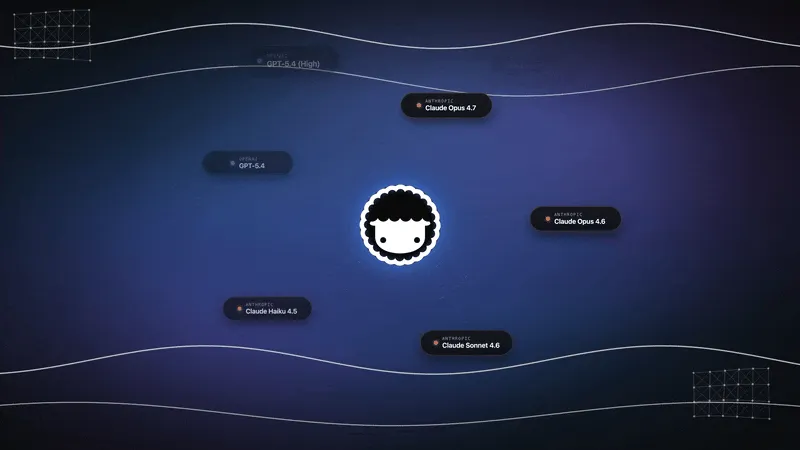
You do not have to pick a model. TSK-1 runs on **Auto** by default and adapts on its own.
Fast edits get an instant response. A hard question gets deeper reasoning. A long-running build gets the most capable path. The kernel reads the task and chooses the depth, so the setting disappears and you stay on the outcome. Power users can still pin a specific model when they want to, but most people never open the menu, because the right default is already selected.
[](https://www.taskade.com/create)
This is the quiet luxury of a kernel. The [thinking modes](https://www.taskade.com/blog/agentic-design-patterns) are there when you want to see them, and invisible when you do not. One default, on autopilot, is really fifteen-plus models coordinated so well you only need to remember one name.
## Your Workspace. Alive.
Most AI tools stop the moment the app is generated. The prompt produces a thing, and then the thing sits there — the root cause of [why AI-generated apps break](https://www.taskade.com/blog/why-ai-generated-apps-break). Taskade keeps going, because TSK-1 wires your workspace into a loop that does not stop when the chat does.
```mermaid
graph TD
P["Prompt"] --> G["Generated app"]
G --> S["Static output
Most AI tools stop here"]
G --> T["Taskade Genesis
A living system"]
T --> M["Memory"]
M --> I["Agents"]
I --> E["Workflows"]
E --> M
E --> R["Keeps running"]
```
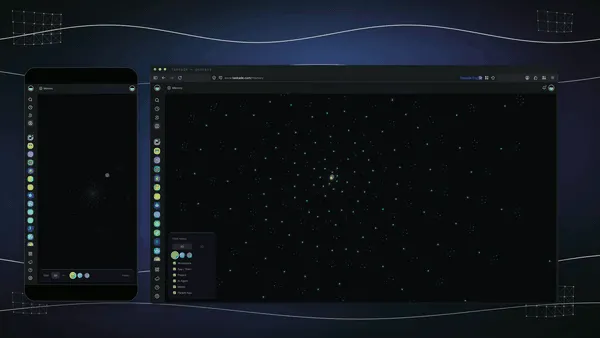
That loop is **Workspace DNA**, and it is the through-line of everything we build:
[](https://www.taskade.com/create)
- **▲ Projects remember.** Your data and context stay connected, so the system knows its own state. Projects are the [memory](https://www.taskade.com/blog/ai-agent-memory).
- **■ Agents reason.** [Multi-agent teams](https://www.taskade.com/blog/agentic-engineering-without-code) understand your goals and take action, not just autocomplete.
- **● Workflows run.** [Automations](https://www.taskade.com/blog/agentic-workflows-explained) keep moving across [100+ integrations](https://www.taskade.com/integrations) after the chat ends.
- **▷ Apps launch.** One prompt. One live app you can share and clone.
The loop, stated plainly: **memory feeds intelligence, intelligence triggers execution, execution updates memory.** That is what people mean when they talk about the [living app movement](https://www.taskade.com/blog/living-app-movement) and how [SaaS quietly evolved into living software](https://www.taskade.com/blog/saas-evolved-living-software). It is also the line that separates [AI app builders with memory](https://www.taskade.com/blog/best-ai-app-builders) from generators that forget you between prompts. TSK-1 is the kernel that makes the loop real. For the full teardown, read [the anatomy of a Taskade Genesis app](https://www.taskade.com/blog/anatomy-of-genesis-app) and the [Workspace DNA architecture](https://www.taskade.com/blog/workspace-dna-architecture).
## Clone Apps. Ship Today.
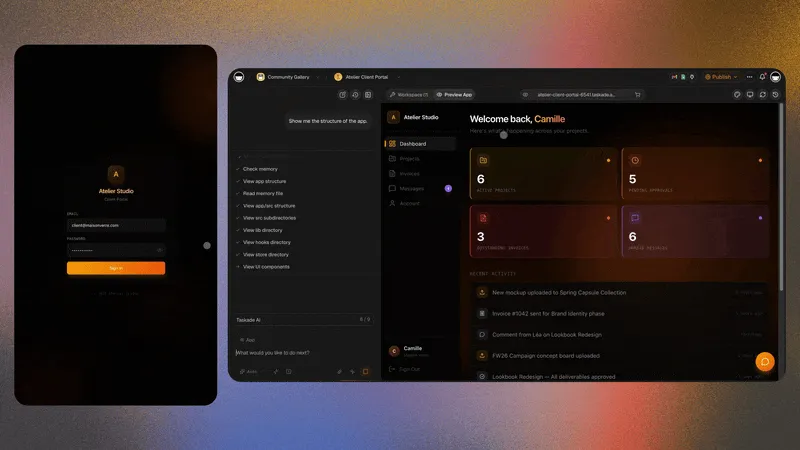
The fastest way to understand a kernel is to run something on it. Every app below is a live, working app someone built by describing it, and you can clone it in one click. They all run on TSK-1.
[](https://www.taskade.com/apps)
| App kit | What it does | Clone it |
|---|---|---|
| **Client Portal** | Clients sign in and see their progress. | [Browse live apps](https://www.taskade.com/apps) |
| **Invoice Generator** | Bill it. Track who paid. | [Browse live apps](https://www.taskade.com/apps) |
| **Store Manager** | Stock, orders, and follow-ups in one place. | [Browse live apps](https://www.taskade.com/apps) |
| **Client CRM** | A simple pipeline for leads and clients. | [Browse live apps](https://www.taskade.com/apps) |
| **Task Dashboard** | See who owns what at a glance. | [Browse live apps](https://www.taskade.com/apps) |
| **Streak Tracker** | Habits that stick, streaks that grow. | [Browse live apps](https://www.taskade.com/apps) |
Each of these is the [same pattern](https://www.taskade.com/blog/free-ai-app-builders): a non-technical operator running a whole business on one app they built by describing it. [Browse live app kits](https://www.taskade.com/apps), clone one, point it at your data, and it runs your business the same day. Prefer to start from scratch? [Build your own with AI](https://www.taskade.com/create).
## The Dots, Connected
TSK-1 did not appear out of nowhere. It is the name for a direction the whole industry has been walking toward for decades, and the one Taskade has been building deliberately.
The pattern rhymes with the [history of computing](https://www.taskade.com/blog/history-of-computing). We went from renting a slice of a server ([the web-hosting era](https://www.taskade.com/blog/hosting-to-ai-infrastructure)) to [virtual machines](https://www.taskade.com/blog/virtualization-history) to [the cloud](https://www.taskade.com/blog/hosting-to-ai-infrastructure), each layer hiding the one below it so more people could build. Software followed the same arc: from code you compiled and shipped, to [SaaS you rented](https://www.taskade.com/blog/saas-evolved-living-software), to a [living software era](https://www.taskade.com/blog/living-software-era) where the app runs itself. Each step abstracts away the machinery so the person on top can focus on the outcome. A kernel is that abstraction made concrete. It is why we can say [your workspace is a computer](https://www.taskade.com/blog/your-workspace-is-a-computer), because now it has the three things a computer has: a shell, a kernel, and a filesystem.
The AI side of the story is the same shape. We went from single models to [autonomous task management](https://www.taskade.com/blog/autonomous-task-management), from one chatbot to [agentic AI](https://www.taskade.com/blog/agentic-ai) and [multi-agent systems](https://www.taskade.com/blog/agentic-engineering-without-code), from stateless prompts to [memory](https://www.taskade.com/blog/ai-agent-memory) and [intelligence that compounds](https://www.taskade.com/blog/what-is-intelligence). We made the case back in 2024 that [agentic workflows are paving the path toward AGI](https://www.taskade.com/blog/agentic-workflows-towards-agi), and every layer since has moved in that direction. [Taskade EVE](https://www.taskade.com/blog/eve-meta-agent) became the shell that turns a description into a build. [Model Context Protocol](https://www.taskade.com/blog/taskade-mcp-server) let the rest of your AI tools reach the workspace. What was missing was a name for the layer holding it together. That is TSK-1. It is the [origin of Taskade Genesis](https://www.taskade.com/blog/genesis-origin) reaching its natural conclusion: not a better [app builder](https://www.taskade.com/blog/free-ai-app-builders), but the kernel of the [agentic workspace](https://www.taskade.com/blog/agentic-workspaces).
The proof is in what people already run on it. [One solo consultant](https://www.taskade.com/apps) has built more than 300 apps on Taskade — an entire revenue engine and a content system, run by one person. And our first Enterprise customer, an IT program manager with no engineering team, put it best after shipping a production field-service dashboard: *what would have taken a 40-person team eighteen months in the Fortune 500 world shipped in a few weeks* — by describing it. That is not a demo. That is a kernel doing its job.
## What This Means for You
You do not need to understand kernels to use one. You never think about the kernel in your laptop, and you will never think about TSK-1. You will just notice that the app you described **remembers** your customers, **reasons** about what to do next, and **keeps running** while you are asleep.
That is the promise of living software, and it is now the default. Every plan runs on TSK-1, including [free](https://www.taskade.com/pricing). You describe the work. The kernel makes it run.
- **[Build your next app](https://www.taskade.com/create)** by describing it in plain language.
- **[Clone a live one](https://www.taskade.com/apps)** and point it at your own data.
- **[See how the loop works](https://www.taskade.com/blog/anatomy-of-genesis-app)** under the hood.
- **[See how every model actually performs](https://www.taskade.com/tsk)** on the TSK-1 Benchmark: dated result summaries and per-model evidence.
Remember. Reason. Run. One prompt. One living workspace, now with a kernel that has a name.
## Frequently Asked Questions
### What is Taskade TSK-1?
TSK-1 is the Taskade System Kernel, the intelligence layer that coordinates AI models, memory, agents, and workflows into one running workspace. Every app built with [Taskade Genesis](https://www.taskade.com/ai/apps) runs on it, so a single prompt becomes an app that remembers context, reasons with [agents](https://www.taskade.com/agents), and keeps running after the chat ends.
### What does TSK-1 stand for?
It stands for **Taskade System Kernel**, version one. A kernel is the innermost core of a computer, the part that coordinates everything else and talks to the machine underneath. TSK-1 plays that role for your workspace, sitting at the center and connecting models, projects, agents, and automations so the whole thing runs as one system.
### Is TSK-1 its own AI model?
No. TSK-1 is a kernel, not a model. It coordinates [frontier models](https://www.taskade.com/learn/genesis/ai-models) from top AI labs and routes each task to a sensible default automatically. The kernel is the layer above the models that turns them into a running system with [memory](https://www.taskade.com/blog/ai-agent-memory) and [agents](https://www.taskade.com/blog/agentic-engineering-without-code).
### Do I need to choose an AI model?
No. TSK-1 runs on Auto and adapts on its own, from instant edits to deep reasoning, depending on the task. Power users can pin a specific model, but most people never touch the setting. The kernel makes the choice so you can stay on the outcome.
### How is this different from an AI app builder?
[AI app builders](https://www.taskade.com/blog/free-ai-app-builders) generate an app and then it sits there, a static artifact you host and maintain. Taskade builds an app that keeps running: projects become the memory, [agents](https://www.taskade.com/agents) reason over living context, and [automations](https://www.taskade.com/automate) execute after you leave. The workspace is the app and its runtime, so there is no export step and no separate hosting. That is the [living software](https://www.taskade.com/blog/saas-evolved-living-software) difference.
### Do I need to know how to code?
No. You describe the work in plain language, your customers, your jobs, your invoices, and Taskade Genesis turns it into a working app on TSK-1. Non-technical operators across trades, real estate, clinics, and sales already run production apps this way, with no developer and no setup wizard.
### How much does Taskade cost?
Taskade has a free plan, with paid tiers at $10/month (Pro, the popular choice for 10 users) and $25/month (Business) on annual billing. TSK-1 powers every plan, including free. Custom domains unlock on Pro and above, and client logins via [App Users](https://www.taskade.com/learn/account) work on every plan. See [pricing](https://www.taskade.com/pricing) for the full breakdown.
### What can I build with TSK-1?
Anything you can describe: a CRM, a [client portal](https://www.taskade.com/apps), an invoice generator, an operations dashboard, a storefront, a habit tracker. Each runs on the same Workspace DNA loop, connected projects for memory, [AI agents](https://www.taskade.com/agents) for intelligence, and [automations](https://www.taskade.com/automate) for execution. [Browse live app kits](https://www.taskade.com/apps) and clone one in a click, or [build your own](https://www.taskade.com/create).