# Meta Muse History: From Llama to the Muse Agent (2026)
> The full history of Meta Muse: FAIR, Llama, the Llama 4 stumble, the $14.3B Scale AI deal, Meta Superintelligence Labs, Muse Spark, and the Muse agent.
- Source: https://www.taskade.com/blog/history-of-meta-muse
- Published: 2026-11-09
- Author: Taskade Team
**Meta Muse** is Meta's personal AI agent. It launched in the US on **September 8, 2026**, and it runs every user's errands inside a private cloud computer that Meta calls the **Muse Secure VM**. A second agent, the **Sentinel**, checks everything that tries to leave that machine. The name "Muse" also covers the model family behind it, from **Muse Spark** (April 8, 2026) to **Muse Wonder** (October 12, 2026).
None of that came from nowhere. Muse is the end point of a twelve-year chain: Facebook's research lab in 2013, the open Llama models from 2023, the Llama 4 stumble in April 2025, a **$14.3 billion** bet on Scale AI and its 28-year-old founder, a new lab called **Meta Superintelligence Labs (MSL)**, and a January 2026 experiment in which Meta's product chief, Nat Friedman, started to use an open-source agent called OpenClaw.
This guide joins every link of that chain into one dated, sourced story. It draws on Meta's own posts and filings, the Q3 2026 earnings call, and three long interviews with Alexandr Wang, Meta's Chief AI Officer: a Y Combinator talk (July 29, 2026), Cleo Abram's *Huge Conversations* (October 7, 2026) and the David Senra show (October 11, 2026). Where sources disagree, we show both numbers. Where a claim rests on one speaker, we say so.
> **TL;DR:** Meta Muse is Meta's personal AI agent, launched in the US on September 8, 2026 after a 15-month rebuild that began with a $14.3B Scale AI deal in the wake of the Llama 4 stumble. Each user gets a private Secure VM plus a Sentinel checker agent. Meta says more than 10 million people set it up in about six weeks. [Build a workspace agent you can audit →](https://www.taskade.com/create)
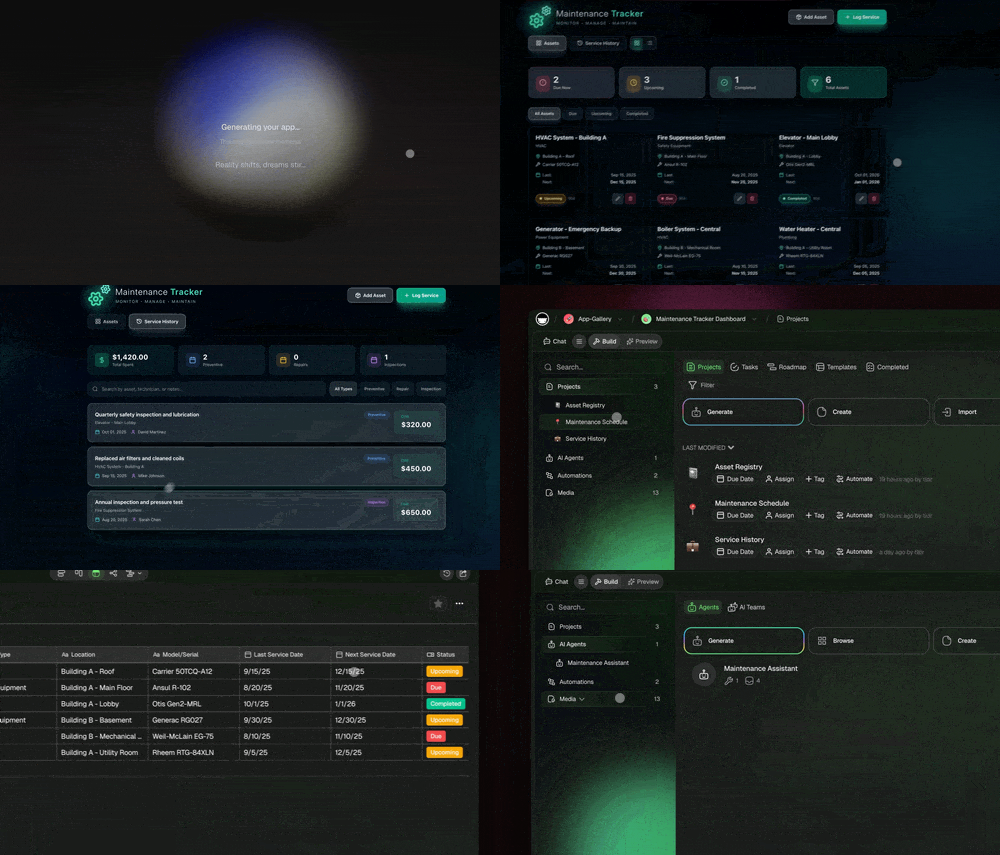
*Muse puts the agent in a private machine for one person. Taskade puts agents, projects and automations in one shared workspace. We compare the two designs [near the end of this guide](#where-does-taskade-genesis-fit-next-to-meta-muse).*
### Meta Muse at a Glance (Checked November 7, 2026)
| Field | Fact | Source |
|---|---|---|
| **What it is** | A personal AI agent that "proactively helps with people's goals" and does tasks for them | Meta newsroom, 2026-09-08 |
| **Maker** | Meta Platforms, built by Meta Superintelligence Labs (MSL) | Meta newsroom |
| **Launch** | September 8, 2026, in the US | Meta newsroom |
| **Where you use it** | Muse app on iOS and Android, the web at muse.ai, Mac, and chat in WhatsApp | Meta newsroom, TechCrunch 2026-09-18 |
| **Markets** | US (Sep 8), Canada (Sep 18), Japan (Oct 23), Singapore (Oct 27) | Meta, trade press |
| **Model** | Muse Spark, "Meta's most capable model to date" at launch. Wang says the launch build was a specially trained Muse Spark 1.3 | Meta newsroom, Senra interview |
| **Where it runs** | Muse Secure VM: "a dedicated secure computer with its own browser" per user | Meta newsroom |
| **Safety layer** | A separate Sentinel agent. "Nothing Muse does reaches the internet unless the Sentinel approves it" | Meta newsroom |
| **Payments** | Link by Stripe one-time-use cards. Meta calls Muse "the first AI agent covered by Link's purchase protections" | Meta newsroom |
| **Price model** | "Free for most of what people need," plus paid plans reported at $20 and $100 a month | Meta newsroom, CNBC and Axios 2026-09-08 |
| **Users** | "More than 10 million people in the US and Canada have set up Muse" in about six weeks | Zuckerberg, Q3 call, 2026-10-21 |
| **Daily use** | "About 25%" of people who set it up use it on any given day | Zuckerberg, Q3 call |
| **Leaders** | Mark Zuckerberg (CEO), Alexandr Wang (Chief AI Officer), Nat Friedman (products and applied research) | CNBC memo, 2025-06-30 |
| **Newest feature** | Spaces, custom trackers and planners that Muse builds from a description (2026-11-06) | Meta newsroom |
| **Coming next** | Muse Confidential VM, Muse on Meta glasses, the Muse Charm device | Meta newsroom, Q3 call |
---
## What Is Meta Muse?
**Meta Muse is a consumer AI agent that does tasks on a person's behalf, such as comparing prices, filling forms, booking travel and checking out with a one-time card.** Meta launched it on September 8, 2026 as "The World's First Personal AI Agent Built for Everyone." It is free for most use, and it runs inside a private, per-user cloud machine.
The word "Muse" confuses people, because Meta uses it for four different things. Here is the short map:
| Name | What it is | First shipped |
|---|---|---|
| **Muse** (the agent) | The personal agent app, on iOS, Android, muse.ai, Mac and WhatsApp | 2026-09-08 |
| **Muse Spark** | Meta's first closed frontier model family (1.0 to 1.3) | 2026-04-08 |
| **Muse Wonder** | The larger model family that Meta calls "our first frontier model" | 2026-10-12 |
| **Muse Code** | A terminal coding agent for developers | 2026-08-05 |
| **Muse Image** | Meta's own image model | 2026-07-07 |
| **Muse Glimmer** | A 30B open-weights model that runs on one consumer GPU | 2026-08-10 |
| **Muse Spark Open** | An open-weights mixture-of-experts model, 816B total and 42B active parameters | 2026-10-15 |
| **Muse Charm** | A small keychain device shown at Connect | Shown 2026-09-23, due December |
| **Meta AI** | The older assistant brand inside Facebook, Instagram, WhatsApp and the Meta AI app | 2023-09-27 |
The agent is the product most people mean when they search for "Meta Muse." The rest of this guide calls it **the Muse agent** when the difference matters, and **Muse Spark** or **Muse Wonder** when we mean a model.
What makes the Muse agent different from a chatbot is that it keeps working after you close the app. You give it a goal ("lower my internet bill", "find a pickup for the ID I left on the plane"), and it plans, browses, messages, waits and comes back when it needs a decision. That is the same shift that the [history of AI agents](https://www.taskade.com/blog/ai-agents-history) traces from 1970s research to the agent loop, and the same category that [what AI agents are](https://www.taskade.com/blog/what-are-ai-agents) explains for beginners.
```mermaid
graph TD
U["You give Muse a goal"] --> P["Muse plans the steps"]
P --> VM["Works inside your Secure VM
browser, connected apps, memory"]
VM --> S{"Anything leaving the VM?"}
S -->|"No"| KEEP["Keeps working inside the VM"]
S -->|"Yes"| SEN["Sentinel agent checks it"]
SEN --> ASK{"Sensitive or a new destination?"}
ASK -->|"Yes"| H["Muse asks you first"]
ASK -->|"No"| OUT["Action goes out"]
H --> OUT
OUT --> R["Muse reports back with an audit trail"]
style U fill:#1e1e2e,color:#94a3b8,stroke:#475569
style KEEP fill:#1e1e2e,color:#94a3b8,stroke:#475569
style VM fill:#0d1b2a,color:#7dd3fc,stroke:#38bdf8,stroke-width:1.5px
style SEN fill:#2a1225,color:#ff8fa3,stroke:#ff2d60,stroke-width:2px
style H fill:#1a140a,color:#ffb74d,stroke:#e65100,stroke-width:1.5px
style R fill:#0d1a0e,color:#86efac,stroke:#22c55e,stroke-width:1.5px
```
---
## When Did Meta Muse Come Out? The Full Timeline (2013 to 2026)
**The Muse agent came out on September 8, 2026, in the US.** The first Muse model, Muse Spark, came out five months earlier, on April 8, 2026. The research line behind both starts on December 9, 2013, when Facebook founded its AI research lab, FAIR. The newest Muse feature, Spaces, shipped on November 6, 2026.
Most timelines online stop at model names or start at the launch. The table below joins the whole chain, with one source per row. Rows marked "per Wang" rest on his interviews alone.
### Meta Muse Master Timeline
| Date | Event | Source |
|---|---|---|
| 2013-12-09 | Facebook founds FAIR (Facebook AI Research). Yann LeCun leads it | TechCrunch 2013 |
| 2015 | Facebook M, an assistant in Messenger that books restaurants and tickets, reaches about 10,000 testers. Humans work behind it | Gary Marcus, 2026-09-22 |
| 2016 | Alexandr Wang (19) and Lucy Guo found Scale at Y Combinator | Wikipedia, WaPo |
| 2016-17 | FAIR releases PyTorch (public release January 2017) | Wikipedia |
| 2018-01 | Facebook cancels M | Gary Marcus |
| 2019-08-05 | Scale raises $100M led by Founders Fund and passes a $1B valuation | Bloomberg |
| 2021-10 | Facebook becomes Meta. FAIR becomes Fundamental AI Research | CNN |
| 2022-11-15 | Galactica goes up and is pulled about three days later | MIT Tech Review |
| 2023-02-24 | LLaMA (Llama 1) ships to researchers. The weights leak within a week | Meta AI blog, CNBC |
| 2023-07-18 | Llama 2 ships with a commercial license, with Microsoft | Meta newsroom |
| 2023-09-27 | The Meta AI assistant launches at Connect 2023 | Meta newsroom |
| 2024-04-18 | Llama 3 ships | Meta AI blog |
| 2024-05-21 | Scale raises a $1B Series F at $13.8B. Meta joins as an investor | Scale blog |
| 2024-07-23 | Llama 3.1, with a 405B model, ships | Meta AI blog |
| 2025-04-05 | Llama 4 Scout and Maverick ship. Behemoth stays in training | Meta AI blog |
| 2025-04-08 | LMArena controversy: an "experimental" Maverick ranked #2, the public build far lower | The Verge |
| 2025-04-29 | The standalone Meta AI app launches at LlamaCon | Meta newsroom |
| 2025-05-28 | Meta AI reaches 1B monthly users across Meta's apps | CNBC |
| 2025-06-12 | Meta puts $14.3B into Scale AI for a 49% non-voting stake. Wang joins Meta | CNBC, Scale press release |
| 2025-06-30 | Zuckerberg's memo creates Meta Superintelligence Labs. Wang is Chief AI Officer, Nat Friedman leads products | CNBC |
| 2025-07-25 | Shengjia Zhao becomes MSL Chief Scientist | Zuckerberg on Threads |
| 2025-07-30 | Zuckerberg publishes the "Personal Superintelligence" letter | Meta newsroom |
| 2025-08-19 | MSL splits into four groups: TBD Lab, FAIR, Products and Applied Research, MSL Infra | Bloomberg |
| 2025-10-22 | Meta cuts about 600 MSL jobs. TBD Lab is spared | Axios |
| 2025-11 | Yann LeCun says he will leave Meta to found a new lab | BBC, AP |
| 2026-01 | Nat Friedman starts to use OpenClaw | Friedman on X |
| 2026-02 | Wang and Friedman write memos to Meta's board. A prototype follows in one to two weeks (per Wang) | Senra interview |
| 2026-02-15 | OpenClaw creator Peter Steinberger joins OpenAI | TechCrunch |
| 2026-03-10 | Meta buys Moltbook, the agent social network | TechCrunch |
| 2026-04-08 | **Muse Spark** (codename Avocado) ships: Meta's first closed frontier model | CNBC, TechCrunch |
| 2026-07-07 | Muse Image (codename Mango) ships | Meta newsroom |
| 2026-07-09 | Muse Spark 1.1 and the Meta Model API (public preview) | Meta research blog |
| 2026-07-29 | Wang's Y Combinator talk goes up | YouTube |
| 2026-08-05 | Muse Code (beta) with Muse Spark 1.2 | Meta research blog |
| 2026-08-10 | Muse Glimmer: 30B open weights, Apache 2.0 | MarkTechPost, Phoronix |
| 2026-08-10 | Zuckerberg publishes "The Future Is for Everyone," a 6,500-word essay that expands Personal Superintelligence | Meta newsroom, 404 Media |
| 2026-09-02 | Muse Spark 1.3 | Meta research blog |
| **2026-09-08** | **The Muse agent launches in the US** | Meta newsroom |
| 2026-09-16 | The beta for outbound calls to US businesses expands | TechCrunch, 2026-09-17 |
| 2026-09-17 | Muse for Mac | 9to5Mac, TechCrunch |
| 2026-09-18 | #1 free app on the US App Store. Canada opens | TechCrunch, iPhone in Canada |
| 2026-09-20 | Amazon blocks Muse from shopping on Amazon.com | GeekWire, SiliconANGLE |
| 2026-09-23 | Meta Connect 2026: Muse Charm, Muse email, glasses integration | CNBC |
| 2026-09-29 | Muse for Small Business | Meta newsroom |
| 2026-10-12 | Muse Wonder and Muse Wonder Full | Meta newsroom |
| 2026-10-15 | Muse Spark Open, 816B total and 42B active parameters | Hugging Face |
| 2026-10-20 | Meta pauses Muse chat sharing after a DNS exposure report | Ars Technica |
| 2026-10-21 | Q3 call: more than 10M set-ups, about 25% daily use | Meta Q3 2026 call |
| 2026-10-23 | Japan opens, the first market outside North America | PhocusWire |
| 2026-10-27 | Singapore opens | Meta newsroom |
| 2026-11-05 | Muse Voice and expressive avatars | Meta newsroom |
| 2026-11-06 | Spaces in Muse | Meta newsroom |
```mermaid
graph TD
subgraph Y1["2013 to 2022: research years"]
A1["Dec 2013
FAIR founded"] --> A2["2015 to Jan 2018
Facebook M"]
A2 --> A3["2017
PyTorch"]
end
subgraph Y2["2023 to 2025: open models"]
B1["Feb 2023
LLaMA"] --> B2["Jul 2023
Llama 2"]
B2 --> B3["Apr 2024
Llama 3"]
B3 --> B4["Apr 2025
Llama 4 stumble"]
end
subgraph Y3["Jun 2025 to Mar 2026: refounding"]
C1["Jun 12 2025
Scale AI deal"] --> C2["Jun 30 2025
MSL founded"]
C2 --> C3["Jul 30 2025
Personal Superintelligence"]
C3 --> C4["Early 2026
OpenClaw memos"]
end
subgraph Y4["Apr to Nov 2026: Muse"]
D1["Apr 8
Muse Spark"] --> D2["Sep 2
Spark 1.3"]
D2 --> D3["Sep 8
Muse agent"]
D3 --> D4["Oct 12 to 15
Wonder, Spark Open"]
D4 --> D5["Nov 6
Spaces"]
end
A3 --> B1
B4 --> C1
C4 --> D1
style B4 fill:#1a0d0d,color:#ef9a9a,stroke:#b71c1c,stroke-width:1.5px
style C1 fill:#1a140a,color:#ffb74d,stroke:#e65100,stroke-width:1.5px
style D3 fill:#2a1225,color:#ff8fa3,stroke:#ff2d60,stroke-width:2px
style Y1 fill:#0a1420,stroke:#1a2a45
style Y2 fill:#0a1420,stroke:#1a2a45
style Y3 fill:#1a140a,stroke:#3a2a1a
style Y4 fill:#0a1a14,stroke:#1b3d2a
```
### Dates People Get Wrong
Six claims about Muse dates and numbers show up wrong in popular sources, including Wikipedia. Here is how we resolved each one:
| Claim you will see | What the record shows | How we write it |
|---|---|---|
| "Muse Spark launched in July 2026" | Muse Spark shipped on April 8, 2026. July 9 was Spark 1.1 and the Meta Model API | April 8, 2026 |
| "The Personal Superintelligence memo came out in June 2025" | MSL was founded by internal memo on June 30, 2025. The public letter is dated July 30, 2025 | Both, with their own dates |
| "Muse launched in late September" | Meta's launch post is dated September 8, 2026 | September 8, 2026 |
| "Muse Image and Spark 1.1 came two months after Spark" | Image shipped July 7 and Spark 1.1 on July 9, three months after Spark | July 2026 |
| "Friedman first tried OpenClaw in February 2026" | Friedman says January. The board memos came in February | Early 2026 |
| "Muse had 5 million downloads in 22 days" | A Sensor Tower estimate, not a Meta figure. Meta's own figure is 10M+ set-ups by October 21 | Attributed estimate |
---
## Who Built Meta Muse? Alexandr Wang, Nat Friedman and MSL
**Meta Muse was built by Meta Superintelligence Labs (MSL), led by Chief AI Officer Alexandr Wang, with Nat Friedman leading products and applied research under CEO Mark Zuckerberg.** Wang founded the data company Scale AI at 19 and joined Meta in June 2025 as part of a $14.3 billion deal. Friedman, a former GitHub CEO, set the product's taste.

*Photo: Meta Platforms, Inc., via [Wikimedia Commons](https://commons.wikimedia.org/wiki/File:Alexandr_Wang,_Chief_A.I._Officer,_Meta.jpg), [CC BY-SA 4.0](https://creativecommons.org/licenses/by-sa/4.0/). Resized.*
The people around Muse matter because the product is, by Wang's own account, the work of a small team with one point of view. He describes the core group as "fewer than 200 people" across the model and the product, and calls the result "a single work of art." That figure is his, from the Senra interview, and no Meta filing confirms it. Zuckerberg's public framing is that Muse went "from an idea on a whiteboard to a successful product in just about 8 months."
### Who Runs Muse and MSL (as of November 2026)
| Person | Role | Since | What they own in the Muse story |
|---|---|---|---|
| **Mark Zuckerberg** | CEO, Meta | 2004 | Called Wang after Llama 4, wrote the MSL memo and the Personal Superintelligence letter |
| **Alexandr Wang** | Chief AI Officer, leads MSL and TBD Lab | 2025-06 | The model program, the launch gate, the meme campaign on X |
| **Nat Friedman** | Leads AI products and applied research | 2025-06 | First at MSL to use OpenClaw, wrote board memos, product taste |
| **Shengjia Zhao** | MSL Chief Scientist (announced 2025-07-25) | 2025-07 | Model research. Current role not re-checked for this guide |
| **Rob Fergus** | Leads FAIR inside MSL | 2025-08 | Long-horizon research |
| **Aparna Ramani** | Leads MSL Infra | 2025-08 | Compute and serving |
| **Susan Li** | CFO | 2022 | Muse economics on the Q3 2026 call |
| **Alex Schultz** | Chief Data Officer (named 2026-07-01) | 2026-07 | Introduced Wang to Zuckerberg years earlier, per Wang |
| **Moxie Marlinspike** | Recruited to work on the Muse Confidential VM | 2026 | The coming "even Meta cannot see it" tier |
Wang's background explains the shape of MSL. He grew up in Los Alamos, New Mexico, did math and programming contests, worked at Quora, and studied at MIT before he left for Y Combinator. In 2016 he entered Y Combinator with Lucy Guo. In his YC talk he says their first idea was an AI agent for medical care, and that a YC partner told them within a month or two that it was going nowhere. They pivoted to data. Ten years later, one of the named Muse use cases is sorting out medical claims. The idea came back once the models could carry it.
[Alexandr Wang at Y Combinator, This is a Once-in-a-Civilization Opportunity](https://www.youtube.com/embed/sJ4VJWycX9M?rel=0)
*Source A: Alexandr Wang at Y Combinator, published July 29, 2026. He discusses Scale, the MSL rebuild and Muse Spark 1.1.*
---
## Before Muse: FAIR, PyTorch and Facebook M (2013 to 2022)
**Meta's AI history starts on December 9, 2013, when Facebook founded FAIR with Yann LeCun as its director.** FAIR gave the world PyTorch, the framework most AI labs still train on. In 2015 Facebook also tried a personal assistant called M, which was cancelled in January 2018. Muse is, in a real sense, M's second attempt.
FAIR's first decade was a research lab's decade. It published openly, co-founded the Partnership on AI in 2016, and released PyTorch to the public in January 2017. In 2018 Jérôme Pesenti took over as head of FAIR and LeCun became chief AI scientist. When Facebook renamed itself Meta in October 2021, FAIR became "Fundamental AI Research." The lab kept its open habit, and that habit shaped Llama.
The forgotten chapter is **Facebook M**. It lived inside Messenger and promised to book restaurants, buy gifts and get theater tickets. Gary Marcus pointed out on September 22, 2026, two weeks after the Muse launch, that M reached only about 10,000 users, that it later emerged that humans worked behind the scenes, and that the project "ended in sorrow in January 2018, canceled less than three years after it was launched." His question for Muse: would better models change the ending?
| Assistant | Years | Who did the work | How it ended |
|---|---|---|---|
| **Facebook M** | 2015 to 2018 | A model plus human trainers who finished many tasks | Cancelled January 2018 |
| **Meta AI** | 2023 to now | Llama models, then Muse Spark | Still live inside Meta's apps |
| **Muse agent** | 2026 to now | Muse Spark in a per-user VM, with a Sentinel checker | Launched September 8, 2026 |
The M comparison is fair and also incomplete. M had no model that could read a web page, plan ten steps and recover from a dead end. Muse does. But the human question did come back. In September 2026, 404 Media reported that some Muse phone calls in internal testing were placed by human call-center workers. We cover that in [the trust record](#is-meta-muse-safe-the-trust-record-so-far).
The **Galactica** episode in November 2022 is the other piece of prehistory. Meta's science model went up and came down in about three days after it produced confident nonsense. Two weeks later ChatGPT launched (see the [OpenAI and ChatGPT history](https://www.taskade.com/blog/openai-chatgpt-history)). Meta's answer was not a chatbot. It was open weights.
---
## What Happened to Llama? From LLaMA to the Llama 4 Stumble (2023 to 2025)
**Llama was Meta's open-weights model family from February 2023 to April 2025, and Llama 4 was the last major Llama release.** Llama 4 Scout and Maverick shipped on April 5, 2025, but the release drew criticism over benchmark tuning, and the largest model, Behemoth, never shipped. That stumble is what pushed Zuckerberg to call Alexandr Wang.
For two years, Llama made Meta the center of open AI. LLaMA went to researchers in February 2023, and its weights leaked within days. Llama 2 came in July 2023 with a commercial license and Microsoft as a partner. Llama 3 (April 2024) and Llama 3.1 (July 2024, with a 405B model) put open weights close to the closed frontier. By early 2025, Meta said Llama had passed 1 billion downloads.
| Model | Released | What changed | License |
|---|---|---|---|
| **LLaMA (Llama 1)** | 2023-02-24 | 7B to 65B, for researchers. Weights leaked | Research only |
| **Llama 2** | 2023-07-18 | Chat models, Microsoft partnership | Commercial license |
| **Llama 3** | 2024-04-18 | 8B and 70B, a big quality jump | Llama community license |
| **Llama 3.1** | 2024-07-23 | 405B, the largest open model at the time | Llama community license |
| **Llama 3.2** | 2024-09-25 | Small and vision models | Llama community license |
| **Llama 3.3** | 2024-12 | 70B at near-405B quality | Llama community license |
| **Llama 4 Scout** | 2025-04-05 | Mixture of experts, 17B active of 109B total, 10M context | Llama 4 license |
| **Llama 4 Maverick** | 2025-04-05 | 17B active of about 400B total | Llama 4 license |
| **Llama 4 Behemoth** | Never released | Was still in training at launch, later delayed | n/a |
The trouble started three days after launch. On April 8, 2025, The Verge and others reported that the Maverick that ranked #2 on LMArena was an "experimental" chat-tuned version, not the build Meta released. The public build ranked far lower once tested. LMArena changed its policy. In May 2025 the Wall Street Journal reported that Behemoth was delayed. It never shipped.
Wang's account of what followed is short. In the Senra interview he says Llama 4 was "not on the trajectory" Meta wanted, that Zuckerberg called him for advice, and that the advice turned into a deal. Meta AI kept growing on Llama underneath (it passed 1 billion monthly users across Meta's apps by May 28, 2025), but the frontier race had moved to reasoning models and agents. For the wider open-model story, see the [history of open-source LLMs](https://www.taskade.com/blog/open-source-llm-history), and for today's options, the [best open-source LLMs](https://www.taskade.com/blog/open-source-llms).
```mermaid
graph TD
F["FAIR, Dec 2013
open research culture"] --> PT["PyTorch, 2017"]
F --> L1["LLaMA, Feb 2023"]
L1 --> L2["Llama 2, Jul 2023"]
L2 --> L3["Llama 3 and 3.1, 2024"]
L3 --> L4["Llama 4, Apr 2025
not on the trajectory"]
L4 --> DEAL["Scale AI deal, Jun 2025"]
DEAL --> MSL["MSL founded, Jun 30 2025"]
MSL --> SP["Muse Spark, Apr 2026
closed weights"]
SP --> AG["Muse agent, Sep 2026"]
SP --> OPEN["Glimmer and Spark Open
open weights return"]
style L4 fill:#1a0d0d,color:#ef9a9a,stroke:#b71c1c,stroke-width:1.5px
style DEAL fill:#1a140a,color:#ffb74d,stroke:#e65100,stroke-width:1.5px
style AG fill:#2a1225,color:#ff8fa3,stroke:#ff2d60,stroke-width:2px
style OPEN fill:#0d1a0e,color:#86efac,stroke:#22c55e,stroke-width:1.5px
```
---
## Why Did Meta Buy 49% of Scale AI? The 2025 Refounding
**On June 12, 2025, Meta put $14.3 billion into Scale AI for a 49% non-voting stake, and Scale's founder Alexandr Wang joined Meta.** Scale said the deal valued it at more than $29 billion. Wang calls it a talent deal, not a product deal: Meta bought the person and a few of his team, and Scale kept running on its own.
Meta already knew Scale. It was a customer for years, and it joined Scale's $1 billion Series F as a new investor in May 2024. In the Senra interview, Wang says Alex Schultz introduced him to Zuckerberg years before the deal, that the first meeting took about a year to schedule, and that the two then talked about every six months. After Llama 4, Zuckerberg asked for advice. Wang says he sent "lots and lots of ideas," and that the talks became a deal in five to six weeks. Those details are his.
### The Scale and Meta Deal in Numbers
| Term | Value | Source |
|---|---|---|
| Announced | June 12, 2025 | Scale press release, CNBC |
| Amount | $14.3 billion (other reports: $14.8B, "nearly $15B") | Scale spokesperson to CNBC |
| Stake | 49%, with no voting power | CNBC |
| Valuation implied | More than $29 billion | Scale press release |
| Booked by Meta | $13.79B in non-marketable equity, described as a "non-voting minority" | Meta 10-Q, Q2 2025 |
| Interim Scale CEO | Jason Droege, then Chief Strategy Officer | Scale press release |
| Wang's role at Scale | Stays on the board, later chairman | Scale press release, Scale blog |
| Permanent Scale CEO | Francis deSouza, effective August 10, 2026 | Scale blog, Axios 2026-07-30 |
| Time from first call to deal | Five to six weeks | Wang, Senra interview |
| Side effect | Google, OpenAI and xAI reportedly pulled back from Scale work | Reuters, June 2025 |
```mermaid
sequenceDiagram
participant Z as Zuckerberg
participant W as Alexandr Wang
participant S as Scale AI
participant M as Meta
Z->>W: Asks for advice after Llama 4
W->>Z: Sends many ideas and one thesis
Note over Z,W: Numbers come up. Five to six weeks, per Wang
M->>S: $14.3B for 49%, non-voting
S->>S: Jason Droege becomes interim CEO
W->>M: Joins as Chief AI Officer with a few people
M->>M: Jun 30 2025, memo creates MSL
```
Why would a social company pay that much for a data-labeling company? Wang's thesis, as he tells it, is about time. Meta's apps hold the hours people *want* to spend: friends, video, messages. If AI removes the hours people *have* to spend on chores, a world of AI favors the company that owns the leisure. That pitch is also the Muse pitch: "Muse can help save you money and save you time."
He also says Meta "looked like damaged goods" on AI in mid-2025, which is why he saw the move as a refounding rather than a job. Leaving Scale after nine years, he says, was a hard emotional process.
### What Scale Taught Wang, and Where It Shows Up in Muse
Wang's YC talk lays out three lessons from Scale. Each one returns in Muse.
| Scale-era lesson | What it meant at Scale | Where it shows up in Muse |
|---|---|---|
| **Find the missing ingredient** | In 2016, compute and code were "a button online." Data was not, so Scale became the button | In 2026 models are a button. Reliability for people who never code is not, so Muse tries to be that button |
| **Hold a belief nobody agrees with** | Investors doubted a data business "even though our numbers were great" | Personal agents, while the industry crowded into coding agents |
| **Right idea, wrong time** | The first YC idea, a medical-care agent, failed | Medical claims are a named Muse use case |
| **Pick the longest steep curve** | Ride Moore's law, then AI progress | Each AI wave is about 10x the last: self-driving, chatbots, coding agents, then agents for everyone |
| **Skyscrapers vs diamond mining** | Scale was an efficiency business with a linear payoff | MSL is a power-law lab, but the 100+ behavior eval sheet is skyscraper work inside it |
| **Nobody is good at what they never did** | New hires needed hands-on rounds | Many rounds of from-scratch user tests for first-time agent users |
```mermaid
graph TD
subgraph S2016["2016: what Scale saw"]
C1["Compute: a button online"] --> GAP1["Missing: labeled data"]
C2["Code: a button online"] --> GAP1
GAP1 --> SC["Scale becomes the button"]
end
subgraph S2026["2026: what MSL saw"]
M1["Frontier models: a button"] --> GAP2["Missing: reliability and trust
for people who never code"]
M2["Agent harnesses: a button"] --> GAP2
GAP2 --> MU["Muse becomes the button"]
end
SC --> M1
style GAP1 fill:#1a140a,color:#ffb74d,stroke:#e65100,stroke-width:1.5px
style GAP2 fill:#1a140a,color:#ffb74d,stroke:#e65100,stroke-width:1.5px
style SC fill:#0d1b2a,color:#7dd3fc,stroke:#38bdf8,stroke-width:1.5px
style MU fill:#2a1225,color:#ff8fa3,stroke:#ff2d60,stroke-width:2px
style S2016 fill:#0a1420,stroke:#1a2a45
style S2026 fill:#0a1a14,stroke:#1b3d2a
```
In 2026, Wang says the bottleneck is not model progress: "the bottleneck is diffusing that through the rest of the world." That one sentence is the strategy of Muse. Meta did not try to win the coding-agent race. It tried to get agents to the people who will never open a terminal.
---
## What Is Meta Superintelligence Labs (MSL)? The Memo, the Letter and the Layoffs
**Meta Superintelligence Labs (MSL) is Meta's AI organization, created by a Zuckerberg memo on June 30, 2025, with Alexandr Wang as Chief AI Officer.** It holds four groups: TBD Lab for frontier models, FAIR for research, Products and Applied Research under Nat Friedman, and MSL Infra. MSL built every Muse model and the Muse agent.
The founding memo, which CNBC published in full, named Wang as Chief AI Officer to "lead MSL" and named Friedman to head "our work on AI products and applied research." It listed 11 new hires from OpenAI, Google and Anthropic. Press reports that month described offers from $1 million to $100 million. Wang later called the big packages "kind of net neutral" against the equity those researchers left behind at OpenAI and Anthropic, which is his opinion.
A month later, on **July 30, 2025**, Zuckerberg published the public letter "Personal Superintelligence." Its idea is that AI should serve each person's own goals rather than automate everyone out of work. Wang says he, Friedman and others helped write it. That is the line Muse is built on.
### How MSL Changed (2025 to 2026)
| Date | Change | Source |
|---|---|---|
| 2025-06-30 | MSL created. Wang is Chief AI Officer. Friedman leads products | CNBC memo |
| 2025-07-03 | Daniel Gross joins from Safe Superintelligence | CNBC |
| 2025-07-14 | Reports that MSL is weighing a closed model | NYT |
| 2025-07-25 | Shengjia Zhao named Chief Scientist | Zuckerberg on Threads |
| 2025-07-30 | "Personal Superintelligence" letter | Meta newsroom |
| 2025-08-19 | Split into TBD Lab, FAIR, Products and Applied Research, MSL Infra. AI hiring freezes | Bloomberg |
| 2025-10-22 | About 600 MSL roles cut. TBD Lab spared. Wang: each person will be "more load-bearing" | Axios |
| 2025-11 | LeCun announces his exit to found a new lab | BBC, AP |
| 2026-01-28 | 2026 capex guidance of $115B to $135B, citing MSL | Meta Q4 2025 results |
| 2026-03-16 | Moltbook founders join MSL after the March 10 purchase | TechCrunch |
| 2026-04-23 | Meta plans to cut about 10% of staff to focus on AI | UPI |
```mermaid
graph TD
Z["Mark Zuckerberg
CEO"] --> W["Alexandr Wang
Chief AI Officer, leads MSL"]
W --> TBD["TBD Lab
frontier models"]
W --> FAIR["FAIR
Rob Fergus"]
W --> PAR["Products and Applied Research
Nat Friedman"]
W --> INF["MSL Infra
Aparna Ramani"]
TBD --> POD["Research pods
tech leads break ties"]
PAR --> APP["Muse agent, Meta AI app"]
TBD --> MOD["Muse Spark, Muse Wonder"]
MOD --> APP
style W fill:#2a1225,color:#ff8fa3,stroke:#ff2d60,stroke-width:2px
style TBD fill:#0d1b2a,color:#7dd3fc,stroke:#38bdf8,stroke-width:1.5px
style PAR fill:#0d1a0e,color:#86efac,stroke:#22c55e,stroke-width:1.5px
style APP fill:#1a140a,color:#ffb74d,stroke:#e65100,stroke-width:1.5px
```
### How MSL Runs, in Wang's Words
Wang's two long interviews describe the operating model. These are his descriptions, not audited org facts.
| Principle | What Wang says | Source |
|---|---|---|
| **Talent density** | "the core thing to bet on." Talent attracts talent | YC talk |
| **Small and technical** | Modeled on a "small incredibly cracked highly technical team" | Senra interview |
| **Flat TBD Lab** | All TBD researchers report to him directly, more than 200 people. Pods have technical leads who break ties. "They don't need managers, they need a great environment" | Senra interview |
| **Diamond mining** | Frontier research is a power-law business. Nurture the few ideas that pay | Senra interview |
| **Coach, not auteur** | At Scale he did every job and became the bottleneck. At Meta he sets the north star and clears the path | Senra interview |
| **Pay** | The big offers were "kind of net neutral" against OpenAI and Anthropic equity | Senra interview |
Outside reports disagree on TBD Lab's size: about 50 people in September 2025 per Fortune, and Wang's own "more than 200" a year later. Both can be true if the lab grew. We print Wang's figure as his.
---
## Muse Spark: From Codename Avocado to Spark 1.3 (2026)
**Muse Spark is Meta's first closed frontier model family, released on April 8, 2026 under the codename Avocado.** It replaced Llama inside the Meta AI app and meta.ai, with Instant and Thinking modes. Meta then shipped Spark 1.1 (July 9), 1.2 with Muse Code (August 5) and 1.3 (September 2). The Muse agent launched on Spark.
Muse Spark arrived about nine months after MSL's founding memo, which matches Wang's YC timeline. It was late by some outside measures. On March 12, 2026, the New York Times reported that Avocado had slipped and trailed Google, OpenAI and Anthropic in internal tests. When it shipped on April 8, CNBC reported that Meta's stock rose 6.5% that day. The bigger news was the license: for the first time, Meta's best model shipped without open weights.
### The Muse Model Line (2026)
| Model | Released | What changed | How you get it |
|---|---|---|---|
| **Muse Spark** (Avocado) | 2026-04-08 | MSL's first model. Closed weights. Instant and Thinking modes | Meta AI app, meta.ai |
| **Muse Image** (Mango) | 2026-07-07 | Meta's own image model, replacing licensed technology | Meta AI, WhatsApp, Instagram |
| **Muse Spark 1.1** | 2026-07-09 | 1M-token context, per Meta's research post | Meta Model API (public preview, US) |
| **Muse Spark 1.2** | 2026-08-05 | Shipped inside Muse Code, with parallel sub-agents | Muse Code beta, Meta Model API |
| **Muse Glimmer** | 2026-08-10 | 30B, open weights, Apache 2.0, runs on one consumer GPU | Hugging Face |
| **Muse Spark 1.3** | 2026-09-02 | About 20% fewer tool calls and 25% fewer tokens, stronger prompt-injection resistance | Meta Model API, Muse Code |
| **Muse agent build** | 2026-09-08 | Wang says "a specially trained version of Muse Spark 1.3" passed the launch gate | Muse app |
| **Muse Wonder / Wonder Full** | 2026-10-12 | "Our most capable models to date." Zuckerberg: "our first frontier model" | Meta Model API, Muse Code. Muse app subscribers first |
| **Muse Spark Open** | 2026-10-15 | 816B total, 42B active parameters, about 1M-token context, custom Muse Model License | Hugging Face and major clouds |
| **Muse Voice** | 2026-11-05 | Real-time voice and expressive avatars in Muse | Muse app, US first |
Taskade does not publish live vendor prices for AI models, so this table has no token prices. For the API and license side by side with Llama and Mistral, see [Mistral vs Llama](https://www.taskade.com/compare/mistral-vs-llama).
```mermaid
graph TD
L4["Llama 4, Apr 2025"] --> RB["MSL zero-based rebuild
Jun 2025 onward"]
RB --> S1["Muse Spark, Apr 8 2026
codename Avocado"]
S1 --> IMG["Muse Image, Jul 7"]
S1 --> S11["Spark 1.1 + Model API, Jul 9"]
S11 --> S12["Spark 1.2 + Muse Code, Aug 5"]
S12 --> GL["Muse Glimmer 30B, Aug 10
open weights"]
S12 --> S13["Spark 1.3, Sep 2"]
S13 --> AG["Muse agent, Sep 8
specially trained 1.3, per Wang"]
S13 --> WON["Muse Wonder, Oct 12"]
WON --> OPEN["Spark Open, Oct 15
816B total, 42B active"]
style L4 fill:#1a0d0d,color:#ef9a9a,stroke:#b71c1c,stroke-width:1.5px
style S1 fill:#0d1b2a,color:#7dd3fc,stroke:#38bdf8,stroke-width:1.5px
style AG fill:#2a1225,color:#ff8fa3,stroke:#ff2d60,stroke-width:2px
style WON fill:#1a0d24,color:#ce93d8,stroke:#6a1b9a,stroke-width:1.5px
style GL fill:#0d1a0e,color:#86efac,stroke:#22c55e,stroke-width:1.5px
style OPEN fill:#0d1a0e,color:#86efac,stroke:#22c55e,stroke-width:1.5px
```
Two points from the YC talk are worth flagging. The host said Spark was "Opus level" and about "eight x cheaper," and Wang repeated it on stage. No benchmark or price table in these sources backs that, so we list it under [claims we could not verify](#claims-we-could-not-verify). Wang also said that coding with Spark then ran through third-party harnesses and that a Meta harness was "on the way." Muse Code shipped one week after the talk went up. The [history of the agent harness](https://www.taskade.com/blog/agent-harness-history) explains why the harness, not the model, is where most agent behavior lives.
---
## How OpenClaw Inspired the Muse Agent (Early 2026)
**The Muse agent began in early 2026, after Nat Friedman used OpenClaw, the open-source personal agent built by Peter Steinberger.** Friedman later wrote that Meta "built muse from scratch" but that it was "definitely heavily inspired as a product by openclaw." Wang and Friedman then wrote memos to Meta's board, and a prototype followed within weeks.
OpenClaw had gone viral in January 2026 as a self-hosted agent that lived on your own machine, read your mail and messages, and acted on them. (The full story, from Clawdbot to Moltbot to OpenClaw and the Moltbook social network, is in our [history of OpenClaw and Moltbook](https://www.taskade.com/blog/moltbook-clawdbot-openclaw-history).) Friedman says he started using it in January and then bought Mac minis for the MSL team so they could run it too.
The anecdotes from the Senra interview explain why it landed. Friedman called his experience "somewhere between terrifying and euphoric." Wang says his first serious task was a self-analysis prompt that Friedman wrote, run with access to his email and photos, and that it felt like "3 years of therapy." Staff meetings, he says, started with "crazy agent stories."
```mermaid
sequenceDiagram
participant F as Nat Friedman
participant OC as OpenClaw
participant W as Alexandr Wang
participant B as Meta board
participant T as MSL team
F->>OC: January 2026, first at MSL to use it
F->>W: Shares prompts and results
W->>OC: Tries it with email and photos
W->>B: Memo: the super agent is the final consumer product
F->>B: Memos, including Trust is a must
B->>T: Green light
T->>T: Prototype in one to two weeks, mascot included
Note over T: Seven months of polish follow, per Wang
```
Two memos went to the board in February, by Wang's account. Wang wrote that the super agent is in many ways "the final consumer product." Friedman wrote two memos. One was titled **"Trust is a must."** Wang says these memos defined the core of Muse. (The transcript garbles the second title, so we do not cite it.)
### The Contrarian Bet: Personal Agents, Not Coding Agents
In February 2026, the obvious move was to chase coding agents, where Anthropic led by a wide margin (see the [Anthropic and Claude history](https://www.taskade.com/blog/anthropic-claude-history) and [Claude Code vs OpenClaw](https://www.taskade.com/blog/claude-code-vs-openclaw)). MSL went the other way. Wang's reasoning: coding agents serve developers, and consumer AI is where Meta's users are. Meta's apps reach more than 3.5 billion people a day (Meta reported 3.64 billion daily active people for September 2026).
```mermaid
graph TD
Q{"Feb 2026: where is the next 10x wave?"}
Q --> W1["Self-driving
first wave"]
W1 --> W2["Chatbots
second wave"]
W2 --> W3["Coding agents
third wave, Anthropic leads"]
W3 --> W4["Agents for everyone
fourth wave"]
W3 --> P1["Industry pressure:
compete on coding"]
W4 --> P2["MSL bet: personal agents
for 3.6B daily users"]
style W3 fill:#1e1e2e,color:#94a3b8,stroke:#475569
style P1 fill:#1e1e2e,color:#94a3b8,stroke:#475569
style W4 fill:#2a1225,color:#ff8fa3,stroke:#ff2d60,stroke-width:2px
style P2 fill:#2a1225,color:#ff8fa3,stroke:#ff2d60,stroke-width:2px
```
Wang's read on OpenClaw itself is blunt. He says it "peaked and then disappeared," because its magic moments did not survive daily unreliability. He credits Steinberger as "a visionary." This is his framing. OpenClaw is still in use in power-user and team setups, and Steinberger joined OpenAI on February 15, 2026, where the same ideas fed OpenAI's own agent work. For tools in the same family, see our [OpenClaw alternatives](https://www.taskade.com/blog/best-openclaw-alternatives).
---
## Seven Months of Sanding: How Meta Tested Muse Before Launch
**Meta spent about seven months, February to September 2026, turning the Muse prototype into a product, according to Wang.** The team tracked more than 100 specific behaviors, each with its own eval and a launch-blocking threshold. A checkpoint that was green on 80 rows and red on 20 did not ship. The first all-green checkpoint was a specially trained Muse Spark 1.3.
This is the most reusable part of the Muse story, and no ranking explainer covers it. The details below come from the Senra interview, so they are Wang's description of his own process.
### The Launch Practices, in Wang's Words
| Practice | What it means | Why it matters |
|---|---|---|
| **Model and product as one thing** | "grinding out and sanding out all of the details to make the combined model plus product experience really amazing" | The model team and the app team ship one result |
| **The behavior spreadsheet** | More than 100 specific behaviors, each with an eval. Regular reviews of the red rows | Turns "it feels better" into a number per behavior |
| **Two thresholds per row** | Each row has a launch-blocking threshold and a "good" threshold | A single red row stops a launch |
| **Fresh-user testing** | Many rounds of new users who install from scratch. A/B tests across model versions | First-time agent users fail in ways insiders never see |
| **Hard targets on purpose** | The team tested on the DMV website as "the most frustrating experience for any human" | If it works there, it works on easier sites |
| **One point of view** | Fewer than 200 people, "a single work of art," with Friedman's taste at the center | Fewer handoffs between model and product |
| **Patience from the top** | Zuckerberg hinted at personal agents on earnings calls from February to September | Leadership tolerated a slow, quiet build |
```mermaid
stateDiagram-v2
[*] --> Checkpoint
Checkpoint --> Evaluated: run 100+ behavior evals
Evaluated --> Blocked: any row below its launch threshold
Evaluated --> Candidate: every row above its launch threshold
Candidate --> UserTested: fresh-install user rounds
UserTested --> Shipped: specially trained Spark 1.3
Blocked --> [*]
Shipped --> [*]
```
*A checkpoint that was green on 80 rows and red on 20 still went to Blocked, per Wang.*
```mermaid
xychart-beta
title "A rejected checkpoint vs the launch checkpoint (behavior rows, per Wang)"
x-axis "Checkpoint" [Rejected checkpoint, Launch checkpoint]
y-axis "Behavior rows" 0 --> 100
bar "Green rows" [80, 100]
bar "Red rows" [20, 0]
```
*The chart draws "more than 100 behaviors" as 100 rows. The 80 and 20 split is Wang's example of a checkpoint that did not ship.*
The method maps cleanly onto what the field calls agent evals: one test per behavior, a pass bar per test, and a rule that a single failure blocks release. Our guide to [agent evals](https://www.taskade.com/blog/agent-evals-explained) shows how to build a small version, and the [AI benchmarks history](https://www.taskade.com/blog/ai-benchmarks-history) shows why public leaderboards do not replace this kind of private sheet.
Wang also says the launch was held back "for many months" for safety and security. Documents seen by The Information put the planned release in late August or early September, and it shipped on September 8, so the delay was internal, not a slip from a public date.
[Building Muse, Working with Mark Zuckerberg and The Future of AI, Alexandr Wang on David Senra](https://www.youtube.com/embed/S6l3aRsecuE?rel=0)
*Source C: Alexandr Wang on the David Senra show, published October 11, 2026. He covers the board memos, the behavior spreadsheet, the Scale deal and the meme campaign.*
---
## How Does Meta Muse Work? Secure VM, Sentinel and Approvals
**Meta Muse works by running an agent and the user's data together inside a private cloud machine, the Muse Secure VM, which has its own browser.** A separate Sentinel agent on the same machine must approve anything that leaves it, and Muse asks the person before sensitive actions such as an email or a purchase. Payments go through one-time cards from Link by Stripe.
Meta's launch post describes the design in plain words. The Secure VM "houses both the agent and a person's data." It is isolated from other users' agents. Credentials for connected services sit in secure storage inside it, and Meta says "Muse has no visibility into people's passwords or payment methods." The Sentinel is "kept apart from Muse at the system level," and "Nothing Muse does reaches the internet unless the Sentinel approves it, and it asks the person for permission when needed."
### Muse's Trust Layers
| Layer | What it does | Status (November 2026) | Source |
|---|---|---|---|
| **Secure VM** | A dedicated cloud computer per user, with its own browser, that holds the agent and the data | Live | Meta newsroom |
| **Secret storage** | Logins and payment methods stay in storage that the agent cannot read | Live | Meta newsroom |
| **Sentinel agent** | A second agent that must approve every outbound action. Wang says it blocks secrets such as a card number or a Social Security number from leaving | Live | Meta newsroom, Cleo Abram interview |
| **Ask first** | Muse checks before sensitive actions, and asks about each new website or destination | Live | Meta newsroom, Wang |
| **Audit trail** | "a complete audit trail of everything it has done and plans to do" | Live | Meta newsroom |
| **Forget** | You can tell Muse to "forget" specific things | Live | Meta newsroom |
| **Training opt-out** | You can opt out of your interactions being used to train Meta's models | Live (opt-out, not opt-in) | Meta newsroom, CNBC |
| **Ads separation** | Meta says VM data and conversations do not go to its ad systems | Live | Meta newsroom |
| **One-time cards** | Link by Stripe issues a single-use card per purchase, with Link's purchase protections | Live | Meta newsroom |
| **Confidential VM** | The whole VM encrypted with a key only the user holds, "so not even Meta can access it" | Announced for "later this year," not shipped as of November 7 | Meta newsroom, Q3 call |
```mermaid
graph TD
subgraph VM["Muse Secure VM, one per person"]
MUSE["Muse agent"] --> BR["Its own browser"]
MUSE --> DATA["Your data, memory,
connected apps"]
VAULT["Secret storage
logins, payment methods"]
SEN["Sentinel agent
separate at the system level"]
end
BR --> SEN
DATA --> SEN
SEN --> CHK{"Secret in the request?
New destination?"}
CHK -->|"Secret"| BLOCK["Blocked"]
CHK -->|"New or sensitive"| ASK["Ask the person"]
CHK -->|"Known and safe"| WEB["Internet, apps, calls"]
ASK --> WEB
USER["Person"] --> MUSE
CVM["Confidential VM
key only the user holds
announced, not shipped"] -.-> DATA
style SEN fill:#2a1225,color:#ff8fa3,stroke:#ff2d60,stroke-width:2px
style BLOCK fill:#1a0d0d,color:#ef9a9a,stroke:#b71c1c,stroke-width:1.5px
style ASK fill:#1a140a,color:#ffb74d,stroke:#e65100,stroke-width:1.5px
style WEB fill:#0d1a0e,color:#86efac,stroke:#22c55e,stroke-width:1.5px
style CVM fill:#1e1e2e,color:#94a3b8,stroke:#475569
style VM fill:#0a1420,stroke:#1a2a45
```
The Sentinel is Meta's small, practical version of an idea from AI safety research called **scalable oversight**: one AI does the work, and a second AI watches it. Wang told Cleo Abram that the case that "keeps me up" is control, an agent that knows a rule and breaks it anyway. His answer is to give the checker a different goal from the worker: "make sure nothing bad happens." For the background, see [what AI safety is](https://www.taskade.com/blog/what-is-ai-safety), our guide to [AI guardrails](https://www.taskade.com/blog/ai-guardrails), and the wiki entry on [prompt injection](https://www.taskade.com/wiki/ai/prompt-injection), the attack the Sentinel's outbound check is meant to blunt.
A per-user VM is one of several ways to sandbox an agent. Our guide to [AI agent sandboxes](https://www.taskade.com/blog/ai-agent-sandboxes) compares containers, microVMs and full VMs, and explains why a full VM with a browser costs more to run. That cost is why Zuckerberg called Muse "very compute intensive."
### One Muse Errand, End to End
Wang told the Senra show about a busy executive who left an ID on a private jet and told Muse he wanted no part in the fix. Muse arranged a courier to bring it to his office. The diagram below is our sketch of how such an errand moves through the trust layers. It is not a Meta log:
```mermaid
sequenceDiagram
participant P as Person
participant M as Muse
participant S as Sentinel
participant C as Courier service
P->>M: I left my ID on the jet. Fix it, I want no part
M->>M: Plans, finds the operator and a courier
M->>S: Request to contact a new destination
S->>P: Approve contact with this courier?
P->>S: Yes
S->>C: Message goes out
C->>M: Pickup confirmed
M->>P: Done, with the audit trail
```
---
## What Can Meta Muse Do? The Use Cases Meta and Wang Name
**Meta Muse is built to save people money and time on errands: shopping, travel, bills, subscriptions, forms, and calls to businesses.** On the Q3 2026 call, Zuckerberg said shopping is the most common use, with more than 25% of weekly active users shopping through Muse and an average purchase above $200, travel included.
Wang's one-line pitch to Cleo Abram was "Muse can help save you money and save you time." The named jobs across Meta's posts and the interviews:
| Job | Example from Meta or the interviews | Asks before acting? | Source |
|---|---|---|---|
| **Shopping** | Compare, buy and check out with a one-time card | Yes, before a purchase | Meta newsroom, Q3 call |
| **Travel** | Book flights and hotels. Travel is a top use case | Yes | Q3 call |
| **Subscriptions** | Cancel unwanted subscriptions | Yes | Cleo Abram interview |
| **Bills** | Cut cable and insurance bills by negotiating | Yes | Cleo Abram interview, Meta newsroom |
| **Gift cards** | Find unspent gift cards | n/a | Cleo Abram interview |
| **Government forms** | The DMV, used as a hard test case | Yes | Cleo Abram interview |
| **Medical claims** | Work through a claim with an insurer | Yes | Cleo Abram interview |
| **Phone calls** | Calls a business, opening with its name, your name and a recording notice | Yes | Cleo Abram interview |
| **Selling** | Sell a car for more | Yes | Meta newsroom |
| **Daily life** | Turn a saved recipe reel into a grocery list. Remember friends' diets for a dinner invite | n/a | Meta newsroom |
| **Small business** | Orders, customer messages, Shopify, Dropbox and Slack | Yes | Meta newsroom, 2026-09-29 |
| **Computer use** | On Mac, act across files, mail, calendar and notes | Yes | TechCrunch, 2026-09-18 |
*The "Asks before acting?" column applies Meta's general rule that Muse asks before sensitive actions such as a purchase or an email. Meta did not publish a rule for each job.*
Wang is open about the weak spot. "The memory of the agents is, like, not like that of a human," he told Cleo Abram. That gap is the subject of our [history of agent memory](https://www.taskade.com/blog/agent-memory-history), which explains why agents forget and what the current fixes are.
Muse also has an identity rule. It is a separate entity from you, which is one reason for the cute mascot, and it does not pose as you to your friends. When it calls a business, it says whose behalf it calls on.
### Can Meta Muse Make Phone Calls?
**Yes, as a beta, and only to US businesses.** Meta did not list phone calls in its September 8 launch post. On September 16, 2026, Muse engineer Ryan Fox wrote that the team "expanded the Muse beta for outbound calls to US businesses," and TechCrunch reported that the feature "will first roll out to users who ask Muse to make a call."
The call feature also has the most awkward history of any Muse feature. In internal tests, some calls went to trained human agents in a call center, and 404 Media reported that some testers learned this only afterward. Meta said it will "only roll it out when it's ready and with the proper disclosures." The record is in [the trust record](#is-meta-muse-safe-the-trust-record-so-far).
| Question | What the record shows (checked November 7, 2026) | Source |
|---|---|---|
| Who can use it? | A beta. Users who asked for calls come first | TechCrunch, 2026-09-17 |
| Whom can it call? | US businesses. The beta names no other kind of call | TechCrunch, 2026-09-17 |
| How does a call open? | With the assistant's name, the user's name and a recording notice, in Wang's demo | Cleo Abram interview |
| Did humans ever place the calls? | In internal tests, some calls went to a call center. Meta says it will roll out only with proper disclosures | 404 Media, 2026-09-22 |
| Is it in Meta's launch post? | No. The launch post names forms, browsing and negotiation, not calls | Meta newsroom, 2026-09-08 |
> **Try the Muse jobs in a workspace you own.** Muse runs errands. Three Taskade App Factory kits track the same jobs, and you stay in charge of every step:
>
> - [Subscription Tracker](https://www.taskade.com/apps/all/subscription-tracker-261q1k3d33sxg50d): see what you pay per month and per year, and catch each renewal before it bills. 3 projects, 1 AI agent, 3 automations.
> - [Bill Calendar Tracker](https://www.taskade.com/apps/all/bill-calendar-tracker-uhho8j6kpsyfb1s5): puts every bill on a month calendar beside the payday that covers it. 3 projects, 1 AI agent, 3 automations.
> - [Medical Expense Log](https://www.taskade.com/apps/all/medical-expense-log-b41kbrifvmo96wil): one row per bill, with its receipt and claim status. 4 projects, 2 AI agents, 3 automations.
>
> Each kit costs nothing, but each one holds automations, and Free cannot import a kit that holds automations. Clone them on Pro or higher: [Clone the Subscription Tracker →](https://www.taskade.com/app/subscription-tracker-261q1k3d33sxg50d?action=clone&utm_source=landing_blog&utm_medium=history&utm_campaign=history-of-meta-muse) *Facts checked on 2026-11-07.*
---
## Is Meta Muse Free? Plans and Availability (Checked November 7, 2026)
**Yes, Meta Muse has a free tier, and Meta says it is "free for most of what people need."** Paid plans add usage. On launch day, Wang told CNBC and Axios that Muse comes in a free tier or monthly plans of $20 or $100, "depending on usage." Muse Wonder goes to paying subscribers first. Facts checked on 2026-11-07.
Meta's own launch post names no prices. The two price points come from Wang's interviews with CNBC and Axios on September 8, 2026. TechCrunch's launch report names the tiers: "Power at $20/month and Maximum at $100/month." It also reports that Muse asks for a payment card to get started, even on the free tier.
| Plan | Monthly price | What changes | Source |
|---|---|---|---|
| **Free** | $0 | Muse for "most of what people need," with a usage limit | Meta newsroom, Axios |
| **Power** | $20 | More usage. Muse Wonder rolls out to subscribers first | TechCrunch, CNBC, Axios, 2026-09-08 |
| **Maximum** | $100 | The most usage | TechCrunch, CNBC, Axios, 2026-09-08 |
| **Muse Code** | Separate subscription | A developer product, not part of the Muse app plans | Meta newsroom, 2026-10-12 |
*Facts checked on 2026-11-07. Muse plan prices are US dollars from launch-day reporting, and Meta can change them.*
Wang's own explanation of the tiers, to Axios: "For the vast majority of users, they should be able to do what they need to within the free tier... But for real power users, you know, those subscription tiers help us cover the compute costs."
**Where can you use it?** Muse opened in the US on September 8, 2026, on iOS, Android, the web at muse.ai and in WhatsApp. A Mac app followed on September 17. Canada opened on September 18, Japan on October 23 (the first market outside North America) and Singapore on October 27. Zuckerberg said on the Q3 call that Meta has "not launched it globally yet" because Muse "is a compute intensive service to run." Muse on Meta glasses was due "starting next month," that is, November 2026.
---
## How Do You Start Using Meta Muse?
**To start with Meta Muse, open the Muse app, muse.ai or WhatsApp in a supported market, add a payment card, and connect your apps one at a time.** Meta says "anyone can use it out of the box, no technical experience required." You choose what each connected app lets Muse do, and you can change or remove that access later.
Meta's launch post gives no step-by-step setup guide, so the steps below join what Meta and TechCrunch published at launch. We did not install Muse for this guide, so read it as a checked summary, not a hands-on test.
| Step | What happens | Source |
|---|---|---|
| **1. Pick a surface** | The Muse app on iOS or Android, the web at muse.ai, the Mac app, or a chat in WhatsApp | Meta newsroom, 2026-09-08 |
| **2. Check your market** | US, Canada, Japan and Singapore as of November 7, 2026 | Meta, trade press |
| **3. Add a payment card** | TechCrunch reports that "Muse requires a payment card to get started," even on the free tier | TechCrunch, 2026-09-08 |
| **4. Connect apps one at a time** | Built-in connectors for some services. For other services with a public API, you supply your own credentials. With no API, Muse uses its browser | TechCrunch, 2026-09-08 |
| **5. Set the access level** | For email, you choose whether Muse only reads your mail or can also send it | Meta newsroom |
| **6. Start small** | Wang's "trust fall": a small task first, then bigger ones as each one works | Senra interview |
| **7. Watch the meter** | A usage meter shows the share of free usage left, and Muse warns you when it runs out | TechCrunch, 2026-09-08 |
| **8. Review and revoke** | Read the audit trail, change access or disconnect a service at any time | Meta newsroom |
```mermaid
graph TD
A["Open Muse
app, muse.ai, Mac or WhatsApp"] --> B{"Supported market?"}
B -->|"No"| W["Wait for your market"]
B -->|"Yes"| C["Add a payment card"]
C --> D["Connect one app"]
D --> E{"Access level"}
E -->|"Read only"| F["Muse can read"]
E -->|"Read and send"| G["Muse can act, asks first
on sensitive steps"]
F --> H["Give a small first task"]
G --> H
H --> I["Check the audit trail
and the usage meter"]
I -->|"It worked"| J["Hand over a bigger errand"]
I -->|"Not yet"| D
style C fill:#1a140a,color:#ffb74d,stroke:#e65100,stroke-width:1.5px
style G fill:#2a1225,color:#ff8fa3,stroke:#ff2d60,stroke-width:2px
style J fill:#0d1a0e,color:#86efac,stroke:#22c55e,stroke-width:1.5px
style W fill:#1e1e2e,color:#94a3b8,stroke:#475569
```
At launch, Meta also said Shop Pay and 1Password support were "coming soon," so Muse can use logins that a person already has. At Connect two weeks later, Meta named Shop Pay and PayPal as new ways to pay.
---
## Is Meta Muse Safe? The Trust Record So Far
**Meta built Muse with more safety layers than most consumer agents, including a per-user VM, a Sentinel checker, ask-first rules and an audit trail.** Its first two months still produced four public incidents: a block by Amazon, a report of human callers in testing, a shared-chat exposure, and a debate over how much it borrowed from OpenClaw. None involved a confirmed breach of the Secure VM.
Trust was the product brief from the start. Friedman's memo was titled "Trust is a must," and Wang agrees with Zuckerberg that for consumers, past a certain point, "trust matters more ... than capability." Here is the public record, dated:
### Muse Trust Record (September to November 2026)
| Date | Event | What happened | Status |
|---|---|---|---|
| 2026-09-20 | **Amazon block** | Amazon blocked Muse from shopping on Amazon.com. It said Muse did not identify itself as an agent, and that it had asked Meta without success to exclude Amazon from Muse. Meta said Muse never sees passwords or payment methods | No public settlement as of November 7 |
| 2026-09-21 | **OpenClaw debate** | After a SOUL.md file drew comparisons, Friedman wrote that Meta "built muse from scratch" but was "heavily inspired" by OpenClaw | Closed by Friedman's statement |
| 2026-09-22 | **Human callers in testing** | 404 Media reported that in internal testing, some Muse phone calls to businesses were handed to trained human agents in a call center, and that some testers learned this only afterward. Meta said it will "only roll it out when it's ready and with the proper disclosures" | Internal test. Later coverage says Meta rolled it back |
| 2026-10-08 to 20 | **Shared-chat exposure** | Security firm Claroc found more than 6,800 shared Muse chat links through public DNS records, because each link's subdomain held the chat title. Meta paused sharing on October 20 | Sharing paused. Claroc saw no evidence of misuse |
| Ongoing | **Training default** | Interactions train Meta's models unless you opt out | Opt-out, by design |
| Planned | **Confidential VM** | Encrypted VM, key held by the user only | Not shipped as of November 7 |
Cleo Abram framed agent trust in three levels during her interview with Wang. Wang's answers map to Muse's design:
```mermaid
graph TD
T["Agent trust"] --> P["1. Privacy
what Meta and others can see"]
T --> D["2. Discretion
do the task without bribes,
threats or spam"]
T --> C["3. Control
the agent that knows a rule
and breaks it anyway"]
P --> PA["Secure VM today
Confidential VM announced"]
D --> DA["Alignment in every training stage
evals over thousands of scenarios
repeated red teaming"]
C --> CA["Sentinel: a second agent
whose goal is that nothing bad happens"]
style P fill:#0d1b2a,color:#7dd3fc,stroke:#38bdf8,stroke-width:1.5px
style D fill:#1a0d24,color:#ce93d8,stroke:#6a1b9a,stroke-width:1.5px
style C fill:#2a1225,color:#ff8fa3,stroke:#ff2d60,stroke-width:2px
style CA fill:#1a140a,color:#ffb74d,stroke:#e65100,stroke-width:1.5px
```
Wang named three research paths toward that third level: scalable oversight (AIs that check AIs), self-improvement aimed at alignment, and better base algorithms. He also admitted the ask-first dialogs annoy people: "some people have said we're, like, really annoying." That trade-off, between friction and safety, is the core design question of every [human-in-the-loop](https://www.taskade.com/wiki/ai-agents/human-in-the-loop) system.
[The Biggest Launch Since ChatGPT, Muse, Cleo Abram with Alexandr Wang](https://www.youtube.com/embed/1LRvMRC_pfY?rel=0)
*Source B: Cleo Abram's Huge Conversations with Alexandr Wang, published October 7, 2026. She covers the Secure VM, the Sentinel, the three levels of trust and regulation.*
> **Copy the one idea Muse and OpenAI's dots agree on: a person approves before anything leaves.** In Taskade, add a [Wait for approval](https://www.taskade.com/learn/automation/approval-step) step before the step that sends mail, posts a message or pays an invoice. The run pauses until a teammate clicks **Approve** or **Reject**. Keep **Then** on **Reject**, so nothing goes out when no one answers. The step is built in. Approvals from Gmail, Slack, Teams and WhatsApp are premium integrations on paid plans.
>
> Start from the [Purchase Approvals kit](https://www.taskade.com/apps/all/purchase-approvals-87wt9ohbi51g9mg6) (8 projects, 2 AI agents, 5 automations, Pro or higher to clone), or follow the [no-code approval workflow guide](https://www.taskade.com/blog/build-approval-workflow). *Facts checked on 2026-11-07.*
---
## How Does Meta Muse Make Money?
**Meta Muse makes money from paid subscriptions today, and Meta plans to add fees on transactions that businesses pay.** On the Q3 2026 call, Zuckerberg said "for most people, the product should be free," that Meta will "get paid a fee based on the transactions that we help facilitate," and that over time it can take "a percent of the value that we are helping to create."
The monetization plan is clearer than most coverage suggests, because Meta laid it out on its October 21, 2026 earnings call:
| Revenue line | What Meta said | Who said it |
|---|---|---|
| **Free core** | "For most people, the product should be free" | Zuckerberg, Q3 call |
| **Subscriptions** | "For people who want the most advanced models or to use extra tokens, they subscribe directly and pay." Monetization starts here | Zuckerberg, Susan Li |
| **Transaction fees** | "we will build commerce tools so we get paid a fee based on the transactions that we help facilitate." "We expect this will be paid for by businesses" | Zuckerberg |
| **Value share** | "a percent of the value that we are helping to create for people" | Zuckerberg |
| **Ads** | Wang told Cleo Abram ads are not the focus "right now." Zuckerberg said people who want Muse to improve their content and ads across Meta "will be able to connect" | Wang, Zuckerberg |
| **Glasses** | "Muse is also central to the business model for the glasses" | Zuckerberg |
| **Cost** | "Muse is very compute intensive to run." Meta expects to improve cost efficiency "by more than 10x in the next year" | Zuckerberg, Li |
```mermaid
graph TD
U["Person uses Muse free"] --> H{"Heavy use or
advanced models?"}
H -->|"Yes"| SUB["Subscription"]
H -->|"No"| FREE["Stays free"]
U --> BUY["Muse completes a purchase"]
BUY --> FEE["Business pays a transaction fee"]
U --> GL["Muse on Meta glasses"]
GL --> HW["Glasses business"]
SUB --> REV["Meta revenue"]
FEE --> REV
HW --> REV
COST["Compute cost per user
target: more than 10x cheaper in a year"] --> REV
style REV fill:#2a1225,color:#ff8fa3,stroke:#ff2d60,stroke-width:2px
style COST fill:#1a0d0d,color:#ef9a9a,stroke:#b71c1c,stroke-width:1.5px
style FEE fill:#0d1a0e,color:#86efac,stroke:#22c55e,stroke-width:1.5px
```
The bill behind Muse is Meta's capital spending. Meta spent $72.22 billion on capex in 2025. Its 2026 guidance started at $115 to $135 billion in January, "to support our Meta Superintelligence Labs efforts and core business," and on October 21 was narrowed to $135 to $145 billion.
| Period | Meta capital expenditures | Source |
|---|---|---|
| 2024 actual | $39.23 billion | Meta 10-K |
| 2025 actual | $72.22 billion | Meta Q4 2025 results |
| 2026 guidance, January | $115 to $135 billion | Meta Q4 2025 results |
| 2026 guidance, April | $125 to $145 billion | Q1 2026 call |
| 2026 guidance, July | $130 to $145 billion | Q2 2026 results |
| 2026 guidance, October | $135 to $145 billion | Meta Q3 2026 results |
| Q3 2026 actual | $34.91 billion | Meta Q3 2026 8-K |
```mermaid
xychart-beta
title "Meta capital expenditures, billions of dollars (2026 is guidance midpoint)"
x-axis "Year" [2024, 2025, 2026 guide]
y-axis "Billions of dollars" 0 --> 160
bar [39.2, 72.2, 140]
```
---
## How Did Muse Grow So Fast? Jolly, Memes and 10 Million Users
**Meta says more than 10 million people in the US and Canada set up Muse in about six weeks, and that about 25% use it on any given day.** Zuckerberg gave those figures on October 21, 2026, and said the start was more than twice as fast as Threads. Muse reached #1 among free apps on the US App Store on September 18.
The download trackers tell the same story with noisier numbers. They disagree with each other by about 2x, so we show them as estimates next to Meta's own figure:
| Date | Figure | Who says it | Type |
|---|---|---|---|
| 2026-09-18 | #1 free app on the US App Store, ahead of ChatGPT | TechCrunch | Chart rank |
| 2026-09-19 | #1 on Google Play in the US | TechCrunch | Chart rank |
| About 2026-09-24 | 3.4M downloads (Sensor Tower), 4.3M (Apptopia), about 2.3M (Appfigures) | Three trackers via TechCrunch | Estimates |
| 2026-09-30 | More than 5M downloads in 22 days | Sensor Tower via 9to5Mac | Projection |
| 2026-10-16 | 2.5M daily active users | Sensor Tower | Estimate |
| 2026-10-20 | 10M US downloads in 40 days | Sensor Tower | Estimate |
| **2026-10-21** | **More than 10M people set up Muse in "a month and a half." About 25% use it daily** | **Zuckerberg, Q3 call** | **Company figure** |
| 2026-10-21 | More than 25% of weekly actives shop with Muse, average purchase above $200 | Zuckerberg, Susan Li | Company figure |
Note the difference in units. Trackers count downloads. Meta counts people who **set up** a Muse agent. Neither is monthly active users.
Wang credits three growth moves in the Senra interview:
1. **The meme campaign.** Wang says he wrote every post on X himself, starting with user stories and moving to mascot memes. His lesson: "the internet rewards risk." Meta also bought house ads from September 9 and national TV.
2. **The mascot in every screenshot.** The mascot, which the team calls Jolly, was in the first prototype and never changed. When people share a Muse screenshot, the mascot tells the viewer "this is a Muse screenshot."
3. **Lead with the benefit.** People "care about like what it can do for them," not about the lab that built it.
The fourth move is a retention pattern Wang calls the **trust fall**: a small task that works, then a slightly bigger one, then a bigger one, until delegation becomes a habit.
```mermaid
stateDiagram-v2
[*] --> SmallTask
SmallTask --> FirstWin: Muse finds an unused gift card
FirstWin --> BiggerTask: user tries a bill negotiation
BiggerTask --> SecondWin: bill goes down
SecondWin --> RealErrand: user hands over a trip
RealErrand --> Habit: delegation becomes daily
Habit --> [*]
```
---
## What Did Meta Announce for Muse at Connect 2026?
**At Meta Connect on September 23, 2026, Muse was the main story: an email address for the agent, a voice mode, Muse on AI glasses, the Muse Charm device, and 16 new connectors plus Shop Pay and PayPal.** Most items had no ship date. Meta's own recap, dated September 24, says Muse on glasses comes "in the coming months" and that it will share more on Muse Charm "later this year."
The pattern is clear from the list. Every new device and channel is another way to reach the same agent in the same Secure VM. Here is what Meta announced, and what had shipped by November 7, 2026:
| Announcement | What Meta said | Status on 2026-11-07 | Source |
|---|---|---|---|
| **Muse email address** | "Muse will have its own email address that it can use to get things done" | No date given | Meta Connect recap, 2026-09-24 |
| **Voice mode** | Long conversations while Muse works on tasks in the background | Shipped as Muse Voice on 2026-11-05, US first | Meta Connect recap, Meta newsroom 2026-11-05 |
| **Muse on AI glasses** | "You'll soon be able to say your agent's name, and Muse can act on what you're looking at" | Due November 2026, per the Q3 call | Meta Connect recap, Q3 call |
| **Muse Charm** | "a delightful and fun device built for you to talk and interact with your Muse." Zuckerberg: ready "in time for the holidays in December." No price | Not shipped | Meta Connect recap, CNBC 2026-09-23 |
| **Muse for Mac** | Muse acts across apps on a Mac with your permission | Shipped 2026-09-17 | TechCrunch, 9to5Mac |
| **Retail connectors** | Walmart, Best Buy, American Eagle Outfitters, DICK'S Sporting Goods, Fanatics, Gap, Michael Kors, Sephora, Ulta and Wayfair | Announced, no date per partner | Meta Connect recap |
| **Travel and groceries** | Expedia ("coming soon") and Instacart | Announced | Meta Connect recap |
| **Work tools** | Notion, Granola, GitHub and Box | Announced | Meta Connect recap |
| **Payments** | Shop Pay and PayPal | Announced | Meta Connect recap |
```mermaid
graph TD
subgraph LIVE["Live by November 7, 2026"]
P["Phone app and muse.ai"]
WA["WhatsApp chat"]
MAC["Mac app, Sep 17"]
VO["Muse Voice, Nov 5"]
end
subgraph SOON["Announced at Connect"]
GL["AI glasses
say its name"]
CH["Muse Charm
December target"]
EM["Its own email address"]
end
P --> VM["One Muse agent
in your Secure VM"]
WA --> VM
MAC --> VM
VO --> VM
GL -.-> VM
CH -.-> VM
EM -.-> VM
VM --> CON["Connectors
retail, travel, work tools,
Shop Pay, PayPal, Link"]
style VM fill:#2a1225,color:#ff8fa3,stroke:#ff2d60,stroke-width:2px
style CON fill:#0d1b2a,color:#7dd3fc,stroke:#38bdf8,stroke-width:1.5px
style LIVE fill:#0a1a14,stroke:#1b3d2a
style SOON fill:#1a140a,stroke:#3a2a1a
```
The same keynote launched new hardware that Muse is meant to live on, including the $1,299 Meta VR Glasses, per CNBC. The glasses link is also why Zuckerberg later called Muse "central to the business model for the glasses."
---
## Muse Wonder, Spark Open and Glimmer: Is Meta Muse Open Source?
**The Muse agent is not open source, and neither is Muse Spark or Muse Wonder.** Meta did return to open weights with two models: **Muse Glimmer** (30B, Apache 2.0, August 10, 2026) and **Muse Spark Open** (816B total and 42B active parameters, custom Muse Model License, October 15, 2026). Zuckerberg called them "2 open weights models" on the Q3 call.
The shift is the biggest licensing change in Meta's AI history. From 2023 to 2025, Meta's best model was always open (Llama). From April 2026, Meta's best model was closed (Muse Spark, then Muse Wonder), with open releases one step behind.
| Model | Weights | License | What it is for |
|---|---|---|---|
| Muse agent (app) | Closed | Consumer terms | Personal errands |
| Muse Spark 1.0 to 1.3 | Closed | Meta Model API terms | API and Meta's own apps |
| Muse Wonder, Wonder Full | Closed | Meta Model API and Muse Code terms | Agents and coding. Muse app subscribers first |
| **Muse Glimmer** | **Open** | **Apache 2.0** | Local agents on one consumer GPU |
| **Muse Spark Open** | **Open** | **Muse Model License**, with attribution and a revenue clause for model-as-a-service providers | Self-hosting and cloud model gardens |
Muse Wonder (October 12) is the model Meta calls "our most capable models to date" and, on the call, "our first frontier model." Meta says Wonder adds **Active Memory**, which keeps relevant details across conversations, and **Active Focus**, which keeps working on a hard goal and checks in before consequential steps. Wonder is on the Meta Model API and Muse Code now. Meta says it "will soon power experiences in Muse," first for subscribers. Wonder Full is for Muse Code subscribers only. Meta has promised a full safety report. TechCrunch reports that both Wonder models were trained at Prometheus, Meta's data center in central Ohio. The benchmark scores in Meta's announcement come from Meta's own tests.
For how this fits the wider open-weights race (DeepSeek, Qwen, Kimi and Mistral), see the [DeepSeek history](https://www.taskade.com/blog/deepseek-ai-history) and the [history of open-source LLMs](https://www.taskade.com/blog/open-source-llm-history).
---
## Can Developers Build on Muse? Meta Model API and Muse Code
**Meta has announced no developer API for the Muse agent itself, but developers can build on its models through the Meta Model API and Muse Code.** The Meta Model API opened in public preview for US developers in July 2026 with Muse Spark 1.1. It is self-serve and works with the OpenAI SDK. Muse Code, a terminal coding agent, followed on August 5, 2026.
This is the part of the Muse story that a developer audience searches for, and it is also the answer to Wang's line at Y Combinator that a Meta harness was "on the way." Muse Code is that harness. Taskade does not publish live vendor prices for AI models, so the table has no token prices.
| Product | What it is | Access (checked November 7, 2026) | Source |
|---|---|---|---|
| **Meta Model API** | Self-serve API at dev.meta.ai. "self-serve and OpenAI SDK-compatible," with the base URL `api.meta.ai/v1`. It also accepts the Anthropic Messages format | Public preview. US only at first. Spark 1.2 brought "expanded global access" | Meta developer blog, 2026-07-08. Meta research blog, 2026-08-05 |
| **Muse Spark 1.1 to 1.3** | The closed Spark models behind the API | Meta Model API | Meta research blog |
| **Muse Code** | "a terminal coding agent," first on Muse Spark 1.2. It coordinates "multiple persistent subagents" that stay active through a session | Beta at launch, installed on macOS or Linux | Meta research blog, 2026-08-05 |
| **Muse Wonder** | The larger model family | Meta Model API and Muse Code | Meta newsroom, 2026-10-12 |
| **Muse Wonder Full** | The largest Wonder build | Muse Code subscribers only, not the API | Meta newsroom, TechCrunch 2026-10-12 |
| **Muse Glimmer** | 30B open weights, Apache 2.0 | Download from Hugging Face | MarkTechPost, 2026-08-10 |
| **Muse Spark Open** | 816B total, 42B active, Muse Model License | Download from Hugging Face and major clouds | Hugging Face, 2026-10-15 |
```mermaid
graph TD
DEV["A developer"] --> Q{"What do you need?"}
Q -->|"Call a model from your app"| API["Meta Model API
OpenAI SDK compatible"]
Q -->|"A coding agent in the terminal"| MC["Muse Code
persistent subagents"]
Q -->|"Weights you run yourself"| OW["Muse Glimmer or
Muse Spark Open"]
Q -->|"A personal errand agent"| AG["Muse app
no developer API announced"]
API --> M1["Spark 1.1 to 1.3, Wonder"]
MC --> M2["Spark, Wonder, Wonder Full"]
style API fill:#0d1b2a,color:#7dd3fc,stroke:#38bdf8,stroke-width:1.5px
style MC fill:#1a0d24,color:#ce93d8,stroke:#6a1b9a,stroke-width:1.5px
style OW fill:#0d1a0e,color:#86efac,stroke:#22c55e,stroke-width:1.5px
style AG fill:#2a1225,color:#ff8fa3,stroke:#ff2d60,stroke-width:2px
```
The split matters for anyone who plans to build on Meta. Meta has announced no platform offer for the consumer agent, its Secure VM or the Sentinel. What Meta sells to developers is models and a coding harness. For the harness idea, see [agent harnesses explained](https://www.taskade.com/blog/agent-harness-explained), and for how models learned to call tools at all, the [history of tool use](https://www.taskade.com/blog/tool-use-history).
---
## What Are Spaces in Meta Muse? (November 2026)
**Spaces are custom mini-apps that Muse builds inside its app from a description, such as a gift tracker, a wedding planner or a school dashboard.** Meta introduced them on November 6, 2026. Connected apps keep each space up to date in the background. Spaces are available everywhere Muse is available. Sharing a space is not available yet.
Meta's definition: "A space is a custom experience you create inside Muse by describing your idea." You describe it, Muse builds it, and you keep editing it. You can add a space to the sidebar or move it into the main tabs, hide it, or schedule when it appears, for example a weekly planner on workdays that becomes weekend plans on Saturday.
| Space Meta shows | What it holds |
|---|---|
| Shopping hub | Gift ideas, saved Instagram wishlists, Marketplace posts and buyer chats |
| School dashboard | Children's events from school emails, added to your calendar |
| Music tracker | New releases and concerts from artists you follow |
| Wedding planner | RSVPs, vendor bills, a to-do list |
| Trip planner | Flights, lodging, bookings and a daily itinerary |
| Order tracker | For a small business: orders, customer messages, what ships today |
| Client hub | Freelance projects, due dates and billing |
| Trivia game, podcast studio | Quizzes, episode research and scripts |
Spaces move Muse from errands toward software that a person shapes by talking. That is the same idea behind prompt-to-app builders, and it is the point where Muse and workspace tools such as Taskade start to overlap. The difference, for now, is that a space lives inside one person's Muse, and Meta is only "exploring ways for you to share your spaces with others."
---
## Meta AI vs Muse: What Is the Difference?
**Meta AI is the assistant brand inside Facebook, Instagram, WhatsApp and the Meta AI app, launched in 2023. Muse is the separate personal agent app launched in 2026, which acts on your behalf from a private VM.** Since April 2026, both run on Muse models. Meta AI answers and creates. The Muse agent does tasks.
| Question | Meta AI | Muse agent |
|---|---|---|
| First launched | September 27, 2023 | September 8, 2026 |
| Where | Inside Meta's apps, the Meta AI app, meta.ai | Muse app, muse.ai, Mac, WhatsApp |
| Model today | Muse Spark family (Llama before April 2026) | Muse Spark family, Wonder for subscribers |
| What it does | Answers, images, search, chat | Plans and does tasks, keeps working after you leave |
| Where it runs | Meta's shared serving | A private Secure VM per user |
| Checker agent | No | Sentinel |
| Price | Free | Free tier plus paid plans |
| Reach | More than 1 billion monthly users (May 2025) | More than 10 million set-ups (October 2026) |
```mermaid
graph TD
MSL["Meta Superintelligence Labs"] --> MODELS["Muse model family
Spark, Wonder, Image, Voice"]
MSL --> OPENW["Open weights
Glimmer, Spark Open"]
MODELS --> MAI["Meta AI
assistant in Meta's apps"]
MODELS --> AGENT["Muse agent
personal agent app"]
MODELS --> CODE["Muse Code
developer agent"]
MODELS --> API["Meta Model API"]
AGENT --> SPACES["Spaces"]
AGENT --> CHARM["Muse Charm device"]
style AGENT fill:#2a1225,color:#ff8fa3,stroke:#ff2d60,stroke-width:2px
style MAI fill:#0d1b2a,color:#7dd3fc,stroke:#38bdf8,stroke-width:1.5px
style OPENW fill:#0d1a0e,color:#86efac,stroke:#22c55e,stroke-width:1.5px
```
---
## Muse vs ChatGPT dots vs OpenClaw at a Glance
**Muse, OpenAI's dots and OpenClaw share one pattern: an agent serves the user, a separate system checks it, and a person approves at the boundary.** They differ on where the agent runs and where the line sits. Muse asks at each new destination. Dots ask by class of action. OpenClaw leaves it to the user's setup.
This is a short summary. For the full comparison, including Grok Bot and Gemini Spark, read [how dots, Muse, Grok Bot and Gemini Spark compare](https://www.taskade.com/blog/always-on-ai-agents).
| Axis | OpenClaw | OpenAI dots | Meta Muse |
|---|---|---|---|
| Where it runs | Your machine or a server you rent | A cloud computer per dot | A Secure VM per user |
| Second-agent check | None by default | Auto-review on consequential steps | Sentinel on all outbound actions |
| Human approval | Up to your setup | By class of action | At each new destination and sensitive action |
| Stronger privacy | Self-hosting | Secrets kept out of the model's context | Confidential VM, announced |
| Audience | Developers and power users | ChatGPT, Slack and Teams users | Meta's users, people who never code |
| Launched | November 2025 as Clawdbot, renamed OpenClaw on January 29, 2026 | September 29, 2026 | September 8, 2026 |
```mermaid
graph TD
subgraph OC["OpenClaw"]
O1["Agent on your machine"] --> O2["Checks: whatever you configure"]
end
subgraph DT["OpenAI dots"]
D1["Agent on a cloud computer"] --> D2["Auto-review per class of action"]
end
subgraph MU["Meta Muse"]
M1["Agent in a Secure VM"] --> M2["Sentinel per new destination"]
end
O2 --> SAME["Shared pattern: one agent serves,
a second system checks,
a person approves at the boundary"]
D2 --> SAME
M2 --> SAME
style SAME fill:#2a1225,color:#ff8fa3,stroke:#ff2d60,stroke-width:2px
style OC fill:#1a140a,stroke:#3a2a1a
style DT fill:#0a1420,stroke:#1a2a45
style MU fill:#0a1a14,stroke:#1b3d2a
```
The pattern matters more than the brands. Two of the largest labs reached the same safety shape in the same month, which makes "checker plus approval" the baseline for any agent that acts in the world. Our guide to [agents vs copilots vs chatbots](https://www.taskade.com/blog/agents-vs-copilots) explains where each kind of tool draws its own line.
---
## Claims We Could Not Verify
Popular videos and posts about Muse repeat several numbers and stories that no primary source backs. Here is how each one stands as of November 7, 2026:
| Claim | Who said it | What the record shows | How to read it |
|---|---|---|---|
| "5 million downloads in 22 days" | Headline in the Cleo Abram video | A Sensor Tower projection (9to5Mac, 2026-09-30). Other trackers differ by about 2x | Estimate, not a Meta figure |
| "Surpassed ChatGPT" | Video headline | Muse was #1 on the US App Store on 2026-09-18. Sensor Tower's 13-day count was 2.5M vs ChatGPT's 3.1M | True for one chart on one day |
| Muse Spark is "Opus level" and "8x cheaper" | The YC host, repeated by Wang | No benchmark or price table in these sources | Unverified |
| Meta's first meeting with Wang took a year | Wang | Only Wang | His account |
| Fewer than 200 people built Muse | Wang | Zuckerberg: "about 8 months" from whiteboard to product, no headcount | His account |
| More than 200 direct reports in TBD Lab | Wang | Fortune put TBD Lab near 50 in September 2025 | His account |
| OpenClaw "peaked and then disappeared" | Wang | OpenClaw is still used in power-user and team setups | His view |
| An "OpenAI Hugging Face incident" with agents that broke scope | Cleo Abram | No primary source found | Host's account |
| Free tier of "100M tokens a week" | Secondary guides | No Meta page found | Unverified |
| An internal agent project called Hatch ran on another lab's model during development | The Information, one outlet | No second source | Single report |
### Tensions Across the Three Interviews
| Tension | One side | The other side |
|---|---|---|
| **Open vs closed** | In the YC talk, Meta wants models that "plug into all of the available harnesses" | The hit product is a closed app on Meta's own VM |
| **Facilitate vs power** | Wang declines to place himself on the regulation spectrum and says his role is to "facilitate" | He runs a large lab and ships the fastest-growing consumer agent |
| **Trust vs race** | Trust matters more than capability for consumers | Bigger models are the next step, in a race Wang calls driven by "personal animosities" |
| **Ads** | Not the focus "right now" | Zuckerberg already describes ad-related connections |
| **Memory** | Wang names memory as the main unsolved problem | The vision is a lifelong "second mind" |
| **OpenClaw** | "Built from scratch" | "Heavily inspired as a product by openclaw" |
---
## Where Does Taskade Genesis Fit Next to Meta Muse?
**Meta Muse and Taskade answer one question differently: where does the agent live?** Muse gives each person a private virtual machine with its own browser and a Sentinel that checks everything that leaves. Taskade puts agents inside a shared workspace, where projects, agents and automations share one memory. Taskade calls that **Workspace DNA: Memory + Intelligence + Execution**.
Muse runs one person's errands in the outside world. Taskade is a work system for a person or a team, and [Taskade Genesis](https://www.taskade.com/create) can turn that work into a live app from one prompt. [Taskade EVE](https://www.taskade.com/blog/eve-meta-agent) builds the app, its agents and its automations together. The two designs solve different jobs, and the honest comparison starts with what each one does not do.
```mermaid
graph TD
subgraph MUSE["Meta Muse: the agent in a private machine"]
M1["One person"] --> M2["Private Secure VM
with its own browser"]
M2 --> M3["Websites, forms, calls,
checkout"]
M3 --> M4["The errand ends"]
end
subgraph TASK["Taskade: agents in a shared workspace"]
T1["A person or a team"] --> T2["Workspace DNA
Memory + Intelligence + Execution"]
T2 --> T3["Projects, AI agents,
automations, approvals"]
T3 --> T4["An app, agent or automation
that stays and can be shared"]
end
style M2 fill:#0d1b2a,color:#7dd3fc,stroke:#38bdf8,stroke-width:1.5px
style T2 fill:#2a1225,color:#ff8fa3,stroke:#ff2d60,stroke-width:2px
style T4 fill:#0d1a0e,color:#86efac,stroke:#22c55e,stroke-width:1.5px
style MUSE fill:#0a1420,stroke:#1a2a45
style TASK fill:#0a1a14,stroke:#1b3d2a
```
### Muse Ideas and Their Taskade Counterparts (Checked November 7, 2026)
| Muse idea | What Muse does | Taskade counterpart | Status in Taskade |
|---|---|---|---|
| **Personal agent that does the work** | Runs errands for one person | [Custom AI agents](https://www.taskade.com/agents) with web search, code, file analysis, custom slash commands and persistent memory | Shipped |
| **Human approval before data leaves** | A dialog for each new destination | The [Wait for approval](https://www.taskade.com/learn/automation/approval-step) step, placed before the step that sends, posts or pays | Shipped, in automations |
| **Approval before a destructive step** | Asks before a purchase or an email | Taskade EVE stops on an **Approve** card before it deletes an automation it did not create in the current chat | Shipped |
| **Sentinel checker agent** | A second agent approves every outbound action | No separate checker agent on every action. Use an approval step | Not offered |
| **Secure VM per user** | A private machine with its own browser | No per-user VM and no browser actions | Different design |
| **Phone calls and form filling** | Calls a business, fills web forms | None | Not offered |
| **Memory** | "Second mind" vision. Memory is the weak spot today, per Wang | Agent persistent memory, workspace project memory, and account preferences in `/user/PREFERENCES.md` under **Settings → Account** | Shipped, scoped to the workspace |
| **Audit trail** | Shows everything Muse did and plans to do | The **Runs** tab shows each automation run and its approval status | Shipped, in automations |
| **Spaces** | Custom trackers inside one person's Muse | Taskade Genesis apps with data, agents and automations that you can share, clone or embed | Shipped |
| **Teams** | Single user by design | Shared workspace, role-based access from Owner to Viewer, multi-agent teams | Shipped |
| **Integrations** | Connected apps such as mail, calendar, Shopify, Slack | 100+ bidirectional integrations. Triggers pull events in, actions push data out. Premium integrations need a paid plan | Shipped |
> **Where Muse goes further:** Taskade agents do not make phone calls, fill web forms or act in a browser on your behalf. Taskade does not give each person a private VM, and it has no separate checker agent on every action. If you want a hands-off errand runner for your personal life, that is Muse's job. If you want agents that work on shared projects, run automations that a person approves, and turn the work into an app, that is Taskade's.
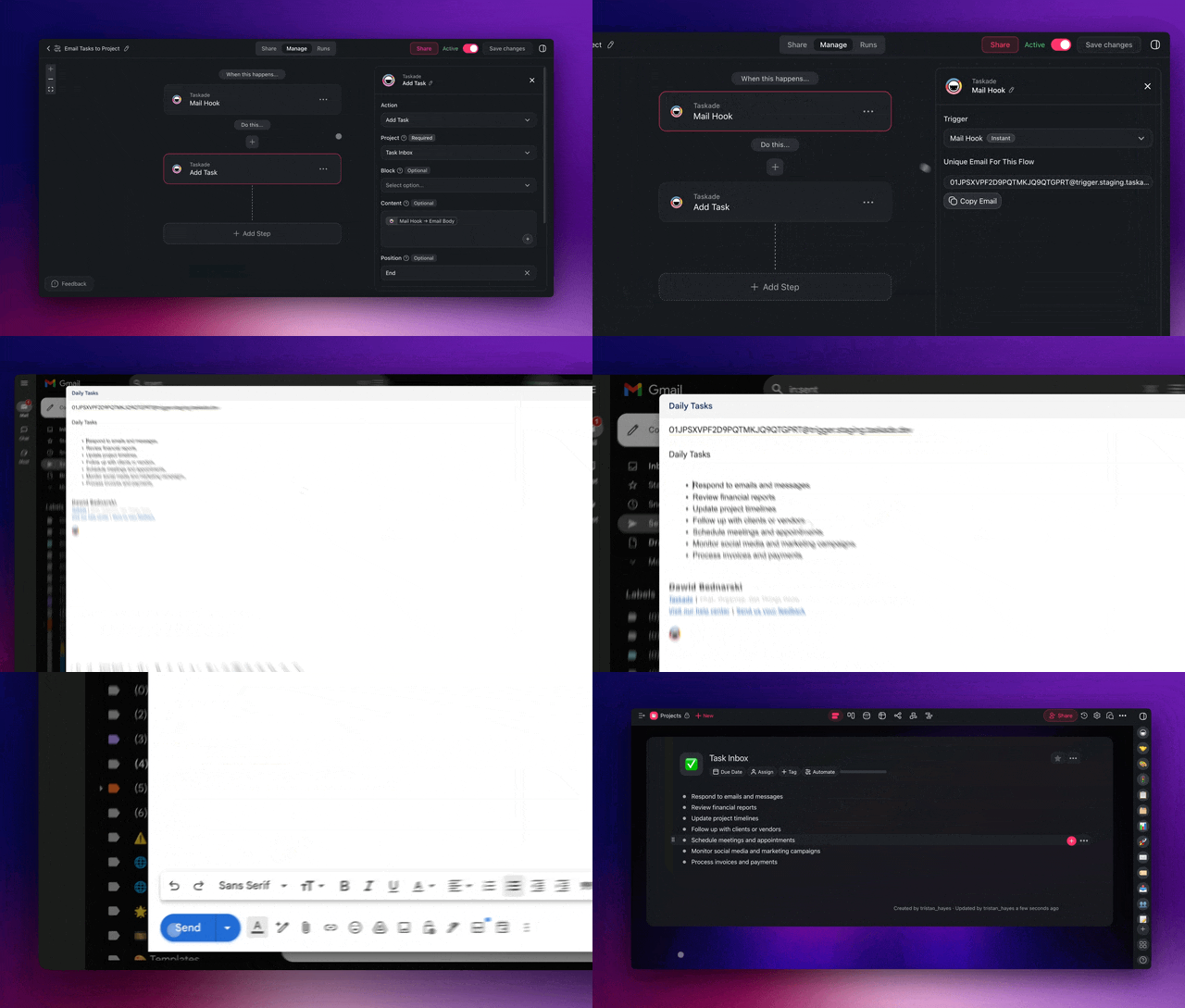
### The Approval Pattern, Built in Taskade
Muse and dots both put a person at the boundary. In a Taskade automation, the boundary is a step you place yourself:
```mermaid
sequenceDiagram
participant TR as Trigger
participant AG as AI agent step
participant WA as Wait for approval
participant TM as Teammate
participant GM as Gmail step
TR->>AG: New renewal date found
AG->>WA: Draft the reminder email
WA->>TM: Notification and email with a Review link
alt Approve
TM->>WA: Approve
WA->>GM: Send the email
else Reject, or no answer with Then on Reject
WA->>WA: Run stops, nothing is sent
end
```
Put each AI step before the approval, so the approver reads the exact text that the next step will send. The Wait for approval step is built in. The Gmail step in this example is a premium integration, available on paid plans. For a full walk-through, see the [no-code approval workflow guide](https://www.taskade.com/blog/build-approval-workflow).
### Build Your Own Personal Errands Agent From One Prompt
Open [Taskade Genesis](https://www.taskade.com/create) and paste:
```text
Build me a personal paperwork app. One AI agent tracks my subscriptions, bills and
medical claims, and it flags every renewal 7 days early. Add a Wait for approval
step before any reminder email goes out.
```
Free includes 2 workspace members, 3 Taskade Genesis apps, 1 AI agent and 10 automation runs per billing period, so this prompt asks for exactly one agent. Free starts with 0 AI credits. On Free, you earn free AI credits with referrals and invites, and you can upgrade any time. Pro is $10/month billed annually ($120/yr), or $20 month to month. Email steps through Gmail or Outlook are premium integrations on paid plans. *Facts checked on 2026-11-07 against [pricing](https://www.taskade.com/pricing).*
Prefer a ready agent? Start with the [Personal Assistant Agent](https://www.taskade.com/agents/personal/personal-assistant-agent) or the [Travel Concierge Agent](https://www.taskade.com/agents/travel-planning/travel-concierge-agent), or browse [live apps in the Taskade App Factory](https://www.taskade.com/apps).
---
## Quo Vadis, Meta?
**Meta's next Muse steps are public: the Confidential VM, Muse on Meta glasses, the Muse Charm device, Muse Wonder inside the app, and a cost cut of more than 10x in a year.** Each one tests a different promise. The Confidential VM tests privacy, the glasses and Charm test reach, and the cost target tests whether a free agent for a billion people can pay for itself.
| Next step | What Meta said | When | Source |
|---|---|---|---|
| **Muse Confidential VM** | The whole VM encrypted "with a key only they hold, so not even Meta can access it." Zuckerberg says he and Friedman recruited Moxie Marlinspike to work on it | "Later this year," "soon" | Meta newsroom, Q3 call, Zuckerberg on the Sources podcast (The Next Web, 2026-09-10) |
| **Muse on Meta glasses** | "coming to Meta Glasses starting next month" | November 2026 | Q3 call |
| **Muse Charm** | A keychain device shown at Connect. Zuckerberg: "about to ship," "from concept to a hardware device in people's pockets in less than 1 year." No price published | December 2026 target | Q3 call, CNBC |
| **Muse Wonder in the app** | "will soon power experiences in Muse, and will roll out first to subscribers" | Not dated | Meta newsroom |
| **Cost efficiency** | "more than 10x in the next year," which Zuckerberg says will let Muse be profitable "once the revenue lines are at scale" | 2027 | Q3 call |
| **Compute for a billion users** | "building out the capacity to serve more than a billion people over the next few years" | Multi-year | Q3 call |
| **More markets** | Not "launched globally yet" because of compute cost | Ongoing | Q3 call |
| **Shared spaces** | "exploring ways for you to share your spaces with others" | Not dated | Meta newsroom |
| **Amazon** | No public settlement after the September block | Open | GeekWire, SiliconANGLE |
Three open questions will decide how this chapter reads in a year.
**Will people trust an agent from an ad company?** Meta's answer is architecture: a VM, a Sentinel, an opt-out, a promise that VM data stays out of ad systems, and a Confidential VM where Meta holds no key. The shared-chat exposure in October showed that the risk sits in the features around the vault, not only in the vault itself.
**Will the economics close?** Zuckerberg calls Muse "very compute intensive." Meta's 2026 capex guidance is $135 to $145 billion, and Meta says revenue from new AI businesses could arrive in 2027. A free agent that runs a full machine and browser per user is, by Meta's own description, a costly product to give away.
**Will memory catch up with the vision?** Wang's "second mind" needs an agent that remembers a life, and he names memory as the weak spot today. Muse Wonder's Active Memory is Meta's first public answer.
Muse also closes a loop that opened in 2015. Facebook M tried to run errands with humans behind the curtain and was cancelled in 2018. Eleven years later, Meta shipped the same promise on its own models, inside a private machine, with a second agent watching the first. Whether it lasts depends less on the next model than on the next incident.
For builders, the lesson is portable. One agent works, a second system checks, a person approves at the boundary, and a launch waits until every behavior row is green. You do not need a frontier lab to copy that. You need a place where the agent, the memory and the approvals live together. ▲ ■ ●
**Ready to build agents that you can audit?** [Create your first app in Taskade Genesis →](https://www.taskade.com/create), browse [AI agents](https://www.taskade.com/agents) and [live apps in the Taskade App Factory](https://www.taskade.com/apps), or [automate the follow-up](https://www.taskade.com/automate).
---
## Related Reading
- [Always-On AI Agents: Dots, Muse, Grok Bot Explained](https://www.taskade.com/blog/always-on-ai-agents): the full comparison of hosted personal agents
- [OpenClaw and Moltbook History](https://www.taskade.com/blog/moltbook-clawdbot-openclaw-history): the open agent that inspired Muse
- [History of Open-Source LLMs](https://www.taskade.com/blog/open-source-llm-history): Llama's place in the open-weights story
- [Anthropic and Claude History](https://www.taskade.com/blog/anthropic-claude-history): the coding lead Meta chose not to chase
- [OpenAI and ChatGPT History](https://www.taskade.com/blog/openai-chatgpt-history): the chatbot that reset the race in 2022
- [Google Gemini History](https://www.taskade.com/blog/google-gemini-history): the other big-tech lab
- [xAI and Grok History](https://www.taskade.com/blog/xai-grok-history): the lab behind Grok Bot
- [History of AI Agents](https://www.taskade.com/blog/ai-agents-history): from research systems to the agent loop
- [History of Agent Memory](https://www.taskade.com/blog/agent-memory-history): why agents still forget
- [AI Agent Sandboxes](https://www.taskade.com/blog/ai-agent-sandboxes): VMs, containers and where agents should run
- [Agent Evals Explained](https://www.taskade.com/blog/agent-evals-explained): build your own behavior spreadsheet
## Sources
1. [Introducing Muse](https://about.fb.com/news/2026/09/introducing-muse-personal-ai-agent/), Meta newsroom, September 8, 2026.
2. [Introducing Spaces](https://about.fb.com/news/2026/11/introducing-spaces-customize-muse-app/), Meta newsroom, November 6, 2026.
3. [Muse Wonder models](https://about.fb.com/news/2026/10/introducing-muse-wonder-models/), Meta newsroom, October 12, 2026.
4. [Meta Q3 2026 earnings call transcript](https://www.fool.com/earnings/call-transcripts/2026/10/21/meta-meta-q3-2026-earnings-call-transcript/), October 21, 2026.
5. [Meta Q3 2026 results, Exhibit 99.1](https://www.sec.gov/Archives/edgar/data/0001326801/000162828026066700/meta-09302026xexhibit991.htm), SEC.
6. [Scale AI founder Wang announces exit for Meta](https://www.cnbc.com/2025/06/12/scale-ai-founder-wang-announces-exit-for-meta-part-of-14-billion-deal.html), CNBC, June 12, 2025.
7. [Zuckerberg's memo creating Meta Superintelligence Labs](https://www.cnbc.com/2025/06/30/mark-zuckerberg-creating-meta-superintelligence-labs-read-the-memo.html), CNBC, June 30, 2025.
8. [Personal Superintelligence](https://about.fb.com/news/2025/07/personal-superintelligence-for-everyone/), Meta, July 30, 2025.
9. [Meta debuts first major AI model since the Scale deal](https://www.cnbc.com/2026/04/08/meta-debuts-first-major-ai-model-since-14-billion-deal-to-bring-in-alexandr-wang.html), CNBC, April 8, 2026.
10. [Meta pushes into personal AI agents](https://www.cnbc.com/2026/09/08/meta-personal-ai-agents-public-reckoning-privacy-safety.html), CNBC, September 8, 2026.
11. [Meta debuts Muse](https://www.axios.com/2026/09/08/meta-debuts-muse-personal-ai-agent), Axios, September 8, 2026.
12. [Meta is putting its muscle behind Muse](https://techcrunch.com/2026/09/25/meta-is-putting-its-muscle-behind-muse-as-the-ai-app-takes-off/), TechCrunch, September 25, 2026.
13. [Amazon blocks Meta's Muse agent](https://siliconangle.com/2026/09/21/amazon-blocks-metas-muse-agent-from-shopping-on-users-behalf/), SiliconANGLE, September 21, 2026.
14. [Meta tests Muse calls made by humans in a call center](https://www.404media.co/meta-tests-muse-ai-agent-calls-that-are-actually-made-by-humans-in-a-call-center/), 404 Media, September 22, 2026.
15. [The secret behind Meta's Muse](https://garymarcus.substack.com/p/the-secret-behind-metas-muse), Gary Marcus, September 22, 2026.
16. [Meta releases Muse Glimmer](https://www.marktechpost.com/2026/08/10/meta-ai-releases-muse-glimmer/), MarkTechPost, August 10, 2026.
17. [Muse Spark Open on Hugging Face](https://huggingface.co/blog/meta-muse-spark-open), October 15, 2026.
18. [Introducing Muse Spark 1.3](https://research.meta.ai/blog/introducing-muse-spark-1-3), Meta research blog, September 2, 2026.
19. [Muse crosses 5 million downloads](https://9to5mac.com/2026/09/30/report-metas-muse-crosses-5-million-downloads-amid-massive-advertising-push/), 9to5Mac, September 30, 2026.
20. [Meta debuts its Muse AI agent. Will consumers trust it?](https://techcrunch.com/2026/09/08/meta-debuts-its-muse-ai-agent-will-consumers-trust-it/), TechCrunch, September 8, 2026.
21. [Amazon blocks Meta's Muse AI assistant](https://www.geekwire.com/2026/amazon-blocks-metas-muse-ai-assistant-in-new-standoff-over-agentic-shopping/), GeekWire, September 2026.
22. [Zuckerberg on the Sources podcast](https://thenextweb.com/news/zuckerberg-muse-sources-interview-labs-holding-back-ai-models), The Next Web, September 10, 2026.
23. Interviews: [Alexandr Wang at Y Combinator](https://www.youtube.com/watch?v=sJ4VJWycX9M) (July 29, 2026), [Cleo Abram, Huge Conversations](https://www.youtube.com/watch?v=1LRvMRC_pfY) (October 7, 2026), [David Senra](https://www.youtube.com/watch?v=S6l3aRsecuE) (October 11, 2026).
24. [The Biggest News From Connect 2026](https://about.fb.com/news/2026/09/the-biggest-news-from-connect-2026/), Meta newsroom, September 24, 2026.
25. [Rival AI agents Instinct and Meta's Muse both add the ability to make calls](https://techcrunch.com/2026/09/17/rival-ai-agents-instinct-and-metas-muse-both-add-the-ability-to-make-calls/), TechCrunch, September 17, 2026.
26. [Build with Muse Spark, now available on Meta Model API](https://dev.meta.ai/resources/blog/build-with-muse-spark), Meta developer blog, July 8, 2026.
27. [Introducing Muse Code and Muse Spark 1.2](https://research.meta.ai/blog/introducing-muse-code-and-muse-spark-1-2), Meta research blog, August 5, 2026.
28. [Meta releases its first frontier model, Muse Wonder](https://techcrunch.com/2026/10/12/meta-releases-its-first-frontier-model-muse-wonder/), TechCrunch, October 12, 2026.
29. [The Future Is for Everyone](https://about.fb.com/news/2026/08/the-future-is-for-everyone/), Mark Zuckerberg, Meta newsroom, August 10, 2026.
30. [Meta Connect 2026 coverage: Meta VR Glasses and the Muse Charm](https://www.cnbc.com/2026/09/23/mark-zuckerberg-1299-meta-vr-glasses-ai-agent.html), CNBC, September 23, 2026.
---
## Frequently Asked Questions About Meta Muse
### What is Meta Muse?
Meta Muse is Meta's personal AI agent. It launched in the US on September 8, 2026, and it does tasks for you, such as shopping, booking travel, lowering bills and filling forms. Each user gets a private cloud computer called the Muse Secure VM, and a separate Sentinel agent must approve anything that leaves it. Muse is also the name of Meta's model family, from Muse Spark to Muse Wonder.
### When did Meta Muse come out?
The Muse agent came out on September 8, 2026, in the US, on iOS, Android, the web at muse.ai and WhatsApp. The first Muse model, Muse Spark, shipped earlier, on April 8, 2026. Canada followed on September 18, Japan on October 23 and Singapore on October 27, 2026.
### Who created Meta Muse?
Meta Superintelligence Labs (MSL) created Meta Muse. MSL is led by Chief AI Officer Alexandr Wang, the founder of Scale AI, who joined Meta in June 2025 as part of a 14.3 billion dollar investment in Scale. Nat Friedman leads AI products and applied research, and Mark Zuckerberg is CEO. Friedman says the product was heavily inspired by the open-source agent OpenClaw but built from scratch.
### What model does Meta Muse use?
Meta Muse runs on Meta's own Muse Spark models. Meta's launch post says Muse is powered by Muse Spark, and Alexandr Wang says the launch build was a specially trained version of Muse Spark 1.3. Meta's larger Muse Wonder models, released on October 12, 2026, roll out to paying Muse subscribers first.
### Is Meta Muse free?
Yes. Meta says Muse is free for most of what people need. On launch day, Alexandr Wang told CNBC and Axios that Muse also has paid monthly plans of 20 dollars and 100 dollars, depending on usage. TechCrunch reported the plan names as Power and Maximum. Meta's own launch post lists no plan names or prices. Facts checked on 2026-11-07.
### Is Meta Muse safe?
Meta Muse has more safety layers than most consumer agents: a private Secure VM per user, a Sentinel agent that approves every outbound action, ask-first rules before purchases and emails, an audit trail, and a forget command. Its first two months also brought an Amazon block, a report of human callers in internal tests, and a shared-chat exposure that led Meta to pause sharing on October 20, 2026. Interactions train Meta's models unless you opt out.
### Is Meta Muse open source?
No. The Muse agent, Muse Spark and Muse Wonder are closed. Meta did release two open-weights models: Muse Glimmer, a 30B model under Apache 2.0, on August 10, 2026, and Muse Spark Open, with 816B total and 42B active parameters under a custom Muse Model License, on October 15, 2026.
### How does Meta Muse make money?
Meta Muse makes money from paid subscriptions today. On the Q3 2026 call, Zuckerberg said the product should be free for most people, that Meta will build commerce tools to earn a fee on transactions that businesses pay, and that over time Meta can take a percent of the value Muse creates. Muse is also central to the business model for Meta's glasses.
### What is the difference between Meta AI and Muse?
Meta AI is the assistant inside Facebook, Instagram, WhatsApp and the Meta AI app, launched in September 2023. Muse is a separate personal agent app, launched in September 2026, that plans and does tasks from a private Secure VM and keeps working after you close it. Both run on Meta's Muse models since April 2026.
### Is Muse available outside the US?
Yes, in a few markets. After the US launch on September 8, 2026, Muse opened in Canada on September 18, Japan on October 23 and Singapore on October 27. Zuckerberg said on October 21, 2026 that Meta has not launched it globally yet because Muse is a compute-intensive service to run.
### What happened to Meta's Llama models?
Llama 4, released on April 5, 2025, was Meta's last major Llama release. It drew criticism after an experimental version ranked high on LMArena, and the largest model, Behemoth, never shipped. Meta then invested in Scale AI, founded Meta Superintelligence Labs, and replaced Llama with the closed Muse Spark model on April 8, 2026. Open weights returned with Muse Glimmer and Muse Spark Open.
### What are Spaces in Meta Muse?
Spaces are custom experiences that Muse builds inside its app from a description, such as a gift tracker, a school dashboard, a wedding planner or a trip planner. Meta introduced them on November 6, 2026. Connected apps keep each space up to date, and spaces are available everywhere Muse is available. Sharing a space is not available yet.