# AI Typography Tools 2026: 14 Font, Pairing and CSS Tools
> 14 AI typography tools sorted by what they make: font pairs, type scales and CSS, lettering images, or real font files. Free plans and font licenses checked.
- Source: https://www.taskade.com/blog/ai-typography-tools
- Published: 2026-11-18
- Author: Taskade Team
In 1818, five years after Giambattista Bodoni died, his widow published the *Manuale Tipografico*: two volumes of type specimens that showed every size and style the Parma press could cut. A printer who wanted a headline face and a text face that belonged together had one tool to decide with: a printed book of samples, read by eye.
*Cover image: the title page and a capital-letter specimen from Bodoni's Manuale Tipografico, Parma, 1818. Wikimedia Commons, public domain.*
The best AI typography tool depends on what you need at the end: a font pairing, a type scale with CSS for a website, lettering inside an image, or a real font file you can install. Fontjoy and Monotype lead free pairing. Typescale and Figma handle type scales. Ideogram and Recraft render the cleanest text in images. Calligraphr and Mixfont make installable fonts. If you want the whole type system for a site in one pass, a [typography AI](https://www.taskade.com/generate/design/website-typography) generator returns the pair, the scale and the line heights together. We checked every free plan and font license on the vendor's own site on November 7, 2026, and re-checked Ideogram's on November 12, 2026.
> **TL;DR:** We sorted **14 AI typography tools by what they produce**: font pairings (Fontjoy, Monotype, FontPair AI), type scales and CSS (Typescale, Figma, Taskade), lettering images (Ideogram, Recraft, Adobe Express, Kittl, Canva, Typogram), and real font files (Calligraphr, Mixfont). Free plans and licenses checked November 2026. Get a full type system with the [AI typography generator](https://www.taskade.com/generate/design/website-typography).
---
## Quick Answer: The Best AI Typography Tool for Each Job
**The right AI typography tool is the one whose output matches your job: a pairing, a scale, an image, or a font file.** Most roundups rank these tools on one list, which compares a font file maker against an image model. The routing table below sends each job to the tool that does it best, with the free plan checked on the vendor's own page on November 7, 2026, except Ideogram's, re-checked on November 12, 2026.
| If you want... | Start with | Why |
|---|---|---|
| Two fonts that work together, free | [Fontjoy](https://fontjoy.com) | One click per pairing, lock one font and regenerate the other, no account wall |
| Pairings with commercial foundry fonts | [Monotype Font Pairing Generator](https://www.monotype.com/font-pairing) | Suggests pairs such as Helvetica with Glypha from the Monotype library |
| A critique of a pairing you already chose | [FontPair AI](https://www.fontpairai.com) | Scores a pair from 1 to 10 with pros and cons, one-time £48.99 |
| A full type scale with CSS for a site | [Typescale](https://typescale.com) or [Utopia](https://utopia.fyi/type/calculator/) | Ratio, base size and breakpoints, exported as CSS |
| Type styles inside a design file | [Figma](https://www.figma.com) | Text styles plus Figma AI on the free Starter plan |
| Pair, scale and line heights in one pass | [Taskade](https://www.taskade.com/create) | Describe the brand, get the whole type system in a workspace |
| A headline or poster with readable text | [Ideogram](https://ideogram.ai) | Free weekly credits (the amount may vary), the text-in-image tool roundups name first |
| Vector lettering and SVG | [Recraft](https://www.recraft.ai) | Editable vector output, commercial rights only on paid plans |
| Text effects on social graphics | [Adobe Express](https://www.adobe.com/express/) | Free plan with daily generations and Adobe Fonts access |
| Merch and print lettering | [Kittl](https://www.kittl.com) | Templates and a commercial license built for print-on-demand |
| A layout that needs type fast | [Canva](https://www.canva.com) | Templates and type presets on a free plan |
| A wordmark with expressive type | [Typogram](https://www.typogram.co) | Free PNG and SVG export with 1,629 font families |
| A font from your own handwriting | [Calligraphr](https://www.calligraphr.com) | Free for fonts of up to 75 characters, exports TTF or OTF |
| A font from a text prompt | [Mixfont](https://mixfont.com) | Prompt-to-font, 50 one-time starter credits on Free |
---
## What Is an AI Typography Tool?
**An AI typography tool is software that picks, sizes, renders or draws type from a description or a few clicks.** The label covers four different products. A pairing tool suggests fonts that work together. A scale tool turns those fonts into sizes, line heights and CSS. A lettering generator paints words into an image. A font file generator produces a TTF or OTF file you can install and type with. Each one returns a different thing, so each one answers a different question.
```
WHAT YOU GET BACK EXAMPLE TOOLS CAN YOU INSTALL IT?
─────────────────────────────── ───────────────────────────────── ───────────────────
A font pairing (names + preview) Fontjoy, Monotype, FontPair AI You install the fonts
A type scale + CSS Typescale, Utopia, Figma, Taskade Paste the CSS
Lettering inside an image Ideogram, Recraft, Kittl, Canva No, it is a picture
A real font file (TTF / OTF) Calligraphr, Mixfont Yes
```
The difference matters the moment you ship. A pairing tool hands you two font names, and you still need the files and a license. A lettering image looks like type, but nobody can select it, search it, translate it or resize it without blur. A font file is the only output that behaves like Bodoni's metal type: you set any words you want in it, at any size.
```mermaid
graph TD
Q["What do you need at the end?"] --> P["Two or three fonts that work together"]
Q --> S["Sizes, line heights and CSS for a website"]
Q --> L["Words inside a poster, logo or thumbnail"]
Q --> F["A font you can install and type with"]
P --> P1["Pairing tools
Fontjoy, Monotype, FontPair AI"]
S --> S1["Type scale tools
Typescale, Utopia, Figma, Taskade"]
L --> L1["Lettering generators
Ideogram, Recraft, Adobe Express,
Kittl, Canva, Typogram"]
F --> F1["Font file makers
Calligraphr, Mixfont"]
style Q fill:#2a1225,color:#ff8fa3,stroke:#ff2d60,stroke-width:2px
style P fill:#1e1e2e,color:#94a3b8,stroke:#475569
style S fill:#1e1e2e,color:#94a3b8,stroke:#475569
style L fill:#1e1e2e,color:#94a3b8,stroke:#475569
style F fill:#1e1e2e,color:#94a3b8,stroke:#475569
style P1 fill:#0d1b2a,color:#7dd3fc,stroke:#38bdf8,stroke-width:1.5px
style S1 fill:#0d1a0e,color:#86efac,stroke:#22c55e,stroke-width:1.5px
style L1 fill:#1a0d24,color:#ce93d8,stroke:#6a1b9a,stroke-width:1.5px
style F1 fill:#1a140a,color:#ffb74d,stroke:#e65100,stroke-width:1.5px
```
Not every tool here uses a neural network, and we say so in each entry. Typescale and Utopia are calculators. Calligraphr traces a template you fill in by hand. They sit in this list because they do the step that the AI tools skip, and a type system built without that step breaks on the first phone it meets.
---
## What a Type System Actually Is
**A type system is a font pair, a size scale, line heights, weights and spacing rules applied to every text style on a site.** A designer decides it once, writes it down, and every page after that inherits it. When AI tools disagree about "typography," they are usually solving one part of this system and leaving the rest to you.
### Font pairing: contrast with one shared trait
A good pair contrasts in one way and agrees in another. The classic move is a serif for headings with a sans serif for body text, or the reverse, where both faces share a similar x-height or a similar geometric skeleton. Fontjoy's own homepage puts it well: good pairs "share an overarching theme yet have a pleasing contrast." Fontjoy's open-source code describes the method in plain terms. It turns each of 1,883 Google web fonts, counting every weight as its own font, into a vector from images of its letters, then rewards pairs that match in some dimensions and differ in others.
### Type scale: one base size times one ratio
A type scale starts from a base size, usually 16 pixels for body text, and multiplies it by one ratio for each step up. The ratios carry musical names because early type designers borrowed them from intervals. A small ratio gives a calm, dense page. A large ratio gives drama and a strong hierarchy, at the cost of very large headings on a small screen.
| Ratio | Name | H1 at a 16px base (5 steps up) | Good fit |
|---|---|---|---|
| 1.125 | Major Second | 28.8px | Dashboards, dense apps |
| 1.200 | Minor Third | 39.8px | Product sites, documentation |
| 1.250 | Major Third | 48.8px | Blogs, marketing pages |
| 1.333 | Perfect Fourth | 67.3px | Editorial, landing pages |
| 1.500 | Perfect Fifth | 121.5px | Posters, single hero headlines |
| 1.618 | Golden Ratio | 177.4px | Display type only |
The values are arithmetic: 16 multiplied by the ratio five times. Here is the Major Third ladder that most marketing sites start from:
```
STEP STYLE RATIO 1.25 (16px base) LINE HEIGHT
───── ──────── ─────────────────────── ───────────
+5 H1 48.8px ████████████ 1.1
+4 H2 39.1px ██████████ 1.15
+3 H3 31.3px ████████ 1.2
+2 H4 25.0px ██████ 1.3
+1 H5 20.0px █████ 1.4
0 Body 16.0px ████ 1.5
-1 Caption 12.8px ███ 1.5
```
```mermaid
xychart-beta
title "Type scale at a 16px base: two common ratios"
x-axis "Text style" [Body, H5, H4, H3, H2, H1]
y-axis "Font size (px)" 0 --> 70
bar "Major Third 1.25" [16, 20, 25, 31, 39, 49]
line "Perfect Fourth 1.333" [16, 21, 28, 38, 51, 67]
```
The gap between the two lines is the reason a single ratio rarely works on every screen. A Perfect Fourth H1 at 67 pixels looks confident on a laptop and takes three lines on a phone. Fluid sizes, covered in the CSS section below, solve this by using a smaller ratio on small screens and a larger one on large screens.
### Line height and measure
Line height shrinks as size grows. Body text reads well at 1.5 times its size, while a 48-pixel heading looks loose at 1.5 and tight at about 1.1. Measure, the length of a line, matters as much as size: most typographers aim for roughly 45 to 75 characters per line of body text. If you already keep a design brief for your product, add a type section to it. Our guide to [AI design tools](https://www.taskade.com/blog/ai-design-tools) shows a DESIGN.md type scale section you can copy, and it explains why a written brief beats a better prompt.
---
## Is the Free Plan Actually Free?
**Most AI typography tools have a free plan, but each one measures it in a different unit, and several free plans forbid commercial use.** Some count credits a week, some count characters, some give one-time credits that never refill. The table below records each free plan in the vendor's own unit, checked on the vendor's own page on November 7, 2026. The Ideogram row was re-checked on November 12, 2026.
| Tool | Free plan (vendor's own unit) | Best for | Entry paid price | Checked |
|---|---|---|---|---|
| Fontjoy | Free generator, no pricing page, no account | Quick free pairings | None listed | 2026-11-07 |
| Monotype Font Pairing Generator | Free on the web, full experience needs a Monotype Fonts subscription | Pairs with foundry fonts | Subscription price not on the page | 2026-11-07 |
| FontPair AI | No free tier listed on the site | Critique of a pairing | £48.99 one-time | 2026-11-07 |
| Typescale | Core scale tool free, Golden Ratio preset marked Pro | A scale with CSS | Pro price not shown | 2026-11-07 |
| Utopia | Free calculator, no account | Fluid clamp() scales | None | 2026-11-07 |
| Figma | Starter: 150 AI credits a day, up to 500 a month | Text styles in a design file | Professional Full seat $16/mo billed annually | 2026-11-07 |
| Taskade | 3 Taskade Genesis apps, 1 AI agent, 10 automation runs per billing period. Free starts with 0 AI credits | Full type system and an app around it | Pro $10/mo billed annually | 2026-11-07 |
| Ideogram | Weekly credits with Google, Apple or Microsoft sign-in (the amount may vary, checked 2026-11-12), all images public | Readable text in images | Plus $20/mo, or $15/mo billed yearly | 2026-11-12 |
| Recraft | 3 generations per style a day, 3 uploads a day, public, personal use only | Vector lettering | Basic $10/mo billed annually | 2026-11-07 |
| Adobe Express | $0, limited generative credits, free daily generations | Text effects on social graphics | Premium $9.99/mo | 2026-11-07 |
| Kittl | Free for personal use only | Merch lettering | Pro $12/mo billed annually ($144/yr), or $15 month to month | 2026-11-07 |
| Canva | $0, limited access to AI, 1 Brand Kit | Social and print layouts | Pro US$144/yr | 2026-11-07 |
| Typogram | Studio Basic: PNG and SVG export with 1,629 non-premium font families, 3 AI icons | Wordmarks and brand type | Studio Premium $6/mo ($72/yr) | 2026-11-07 |
| Calligraphr | 75 characters per font, 2 variants per character, no ligatures | Handwriting fonts | Pro $10 for one month, or $6/mo for 6 months | 2026-11-07 |
| Mixfont | 50 one-time starter credits, one job at a time | Prompt-to-font | Pro $20/mo | 2026-11-07 |
Facts checked on 2026-11-07. The Ideogram row was re-checked on 2026-11-12.
The honest pattern: **pairing tools and type scale calculators are the most generous free category.** Fontjoy, Utopia and the core of Typescale cost nothing and need no account. Lettering and font-file tools gate commercial rights, volume or privacy instead. If you plan to sell what you make, the free plan is a trial, not a license.
---
## Who Owns the Fonts and Lettering You Make?
**The font license decides where you can use type, and free plans are where the restrictions usually sit.** A pairing tool licenses nothing by itself: you inherit the license of each font it suggests. A lettering generator licenses the image under its own terms. A font file generator licenses the font. The table quotes each vendor's own words, checked on November 7, 2026, except the Ideogram row, re-checked on November 12, 2026.
| Source | What the vendor says | Use it for a logo or a product? |
|---|---|---|
| Google Fonts | Official FAQ: open source, no cost, commercial use allowed, including in logos | Yes. Under the SIL OFL, you cannot sell the font files by themselves |
| Monotype pairings | "Try the full font pairing experience with a Monotype Fonts subscription" | Only with a license for each suggested font |
| Recraft | Free images "are owned by Recraft", public, "not licensed for commercial use" | Paid plan only. Paid plans grant "full ownership and commercial rights" |
| Kittl | Free plan: "For personal use only (no commercial rights)". Pro and Expert: up to 500,000 copies | Paid plan only |
| Mixfont | FAQ: fonts "can be used anywhere, for any purpose, including commercial work" | Yes, per the FAQ |
| Calligraphr | FAQ: "Any creation you make with Calligraphr is your sole property," and commercial use is allowed | Yes, per the FAQ. The TTF or OTF file keeps working after Pro ends |
| Canva | Uploaded fonts "should be licensed for embedding" | Follow Canva's content license |
| Ideogram | Pricing FAQ, checked 2026-11-12: "We do not claim ownership of your generated images, and you're free to use them for any purpose, including commercial use." Images are published by default, and only Plus and Pro can generate unpublished images | Yes, but free-plan images are public, so pay for private work |
| Typogram | Studio Basic exports PNG and SVG with non-premium fonts only | Check the license of the font you used |
Three habits prevent most license trouble:
- **Save the terms page on the day you generate.** Terms change, and a dated PDF of the page you agreed to is the best record you can keep.
- **Prefer open fonts for a logo.** A Google Font under the SIL Open Font License can sit in a logo forever with no renewal. A subscription font can stop being yours when the subscription ends.
- **Convert lettering to outlines only after you know the source.** An outlined wordmark is an image of text, which most licenses allow, but the font you started from still needs a license that covers that use.
```mermaid
graph TD
A["You picked a font or made lettering"] --> B{"Where did it come from?"}
B --> G["Google Fonts or another SIL OFL font"]
B --> C["Commercial foundry font"]
B --> I["AI image or lettering generator"]
B --> M["AI font file generator"]
G --> G1["Use it anywhere, including logos
Do not sell the font file alone"]
C --> C1["Buy a license that covers
web, app or logo use"]
I --> I1["Free plan: check personal-use limits
Paid plan: read the commercial terms"]
M --> M1["Read the vendor FAQ and save
the terms page with the file"]
style A fill:#2a1225,color:#ff8fa3,stroke:#ff2d60,stroke-width:2px
style B fill:#1a140a,color:#ffb74d,stroke:#e65100,stroke-width:1.5px
style G fill:#0d1a0e,color:#86efac,stroke:#22c55e,stroke-width:1.5px
style C fill:#0d1b2a,color:#7dd3fc,stroke:#38bdf8,stroke-width:1.5px
style I fill:#1a0d24,color:#ce93d8,stroke:#6a1b9a,stroke-width:1.5px
style M fill:#11111b,color:#cdd6f4,stroke:#00d4aa
style G1 fill:#1e1e2e,color:#94a3b8,stroke:#475569
style C1 fill:#1e1e2e,color:#94a3b8,stroke:#475569
style I1 fill:#1e1e2e,color:#94a3b8,stroke:#475569
style M1 fill:#1e1e2e,color:#94a3b8,stroke:#475569
```
---
## How We Compared These Tools
**We are a vendor too, so here is exactly how this comparison was built.** Taskade sells one of the tools in this list, which is a reason to show the method rather than ask for trust.
- **Every free plan and price** was checked on the vendor's own pricing page, FAQ or documentation on **November 7, 2026**. Ideogram's free plan, price and license and Mixfont's export format were re-checked on November 12, 2026. Where a page did not publish a number in its text, or published two numbers that disagree, the cell or a note says so instead of quoting a third-party figure.
- **The tool screenshots** are headless captures of each public page from the same week.
- **Tools are grouped by what they produce**, not ranked on one scale. A font file maker and a text-in-image model are not competitors, and scoring them together misleads.
- **We did not run one identical prompt through every tool.** Several tools gate output behind credits or paid plans, and four of them do not take a prompt at all. We describe what each tool returns instead of scoring a bake-off.
- **Taskade sits in the type-scale group, entry 6 of 14**, because that is where it honestly fits. It does not draw fonts and it does not render lettering.
- **Every entry names at least one real strength**, including the tools that compete most directly with each other.
Each tool was checked against the same five questions, in the vendor's own words:
| Question | What counts as a yes | Where we looked |
|---|---|---|
| What do you get back? | A pairing, a scale with CSS, an image, or a font file | Product page and docs |
| Can you keep free output? | A result you can save or export on $0 | Pricing page |
| Can you export it? | CSS, SVG, PNG, TTF or OTF | Product page and FAQ |
| Can you use it commercially? | A written commercial right on that plan | Terms, FAQ or pricing page |
| What does the free unit buy? | A stated number of generations, credits or characters | Pricing page |
---
## Font Pairing and Discovery
These tools answer the first question of any type system: which two fonts belong together.
### 1. [Fontjoy](https://fontjoy.com): Best Free Pairing Generator
[Fontjoy](https://fontjoy.com) is the fastest way to see a font pairing. Its homepage promises to "generate font combinations with deep learning," and the open-source code behind it trains on 1,883 fonts from Google's web font library, so every suggestion is a font you can use for free.
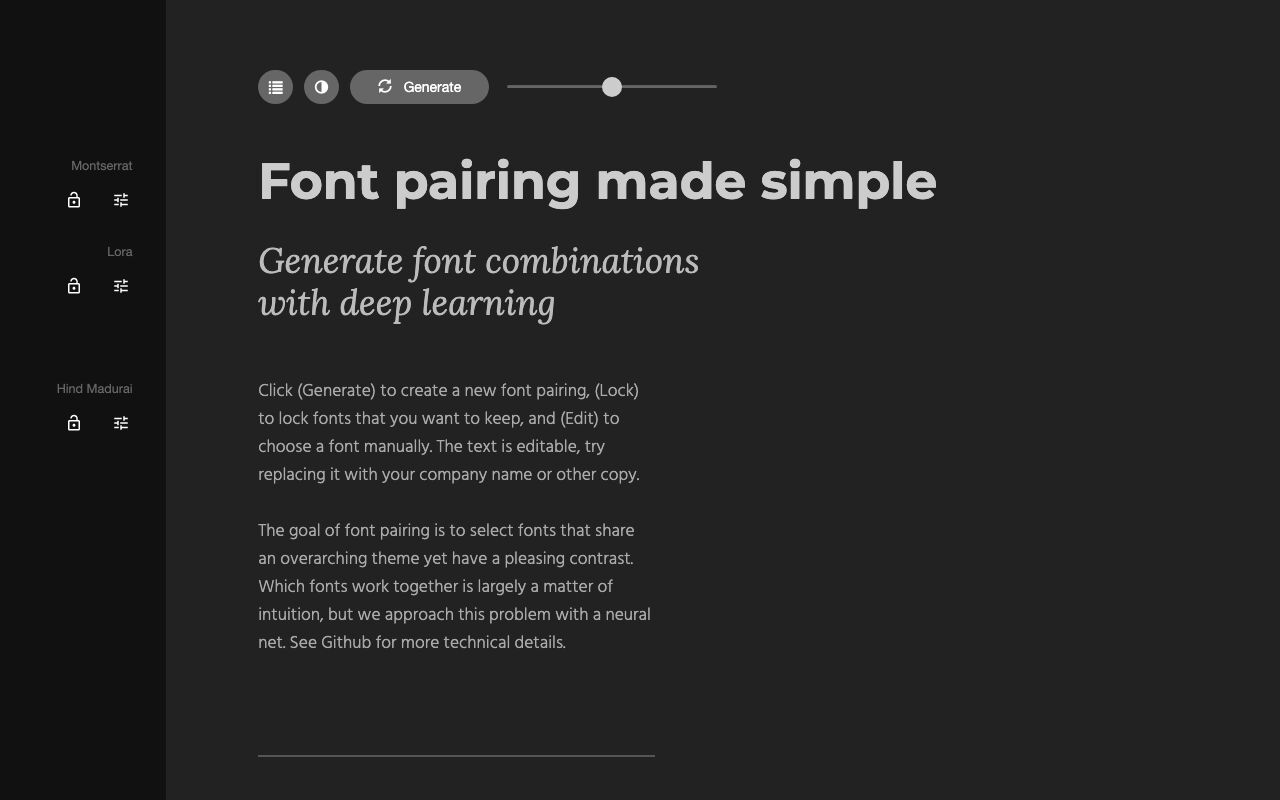
*Fontjoy homepage, captured November 2026.*
**Key features:** a Generate button that proposes a heading, subheading and body font together; a Lock control to keep a font you like while the others change; an Edit control to pick a font by hand; editable sample text, so you can preview your own company name; a contrast slider.
**Free plan (checked Nov 7, 2026):** the whole tool is free. The site lists no pricing and asks for no account.
**Pros:**
- One click per pairing, so you can review dozens in a minute
- Every suggested font comes from Google's free library
- Lock and regenerate is the right workflow for a pairing decision
**Cons:**
- No type scale, no line heights and no CSS export
- The model is several years old, and the page shows no new features
**Pricing:** free.
**Bottom line:** the best free starting point when you have no fonts in mind yet. Use it for ten minutes, keep three candidates, then test them at real sizes.
### 2. [Monotype Font Pairing Generator](https://www.monotype.com/font-pairing): Best for Pairings With Commercial Foundry Fonts
[Monotype](https://www.monotype.com) owns one of the largest type libraries in the world, with families such as Helvetica, Univers and Gill Sans. Its Font Pairing Generator describes itself as "powered by the Monotype AI font pairing generator engine," and it suggests pairs drawn from that library.
**Key features:** a Generate pairs button; a Swap Fonts control that flips which font leads; a More pairs option; a preview card for each pair. On November 7, 2026, the page suggested pairs such as Helvetica with Glypha, Proxima Nova with Candida, and Univers with Egyptienne F.
**Free plan (checked Nov 7, 2026):** the generator runs free on the web. The page says to "try the full font pairing experience with a Monotype Fonts subscription."
**Pros:**
- Suggests foundry classics that many open libraries do not carry
- Useful for brand work where the team already licenses Monotype fonts
- Pairs come with a readable sample paragraph, not a single word
**Cons:**
- Most suggested fonts need a paid license before you can ship them
- The subscription price is not on the pairing page
**Pricing:** the generator is free. Fonts are licensed through a Monotype Fonts subscription.
**Bottom line:** the right pick when your brand already licenses commercial fonts, or when you want a classic foundry pair and can pay for it.
### 3. [FontPair AI](https://www.fontpairai.com): Best for a Second Opinion on a Pairing
[FontPair AI](https://www.fontpairai.com) does not suggest a pair from nothing. It critiques the pair you already have. You upload TTF or OTF files, an image of type, or pick fonts from the Google Fonts library, and it returns a written analysis.
**Key features:** a 14-point font analysis covering classification, characteristics, readability and accessibility; pairing critique with "AI-powered scoring from 1-10 with detailed pros and cons"; a legibility check that compares look-alike characters such as I, l and 1; side-by-side comparison of up to 8 typefaces; CSS export.
**Free plan (checked Nov 7, 2026):** the site lists no free tier.
**Pros:**
- Works with your own font files, not only a fixed library
- The look-alike character check catches a real problem that pairing tools ignore
- One payment, no subscription
**Cons:**
- No free way to try it, based on the site
- The site does not say it checks a formal accessibility standard, so treat the accessibility notes as advice, not an audit
**Pricing:** "a one-time purchase of £48.99," per the FAQ.
**Bottom line:** worth it for a designer who makes pairing decisions every week and wants a structured second opinion before a client review.
---
## Type Scales and CSS for the Web
These tools turn a pairing into sizes, line heights and code a browser can use.
### 4. [Typescale](https://typescale.com): Best for a Type Scale You Can Export as CSS
[Typescale](https://typescale.com) describes itself as a place to "create stunning typography, generate CSS, and find inspiration." It is a calculator, not an AI model, and it is in this list because it does the scale step that every AI pairing tool skips.
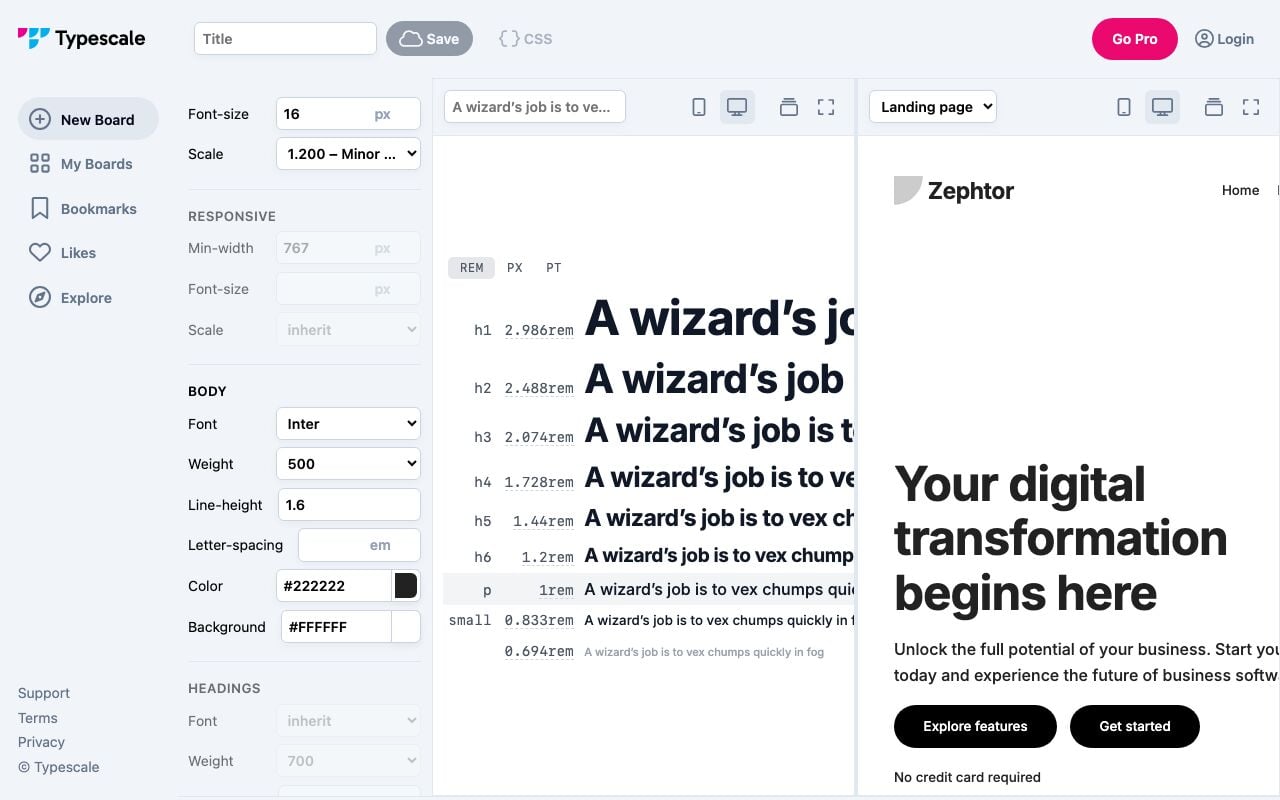
*Typescale editor with a 16px base and a 1.2 ratio, captured November 2026.*
**Key features:** scale presets from 1.067 to 1.618 plus a custom value; separate font, weight, line height and letter spacing for body and headings; a responsive section with its own minimum width, base size and ratio; values in rem, px or pt; a live landing-page preview at phone and desktop widths; a CSS button in the toolbar.
**Free plan (checked Nov 7, 2026):** the core editor is free. In the main ratio menu, only the 1.618 Golden Ratio preset carries a Pro label.
**Pros:**
- The live preview shows your scale on a real page layout, not a list of numbers
- Body and heading settings stay separate, which matches how CSS works
- A responsive breakpoint is built in
**Cons:**
- It does not suggest fonts, so you need a pairing tool first
- The site shows a Go Pro button with no published price
**Pricing:** free core. Pro price not shown on the site.
**Bottom line:** the best free place to turn a pairing into numbers. If you want fluid sizes instead of breakpoints, the free [Utopia](https://utopia.fyi/type/calculator/) calculator exports a clamp() scale as CSS, SCSS or PostCSS.
### 5. [Figma](https://www.figma.com): Best for Type Styles Inside a Design File
[Figma](https://www.figma.com) is where most product teams already keep their designs, and its text styles become the type system that designers and developers share. Figma AI adds generation features across the product on a shared credit system.
**Key features:** text styles and variables that apply a scale across every frame; shared libraries, so one change updates every file; Dev Mode for developers to read sizes and line heights as code; Figma AI features on a credit allowance; Figma Make on the Full seat.
**Free plan (checked Nov 7, 2026):** Starter is free, with unlimited drafts and "150 AI credits/day, up to 500 AI credits/mo."
**Pros:**
- The type system lives in the same file as the designs that use it
- Text styles map cleanly to design tokens and CSS variables
- The free Starter plan is enough for a personal project
**Cons:**
- Figma does not choose a pairing or a ratio for you
- Team libraries and the full product set need a paid seat
**Pricing:** Professional Full seat $16/mo billed annually, or $20 billed monthly, with 3,000 AI credits a month. Dev seat $12/mo and Collab seat $3/mo, billed annually.
**Bottom line:** the right home for a type system once a team designs together. Decide the pair and the scale elsewhere, then set them as Figma styles so nobody drifts.
### 6. Taskade: Best for a Full Website Type System in One Pass
Taskade's [AI typography generator for websites](https://www.taskade.com/generate/design/website-typography) works one stage wider than a calculator. You describe your brand and your audience, and it returns font pairs, a type scale, and line heights for every text style on your site, saved in a workspace next to the brief that produced them.
**Key features:** a full type system from one brand description; sibling tools for [AI font pairing](https://www.taskade.com/generate/design/ai-font-pairing), a print type system and a typography pairing prompt; a [typography recommendation agent](https://www.taskade.com/agents/design/typography-recommendation-specialist) that answers follow-up questions; Taskade Genesis apps that store each type system and send the CSS to your team.
**Free plan (checked Nov 7, 2026):** a free account includes 3 Taskade Genesis apps, 1 AI agent and 10 automation runs per billing period, with no credit card. Free starts with 0 AI credits. On Free, you earn free AI credits with referrals and invites, and you can upgrade any time.
**Pros:**
- Pair, scale and line heights arrive together, so they agree with each other
- The brief, the result and the reason for each choice stay in one place
- An AI agent can apply the same rules to every new brand
**Cons:**
- Taskade does not draw new fonts and does not render lettering images
- It recommends existing fonts, so you still check each font's license
**Pricing:** Pro $10/month billed annually.
**Bottom line:** the best fit when you want a complete web type system and a record of why you chose it.
---
## Lettering and Text Inside Images
These tools paint words into a picture. The result looks like type, but it is an image.
### 7. [Ideogram](https://ideogram.ai): Best for Readable Text in Generated Images
[Ideogram](https://ideogram.ai) is the image model that typography roundups name first for legible words inside a picture. Its homepage promises "crystal-clear type" and "readable type in every layout," and its newest model, Ideogram 4.5, is marked New on the homepage.
**Key features:** prompt-to-image with accurate spelling in headlines, signs and posters; editable text layers in its workflows; style controls for illustration and typographic posters; a public community gallery to learn prompts from.
**Free plan (checked Nov 7, 2026):** "Free accounts get 30 credits each week if they sign in with Google, Apple or Microsoft." An email and password account gets no free credits. "On the free plan, everything you generate is public." On November 12, 2026, Ideogram's pricing FAQ said eligible free accounts get weekly credits, and "the amount may vary."
**Pros:**
- The most reliable text rendering among the image models we compared
- Free credits refill every week, not once
- Strong at poster and headline layouts where type is the subject
**Cons:**
- Free images are public, which rules out client work
- The output is a picture, so you cannot edit the words like live text
**Pricing:** Plus $20/month, or $15/month billed yearly. Pro $60/month, or $42/month billed yearly. Team $30 per user a month, or $20 billed yearly, with a 2-user minimum.
**Bottom line:** the first stop for a poster, a thumbnail or a headline image with words that must read correctly.
### 8. [Recraft](https://www.recraft.ai): Best for Vector Lettering
[Recraft](https://www.recraft.ai) generates editable vector graphics as well as raster images. Its homepage lists "design-ready typography" and "complex editable vector graphics," and its vector generator page says a free account includes full SVG export.
**Key features:** prompt-to-vector generation with clean paths; an AI vectorizer that converts an existing image to SVG; custom styles you can reuse across a set of assets; custom color palettes on paid plans; a choice of other image models on paid plans.
**Free plan (checked Nov 7, 2026):** "Personal use only." The pricing page lists 3 generations per style a day, 3 image uploads a day, and "All images are public." Free images "are owned by Recraft" and "are not licensed for commercial use."
**Pros:**
- Vector output scales from a favicon to a billboard without blur
- Reusable styles keep a set of lettering assets consistent
- Paid plans grant full ownership and commercial rights
**Cons:**
- Free output belongs to Recraft and cannot be used commercially
- The free daily limit is small for serious lettering work
**Pricing:** Basic $10/month billed annually ($120) with 1,000 credits a month. Pro from $16/month billed annually ($192) with 2,000 credits. Teams from $18 per seat a month billed annually.
**Bottom line:** the right pick for a logo mark, an icon set or lettering that must stay sharp at every size, on a paid plan.
### 9. [Adobe Express](https://www.adobe.com/express/): Best for Text Effects on Social Graphics
[Adobe Express](https://www.adobe.com/express/) is Adobe's quick-design app for social posts, flyers and short videos. Its generative features can fill text with a texture or a scene from a prompt, and its free plan includes a slice of the Adobe Fonts library.
**Key features:** generative text effects; templates for every social format; Adobe Fonts inside the editor; background removal and resizing; scheduling for social posts on paid plans.
**Free plan (checked Nov 7, 2026):** US$0, with "limited generative AI credits and assets" and free daily generations for images, text effects and templates. The plan card says "access to 4,000+ fonts from the Adobe Fonts collection." The comparison table on the same page says 5,000+.
**Pros:**
- Text effects and templates on a free plan, no credit card
- Real Adobe Fonts, not lookalikes, inside the editor
- Fast for a designer who needs ten sizes of the same graphic
**Cons:**
- The free generative allowance is not stated as a number
- Not a type system tool: no scale, no CSS
**Pricing:** Premium US$9.99/month with 250 generative credits a month per user and the full Adobe Fonts collection of 30,000+ fonts.
**Bottom line:** the most useful free option for social graphics where the text itself needs to look like something.
### 10. [Kittl](https://www.kittl.com): Best for Merch and Print Lettering
[Kittl](https://www.kittl.com) is a design platform built around logos, merchandise, packaging and labels. Its templates and text tools aim at print-on-demand sellers who need lettering that looks hand-made.
**Key features:** text effects such as arcs, outlines and distress textures; thousands of premium templates from independent designers; AI image and design generation on daily and monthly tokens; mockups for shirts, mugs and packaging.
**Free plan (checked Nov 7, 2026):** "For personal use only (no commercial rights)." The FAQ lists high-resolution and vector exports among the paid-plan benefits.
**Pros:**
- Templates and text effects aimed squarely at merch
- A clear commercial license: up to 500,000 copies on Pro and Expert
- Daily tokens reset every 24 hours on higher plans, 200 a day on Expert and 600 on Max
**Cons:**
- The free plan cannot be used for anything you sell
- High-resolution and vector export sit behind a paid plan
**Pricing:** Pro $12/month billed annually ($144/year) or $15 month to month. Expert $26/month billed annually ($312/year) or $35 month to month. Max $48/month billed annually ($576/year) or $65 month to month.
**Bottom line:** the best fit for a print-on-demand shop that needs lettering with personality and a license to sell it.
### 11. [Canva](https://www.canva.com): Best for Layouts That Need Type Fast
[Canva](https://www.canva.com) is the default design tool for people who are not designers. Its templates carry pre-paired fonts, and its AI features generate designs, images and copy inside the same editor.
**Key features:** 1.6 million+ templates with type already set; font combinations in the text panel; Brand Kits that store brand fonts and colors; AI design and image generation; font upload on paid plans.
**Free plan (checked Nov 7, 2026):** US$0, with "limited access to Standard and Premium AI" and 1 Brand Kit with up to 3 colors. Font upload needs Canva Pro, Teams, Business, Education or Nonprofits, and uploaded fonts "should be licensed for embedding."
**Pros:**
- The fastest path from a blank page to a finished layout
- Template fonts are already paired by Canva's designers
- Pro includes 10 times the AI allowance of the free plan
**Cons:**
- No custom font upload on Free, so your brand font may be missing
- Templates make it easy to look like everyone else
**Pricing:** Pro US$144/year for one person. Business US$250/year per person.
**Bottom line:** the right pick when the deadline matters more than the type system. Upload your brand fonts on Pro so every template uses them.
### 12. [Typogram](https://www.typogram.co): Best for Wordmarks and Brand Type
[Typogram](https://www.typogram.co) calls itself "a typography-first canvas for creating expressive graphic design and distinctive brand identities." It has two products: Studio, an open canvas for posters and wordmarks, and Branding, a guided workflow for a logo and a visual brand system.
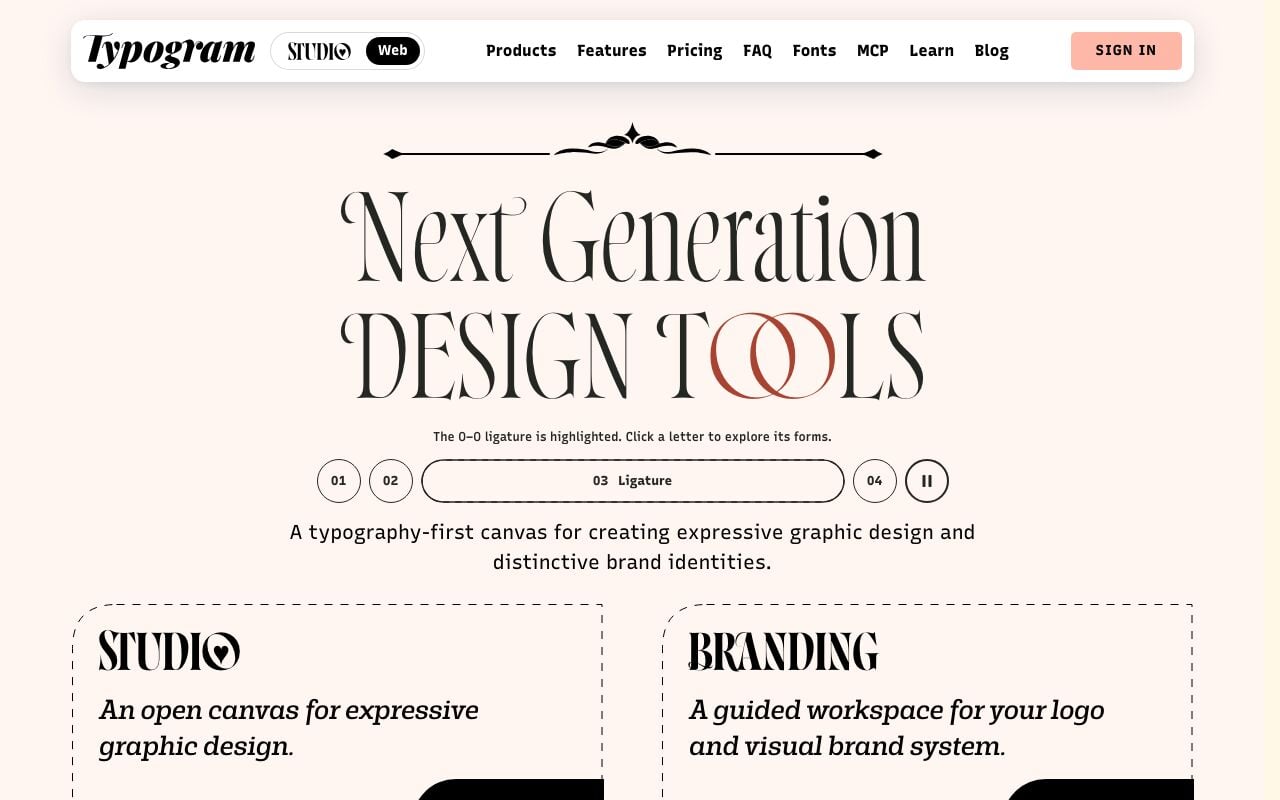
*Typogram homepage, captured November 2026.*
**Key features:** expressive type controls, including alternates and ligatures; a large curated font library; AI vector icon generation; a guided branding flow that ends in logo assets.
**Free plan (checked Nov 7, 2026):** Studio Basic is free, with PNG and SVG export using 1,629 non-premium font families and 3 AI vector icons.
**Pros:**
- Free SVG export, which most lettering tools keep behind a paywall
- Type-first controls designed for wordmarks, not general layout
- A one-time branding license instead of a subscription
**Cons:**
- The full library of 5,178 font families needs Studio Premium
- Not built for long-form layouts or web type systems
**Pricing:** Studio Premium $6/month or $72 billed annually. Branding $124.99 per brand, one-time.
**Bottom line:** the best free tool for a wordmark you can export as SVG and refine in a vector editor.
---
## Real Font File Generators
These tools produce a font you can install and type with, the only output in this list that behaves like real type.
### 13. [Calligraphr](https://www.calligraphr.com): Best for a Font From Your Handwriting
[Calligraphr](https://www.calligraphr.com) turns your handwriting or calligraphy into a font. You print a template, write each character in its box, scan or photograph the page, and the service builds a font file from it. It is template tracing, not generative AI, and it is the most dependable path to a personal font.
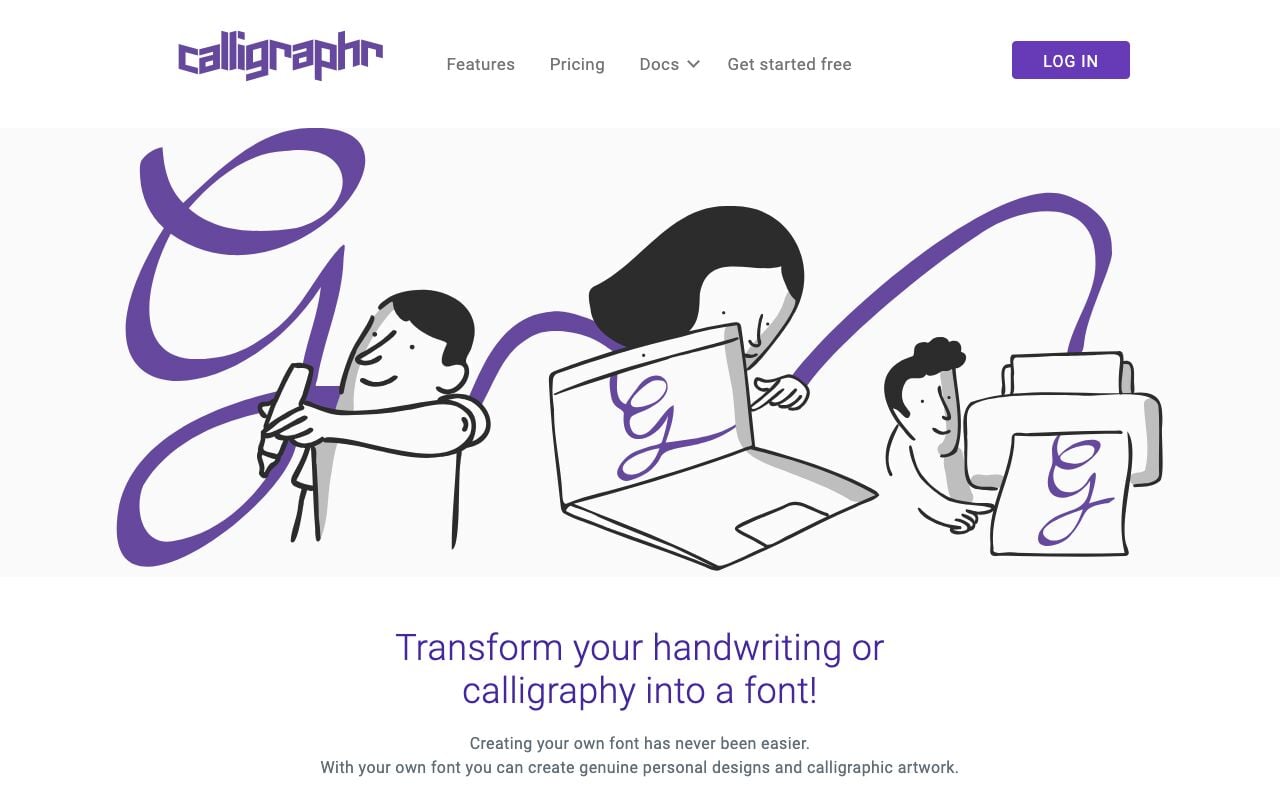
*Calligraphr homepage, captured November 2026.*
**Key features:** printable templates for any character set; several variants per character, so repeated letters look natural; ligatures on Pro; adjustable baseline and size per glyph; export as "a standard font file (ttf or otf)."
**Free plan (checked Nov 7, 2026):** free with registration, 75 characters per font, 2 variants per character, no ligatures.
**Pros:**
- A real installable font, not an image
- Fonts "fully function even when your upgrade period has expired"
- A 100% money-back guarantee on the upgrade
**Cons:**
- Manual work: you write every character by hand
- 75 characters cover a basic Latin alphabet, not accents or symbols
**Pricing:** Pro $10 for one month, or $6/month for a 6-month upgrade, with 600 characters and 15 variants per character.
**Bottom line:** the best way to make a font that is truly yours. Write slowly, use a fine black pen, and fill two variants of every common letter.
### 14. [Mixfont](https://mixfont.com): Best for a Font From a Text Prompt
[Mixfont](https://mixfont.com) generates a downloadable font from a written description. You describe the style, and it returns a font file rather than a picture of letters, which puts it in a small group of true prompt-to-font tools.
**Key features:** prompt-to-font generation; font file download on every plan; private fonts on paid plans; expanded glyph support on paid plans; concurrent jobs that grow with the plan.
**Free plan (checked Nov 7, 2026):** $0 with 50 starter credits. The FAQ says free starter credits "are intended for evaluation and do not reset monthly." One job runs at a time, with basic glyph support.
**Pros:**
- A real font file from a prompt, not an image
- The FAQ grants commercial use for "any font generated on Mixfont"
- A clear credit model with no card needed to start
**Cons:**
- The free plan is a one-time trial, not a monthly allowance
- The homepage names TTF files only ("Download the TTFs directly"), with no OTF option listed (checked 2026-11-12)
**Pricing:** Pro $20/month with 1,000 credits a month. Max $200/month with 5,000 credits a month.
**Bottom line:** the most direct way to get an original display font from words. Test every glyph you need at body size before you commit a brand to it.
---
## How to Turn a Type Scale Into CSS With AI
**To turn a type scale into CSS with AI, ask for CSS custom properties with fluid clamp() sizes, not fixed pixel values.** Fixed sizes need a media query for every breakpoint. A clamp() value grows smoothly between a minimum and a maximum as the screen widens, so one rule covers every screen. The [CSS AI](https://www.taskade.com/generate/programming/css) generator writes these rules from a plain description, and the steps below work in any AI tool.
### Step 1: Pick the pair and the ratio
Choose two fonts and two ratios: a smaller one for phones and a larger one for desktops. A common choice is a 16-pixel base with a 1.2 ratio at 360 pixels wide, and an 18-pixel base with a 1.25 ratio at 1,240 pixels wide. [Utopia](https://utopia.fyi/type/calculator/) defaults to the same viewports and ratios with an 18 and 20 pixel base, and this pairing of a smaller and a larger ratio keeps a phone headline readable while a desktop headline gets room to breathe.
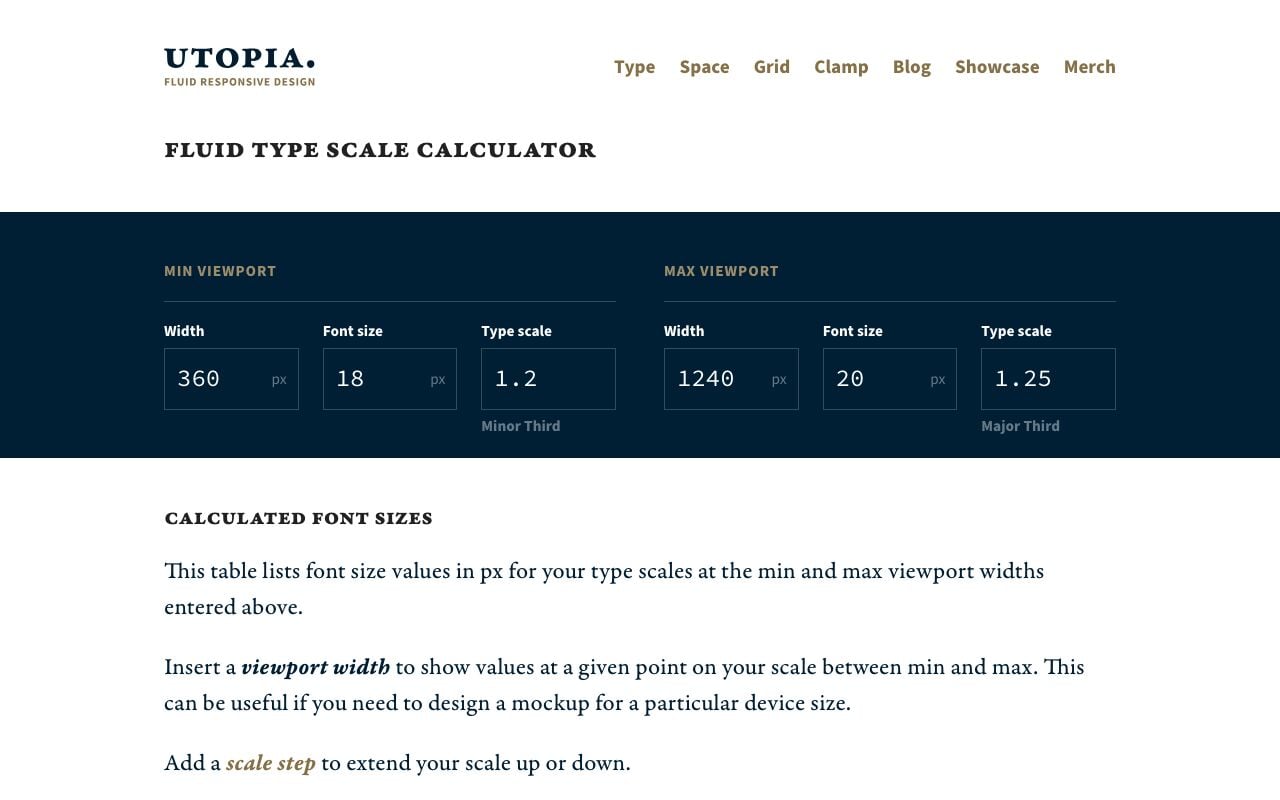
*Utopia's fluid type scale calculator, captured November 2026.*
### Step 2: Generate fluid sizes
Each step of the scale gets a minimum size, a maximum size, and a slope between them. The chart shows how far apart the two ends of the same scale sit:
```mermaid
xychart-beta
title "One fluid scale: size per step on a phone and a desktop"
x-axis "Text style" [Caption, Body, H5, H4, H3, H2, H1]
y-axis "Font size (px)" 0 --> 60
bar "Desktop 1240px" [14.4, 18, 22.5, 28.1, 35.2, 44, 54.9]
line "Phone 360px" [13.3, 16, 19.2, 23, 27.7, 33.2, 39.8]
```
Here is that scale as CSS. Every value is computed from the two ratios above, and both fonts are free on Google Fonts:
```css
:root {
--font-heading: "Fraunces", Georgia, serif;
--font-body: "Inter", system-ui, sans-serif;
--step--1: clamp(0.8333rem, 0.8061rem + 0.1212vw, 0.9rem); /* caption */
--step-0: clamp(1rem, 0.9489rem + 0.2273vw, 1.125rem); /* body */
--step-1: clamp(1.2rem, 1.116rem + 0.375vw, 1.406rem); /* H5 */
--step-2: clamp(1.44rem, 1.31rem + 0.5778vw, 1.758rem); /* H4 */
--step-3: clamp(1.728rem, 1.536rem + 0.8532vw, 2.197rem); /* H3 */
--step-4: clamp(2.074rem, 1.798rem + 1.224vw, 2.747rem); /* H2 */
--step-5: clamp(2.488rem, 2.102rem + 1.718vw, 3.433rem); /* H1 */
}
body { font-family: var(--font-body); font-size: var(--step-0); line-height: 1.5; }
h1 { font-family: var(--font-heading); font-size: var(--step-5); line-height: 1.1; }
h2 { font-family: var(--font-heading); font-size: var(--step-4); line-height: 1.15; }
h3 { font-family: var(--font-heading); font-size: var(--step-3); line-height: 1.2; }
small, figcaption { font-size: var(--step--1); }
```
A prompt that produces this kind of output, in any AI tool:
```
Write CSS custom properties for a fluid type scale.
Fonts: Fraunces for headings, Inter for body.
Min viewport 360px: base 16px, ratio 1.2.
Max viewport 1240px: base 18px, ratio 1.25.
Steps: -1 to 5. Use clamp() with rem and vw.
Add line heights: 1.5 body, 1.1 to 1.2 headings.
```
If you work in Tailwind, the [CSS to Tailwind converter](https://www.taskade.com/convert/coding/css-to-tailwind-css) turns the result into theme values, and the [CSS coding agent](https://www.taskade.com/agents/programming/css-coding) can review the file for mistakes. For full pages around this CSS, see our list of [AI HTML generators](https://www.taskade.com/blog/ai-html-generators).
The video below walks through the same clamp() approach in plain CSS:
[Easy Responsive Typography (CSS-only) by Coding in Public](https://www.youtube.com/embed/R1ehrIk0oUU?rel=0)
### Step 3: Load the fonts fast
A web font is a file the browser must download before it can draw your text. Set `font-display: swap` on each font, or add `&display=swap` to a Google Fonts link, so the browser shows text in a fallback font at once and swaps in the web font when it arrives. Load only the weights you use: two weights of each family cover most sites.
```mermaid
sequenceDiagram
participant R as Reader
participant B as Browser
participant C as Your CSS
participant F as Font host
R->>B: Open the page
B->>C: Read the font rules
C->>B: font-display swap and a fallback stack
B->>R: Show text in the fallback font
B->>F: Fetch the WOFF2 file
F->>B: Font file arrives
B->>R: Swap in the web font
```
Common mistakes, and the fix for each:
| Mistake | What the reader sees | Fix |
|---|---|---|
| Fixed px sizes with no breakpoints | A huge H1 that wraps on a phone | Use clamp() steps from two ratios |
| No font-display setting | Blank text for a moment on slow networks | Add font-display swap |
| Four weights of each family | A slow first page load | Keep two weights per family |
| Line height 1.5 on headings | Loose, floating headlines | Use 1.1 to 1.2 above 30px |
| A fallback font with a very different width | Text jumps when the web font arrives | Pick a fallback with a similar width |
---
## The Web Typography Pipeline, Mapped to Tools
**Every website type system passes through the same seven stages, and no single tool covers all of them.** Mapping the stages makes the choice obvious: a pairing tool feeds the scale, the scale feeds the CSS, and the test decides whether you ship.
```mermaid
graph TD
B["1. Brand brief
audience, mood, reading context"] --> PR["2. Font pairing"]
PR --> LI["3. License check"]
LI --> SC["4. Type scale and line heights"]
SC --> CS["5. CSS tokens and fluid sizes"]
CS --> TE["6. Test on a phone and in dark mode"]
TE --> SH["7. Ship and document the system"]
style B fill:#0d1a0e,color:#86efac,stroke:#22c55e,stroke-width:1.5px
style PR fill:#0d1b2a,color:#7dd3fc,stroke:#38bdf8,stroke-width:1.5px
style LI fill:#1a140a,color:#ffb74d,stroke:#e65100,stroke-width:1.5px
style SC fill:#0d1b2a,color:#7dd3fc,stroke:#38bdf8,stroke-width:1.5px
style CS fill:#2a1225,color:#ff8fa3,stroke:#ff2d60,stroke-width:2px
style TE fill:#1e1e2e,color:#94a3b8,stroke:#475569
style SH fill:#11111b,color:#cdd6f4,stroke:#00d4aa
```
| Stage | Free tool | Paid option | Output |
|---|---|---|---|
| 1. Brief | A Taskade project | Your design team | Audience, mood, reading context |
| 2. Pairing | Fontjoy | Monotype with a font license | Two or three font names |
| 3. License | The Google Fonts FAQ | A foundry license | A record of where each font can be used |
| 4. Scale | Typescale or Utopia | Figma Professional | Sizes and line heights per style |
| 5. CSS | Utopia or the CSS AI generator | Figma Dev Mode | Custom properties with clamp() |
| 6. Test | Browser developer tools | A device lab | Screenshots at phone and desktop width |
| 7. Document | A Taskade project | A design system site | A page that explains every choice |
One test rule saves most rework: if a heading wraps badly on a phone, go back to stage 4 and lower the phone ratio. Do not shrink a single heading by hand, because every hand fix breaks the scale for the next page.
---
## Why We Built the Type System Side Differently
**Every tool above solves one stage of typography, and the reasons for each choice usually live nowhere.** Taskade keeps the whole type system in one workspace with the brand brief, so the pair, the scale, the CSS and the reason for each choice stay together, and an AI agent can apply the same rules to the next brand.
A one-line prompt returns the average pairing. Ask any tool for "a modern font pair" and you will see Montserrat with Lora, or Inter with something serif, because those are the most common answers on the web. A written brief gives the AI something it cannot average away: who reads the site, on what screen, in what mood, and which brand the type must not resemble. The same lesson shows up in interface design, where you [attach a design brief](https://www.taskade.com/blog/ai-design-tools) instead of writing a better prompt.
So Taskade put the brief and the system in the same place. You can turn a brand brief into a font pair with the [creative-to-font-pairing converter](https://www.taskade.com/convert/creative/creative-to-font-pairing), test it at real sizes, and keep the result in a project your team edits together. Or you can build a small app around it. This is the exact prompt we would give [Taskade Genesis](https://www.taskade.com/create):
```
Build a website typography studio: a Type Systems table with brand, mood, heading font, body font, base size, scale ratio and license; an AI agent that suggests three free font pairings for a brand brief, builds a type scale from H1 to caption, and writes CSS custom properties with clamp() sizes; and an automation that emails the CSS and a specimen link to the requester when a type system is marked Approved.
```
```mermaid
sequenceDiagram
participant D as Designer
participant A as Typography app
participant G as AI agent
participant T as Type Systems table
participant M as Automation
D->>A: Submit brand brief and mood
A->>G: Ask for three pairings and a scale
G->>T: Save pair, ratio, sizes and CSS
D->>T: Mark one system Approved
T->>M: Status changed to Approved
M->>D: Email CSS and specimen link
```
The app has three parts: data, one [AI agent](https://www.taskade.com/agents) and one [automation](https://www.taskade.com/automate). That is the shape every Taskade Genesis app shares, and it is why the [AI app builder](https://www.taskade.com/ai/apps) suits small internal tools like this one. Give it a look that matches your brand with the [guide to app styles](https://www.taskade.com/learn/genesis/app-styles), and publish it on your own domain from Pro and up with [custom domains](https://www.taskade.com/learn/genesis/custom-domains).
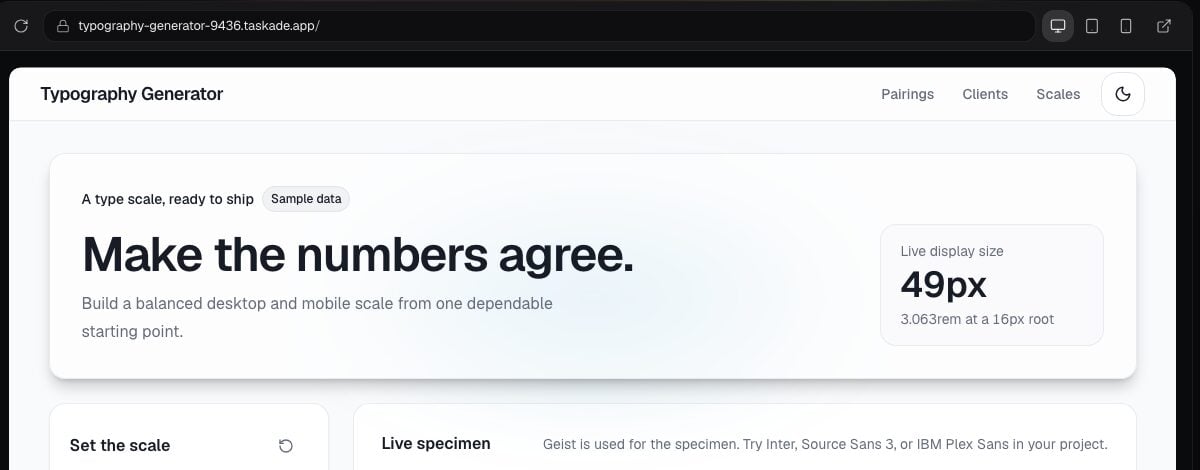
*The Type Scale Generator with CSS kit in the Taskade App Factory, captured November 2026. It shows sample data.*
You can also start from a kit in the [Taskade App Factory](https://www.taskade.com/apps). None of the kits below has a price, but each one holds automations, so cloning it needs a paid plan. On Free, build your own version from the prompt above. The build uses AI credits, and Free starts with none, so earn credits with referrals and invites first.
| Kit | What it does | Contents |
|---|---|---|
| [Type Scale Generator with CSS](https://www.taskade.com/apps/all/type-scale-generator-with-css-for-your-website-yvr44tvtha6it6jl) | Builds a scale from a base size and a ratio, with line heights and CSS per client | 3 projects, 1 AI agent, 3 automations |
| [Brand Kit Generator: colors, fonts and voice](https://www.taskade.com/apps/all/brand-kit-generator-colors-fonts-and-voice-qfsjzkul2vzpnakz) | Drafts brand colors, fonts and a voice guide | 3 projects, 2 AI agents, 2 automations |
| [CSS Generator](https://www.taskade.com/apps/all/css-generator-rv1ntsihlgwkw9gp) | Writes CSS from a description | 6 projects, 1 AI agent, 5 automations |
| [Design System Docs](https://www.taskade.com/apps/all/design-system-docs-dyc46c4ehpxa1p6x) | Documents tokens, type and components | 4 projects, 1 AI agent, 2 automations |
Kit contents checked on November 7, 2026.
---
## Limitations: When Taskade Is Not the Right Tool
**Use a dedicated tool when you need a new font drawn, lettering inside an image, or a foundry license.** Taskade recommends and documents existing fonts. It does not make font files, and it does not paint text into pictures.
- **You need a new font drawn.** Use Calligraphr for your own handwriting or Mixfont for a font from a prompt. A type designer is still the right call for a full brand family with many weights and languages.
- **You need words inside an image.** Use Ideogram for a poster or a headline image, and Recraft for vector lettering you can scale.
- **You need licensed foundry fonts.** Use Monotype or another foundry, and buy a license that covers web, app and logo use.
---
## The Verdict
For a free font pairing, **Fontjoy** is the quickest start, and **Monotype** is the pick when your brand licenses commercial fonts. For a type scale, **Typescale** and **Utopia** turn a pair into numbers and CSS for free, and **Figma** keeps the result as shared text styles. For text inside images, **Ideogram** renders the most reliable words and **Recraft** gives you vectors. For a real font, **Calligraphr** captures your handwriting and **Mixfont** makes one from a prompt.
And before any of them, write the brief. The tools are fast enough now that the decision is the hard part, which is where a shared Taskade workspace and a full type system in one pass help. **[Build your type system in Taskade →](https://www.taskade.com/create)**
> ▲ ■ ● Bodoni's widow printed his specimen book by hand in 1818. Today a type system takes a minute, and the brief is what is left to do well. Memory feeds Intelligence, Intelligence triggers Execution.
---
## AI Typography FAQ
### What is the best AI typography tool in 2026?
It depends on the output you need. Fontjoy and Monotype lead font pairing. Typescale and Figma handle type scales, and Taskade's AI typography generator returns a font pair, a type scale and line heights for a website in one pass. Ideogram leads text inside images, and Calligraphr and Mixfont make installable font files.
### What is the best free AI font pairing tool?
Fontjoy is the simplest free option. It generates a pairing with one click from a neural network trained on Google's web fonts, and it lets you lock one font while it changes the other. It lists no pricing. Monotype's Font Pairing Generator is also free on the web, but it suggests commercial foundry fonts, and Monotype says the full experience needs a Monotype Fonts subscription.
### Can AI create a real font file?
Yes. Mixfont turns a text prompt into a downloadable font, and its free plan includes 50 one-time starter credits. Calligraphr turns your handwriting into a standard TTF or OTF font and is free for fonts of up to 75 characters. Most other AI typography tools output images or font suggestions, not font files.
### Can I use AI-generated fonts and lettering commercially?
Often on paid plans only. Recraft says free-plan images are owned by Recraft and are not licensed for commercial use, and Kittl's free plan is for personal use only. Mixfont's FAQ says any font generated on Mixfont can be used for any purpose, including commercial work. Save the terms page on the day you generate anything you plan to sell.
### Are Google Fonts free for commercial use?
Yes. Google's official FAQ says Google Fonts are open source, cost nothing, and can be used commercially, including in logos, print, websites and apps. Most use the SIL Open Font License, which lets you bundle a font with a product you sell but does not let you sell the font files by themselves.
### What is a type scale?
A type scale is a set of font sizes made by multiplying one base size by one ratio. With a 16 pixel base and a 1.25 ratio, the steps are 16, 20, 25, 31.3, 39.1 and 48.8 pixels. A scale keeps headings and body text in proportion across every page of a site.
### How do I turn a font pairing into CSS?
Ask for CSS custom properties with fluid clamp() sizes, so text grows smoothly between a phone and a desktop screen. Typescale and Utopia export a scale as CSS, and Taskade's CSS AI generator writes the rules from a plain description. Load web fonts with font-display swap so text shows while the font downloads.
### Which AI image generator renders text best?
Ideogram is the tool most typography roundups name first for readable text in images, and its own homepage promises crystal-clear type. Its free plan gives weekly credits when you sign in with Google, Apple or Microsoft (Ideogram says the amount may vary), and everything made on the free plan is public. Recraft is the stronger pick when you need vector lettering.
### What is an AI typography edit?
A typography edit is a photo or video with styled text laid over it, such as a quote card, a title card or a captioned short. Adobe Express, Canva and Kittl handle it best on stills, with text effects and templates. For video captions, keep one font pair and one size scale across every clip so the series reads as one brand.
### How many fonts should a website use?
Two is the usual answer: one font for headings and one for body text. A third font works for code or captions when it has a clear job. Every extra font family adds file weight to the page and makes the brand harder to recognize.
### Can Taskade generate typography for my website?
Yes. Taskade's AI typography generator for websites returns a font pair, a type scale, and line heights for every text style from a description of your brand. With Taskade Genesis you can also build a small app that stores each type system and sends the CSS to your team. Taskade recommends existing fonts and does not draw new ones.
### What does Taskade's free plan include?
Taskade Free includes 3 Taskade Genesis apps, 1 AI agent, 2 workspace members and 10 automation runs per billing period, with no credit card. Free starts with 0 AI credits. On Free, you earn free AI credits with referrals and invites, and you can upgrade any time. Pro costs $10 a month billed annually.
Facts checked on 2026-11-07. See current plans on the [pricing page](https://www.taskade.com/pricing).
---
## Further Reading
- [AI Design Tools 2026](https://www.taskade.com/blog/ai-design-tools): why a design brief beats a better prompt, with a DESIGN.md sample
- [AI HTML Generators](https://www.taskade.com/blog/ai-html-generators): the pages your type system ends up on
- [Best AI Image Generators](https://www.taskade.com/blog/best-ai-image-generators): broader image tools beyond lettering
- [AI Website Builders](https://www.taskade.com/blog/ai-website-builders): builders that apply a type system for you
- [AI Portfolio Generators](https://www.taskade.com/blog/ai-portfolio-generators): where typography carries the whole design
- [AI Design and Branding Tools](https://www.taskade.com/blog/ai-design-branding-tools): design apps you can build with Taskade Genesis
- [Free AI App Builders](https://www.taskade.com/blog/free-ai-app-builders): free builders for the tools around your brand
## Related Reading
- [Free Canva alternative](https://www.taskade.com/compare/free-canva-alternative)
- [Free Figma AI alternative](https://www.taskade.com/compare/free-figma-ai-alternative)
- [Free Framer alternative](https://www.taskade.com/compare/free-framer-alternative)
## Sources
- [Manuale Tipografico, 1818](https://commons.wikimedia.org/wiki/File:Manuale-Tipografico1.jpg): Wikimedia Commons, public domain
- [Fontjoy](https://fontjoy.com) and [Fontjoy source code](https://github.com/Jack000/fontjoy): checked November 7, 2026
- [Monotype Font Pairing Generator](https://www.monotype.com/font-pairing), [FontPair AI](https://www.fontpairai.com), [Typescale](https://typescale.com), [Utopia fluid type scale calculator](https://utopia.fyi/type/calculator/): checked November 7, 2026
- [Figma pricing](https://www.figma.com/pricing/), [Ideogram available plans](https://docs.ideogram.ai/plans-and-pricing/available-plans) (page marked "Last verified: October 15, 2026", and it returned a 404 on November 12, 2026), [Ideogram homepage](https://ideogram.ai): checked November 7, 2026. [Ideogram pricing and FAQ](https://ideogram.ai/pricing): checked November 12, 2026
- [Recraft pricing](https://www.recraft.ai/pricing), [Recraft AI vector generator](https://www.recraft.ai/ai-vector-generator), [Adobe Express pricing](https://www.adobe.com/express/pricing), [Kittl pricing](https://www.kittl.com/pricing): checked November 7, 2026
- [Canva pricing](https://www.canva.com/pricing/), [Canva: upload fonts](https://www.canva.com/help/upload-fonts/), [Typogram](https://www.typogram.co): checked November 7, 2026
- [Calligraphr pricing](https://www.calligraphr.com/en/pricing/), [Mixfont pricing](https://mixfont.com/pricing): checked November 7, 2026. [Mixfont homepage](https://mixfont.com) export format: checked November 12, 2026
- [Google Fonts FAQ](https://developers.google.com/fonts/faq) and [SIL Open Font License](https://openfontlicense.org/open-font-license-official-text/): checked November 7, 2026
[](https://www.taskade.com/)