# AI Agents for Solopreneurs: Run a One-Person Company (2026)
> Run a one-person company with a team of AI agents. They handle content, sales, support, and admin, keep persistent memory, and hand work to each other so you operate like a 10-person team.
- Source: https://www.taskade.com/blog/ai-agents-solopreneurs
- Published: 2026-07-29
- Updated: 2026-11-12
- Author: Taskade Team
**Yes, a solopreneur can run a one-person company with a team of AI agents in 2026 — and the founder keeps only the part that needs a human: strategy, taste, relationships, and the final yes.** A small team of agents now covers the four jobs that consume most solo founders' weeks: a content agent ships marketing, a sales agent works the pipeline, a support agent keeps customers happy, and an admin agent handles invoices and scheduling. The agents keep persistent memory, hand work to each other, and connect to your real tools — so one person operates like a 10-person company. The fastest way there is to stop wearing every hat manually and instead **describe the business you want to run**, then let it build the agents that run it.
> **TL;DR:** A solopreneur in 2026 can run content, sales, support, and admin with AI agents that keep persistent memory and hand work to each other. A four-agent starter team replaces a writer tool, CRM, helpdesk, and scheduler. The fastest path: describe the business and let **[Taskade Genesis](https://www.taskade.com/create)** build the agents, automations, and live app. [Try the working app below →](#see-it-live)
[AI Agent for solopreneurs — clone and run your one-person company in your workspace](https://www.taskade.com/app/content-agent-chatbot-cibvdbpnmfh8ql8k)
This is **not** the same article as our [AI agents for startups](https://www.taskade.com/blog/ai-agents-startups) guide. That one is about a small *team* of humans scaling with agents. And it is not [how to make money vibe coding](https://www.taskade.com/blog/vibe-coding-money). That one is about shipping apps for clients. **This guide is the one-person-business angle.** It shows you how *you, alone,* build a team of AI agents that runs the repeatable work of your company while you sleep. By the end you will know which agents to hire first, how they hand work to each other, and how to wire them into one living workspace. [Try the app above](#see-it-live) or [start your own from a prompt](https://www.taskade.com/create) to follow along.
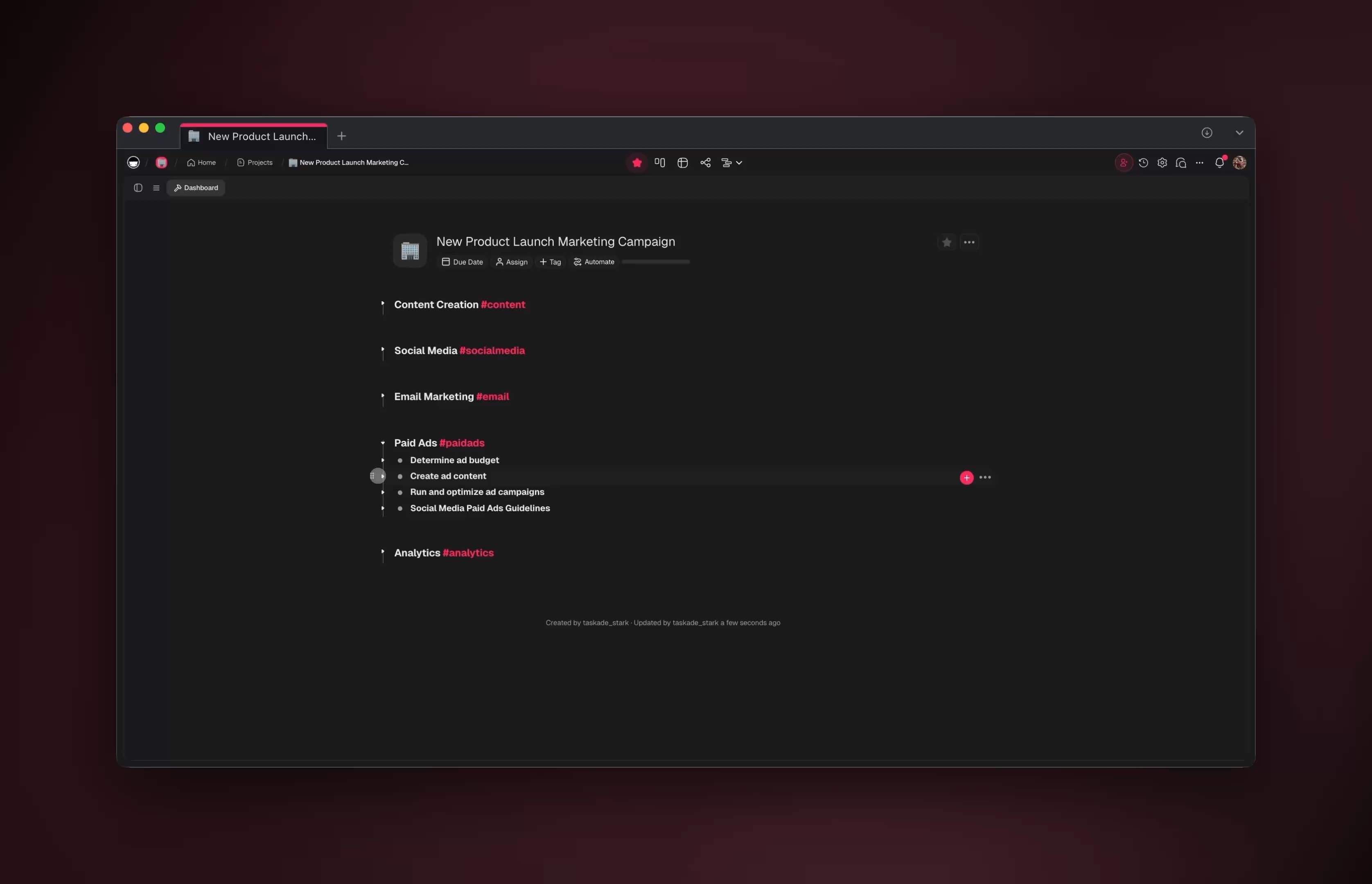
## What does it mean to run a one-person company with AI agents?
Running a one-person company with AI agents means hiring software workers instead of doing every job yourself. A solopreneur wears every hat — marketer, salesperson, support rep, bookkeeper — and the math never works because there are only so many hours in a week. A **team of AI agents** changes the math: each agent owns one function, works around the clock, keeps persistent memory, and hands finished work to the next agent. One founder directs the team; the agents do the volume.
Here is the shift in one picture. The old solopreneur is a single person context-switching between five roles. The 2026 solopreneur is one director above a team of agents that each own a lane.
```mermaid
graph TD
subgraph Old["The old solopreneur (one person, every hat)"]
Y1[You] --> Y2[Marketing]
Y1 --> Y3[Sales]
Y1 --> Y4[Support]
Y1 --> Y5[Admin]
end
subgraph New["The 2026 solopreneur (one director, agent team)"]
D[You
the director] --> CA[Content agent]
D --> SA[Sales agent]
D --> SUP[Support agent]
D --> AD[Admin agent]
CA -.shared memory.- SA
SA -.shared memory.- SUP
SUP -.shared memory.- AD
end
classDef pink fill:#2a1225,color:#ff8fa3,stroke:#ff2d60,stroke-width:2px;
classDef teal fill:#11111b,color:#cdd6f4,stroke:#00d4aa;
class D pink;
class CA,SA,SUP,AD teal;
class Y1 pink;
class Y2,Y3,Y4,Y5 teal;
```
The practical upshot: you stop being the bottleneck on every task and start being the strategist who points the team. The agents do not get tired, do not forget last week's customer, and do not drop the ball when work passes from one role to the next — because they all share the same workspace memory. Learn the building blocks in our [AI agents hub](https://www.taskade.com/agents) and the [agent playbook](https://www.taskade.com/learn/agents/agent-playbook).
## What does an AI solopreneur do?
An AI solopreneur is a one-person business owner who hands the repeatable work of the business to AI agents and automations and keeps the decisions. The job changes from doing every task to three things: setting the goal for each agent, reviewing what the agents send back, and deciding where to spend time and money next.
The work still happens. The solopreneur's hours move from the first draft to the final call. Here is what a typical week looks like once the four-agent starter team below is running:
| Day | What the agents did | What the solopreneur does |
|---|---|---|
| Monday | The sales agent enriched and scored the weekend's inquiries | Approves the follow-ups for the hot leads, picks the week's focus |
| Tuesday | The content agent turned last week's webinar into posts and a newsletter draft | Edits the voice, approves the queue |
| Wednesday | The support agent answered routine questions and flagged three hard ones | Answers the hard cases, adds the answers to the help docs |
| Thursday | The admin agent sent invoices and booked calls from the calendar | Takes the sales calls, sets prices for custom work |
| Friday | Every agent wrote its results back into the shared projects | Reads the numbers, decides which agent gets a new job next |
The pattern behind the table: agents do the volume, and the founder does the judgment. That split is the subject of the rest of this guide.
## How can a solo founder run an entire company with AI agents?
A solo founder runs an entire company with AI agents by giving each agent one repeatable job, keeping every customer record in one shared workspace, and keeping a person on each decision that spends money, signs a customer or speaks for the brand. Agents cover the volume of marketing, sales, support and admin. The founder covers direction, taste and the final yes.
The idea now has a famous backer. On *The Library of Minds*, the Delphi podcast, in an episode published on October 29, 2026, Vercel CEO Guillermo Rauch said he hopes Vercel can help create "the single-person trillion-dollar company". He added that this does not dismiss teams, but that "one person plus agents can now do the work of hundreds of people, thousands of people". That is his claim and his hope, not a measured result. No one-person company of that size exists, and the honest version for a solopreneur today is smaller: one person plus agents doing the work of a small team.
[Vercel CEO: How 1 Person + AI Agents Could Build a $1T Company | Guillermo Rauch](https://www.youtube.com/embed/W9YfKZaK7KI?rel=0)
Rauch's more useful point for a solo founder came later in the same episode. As agents take on the work, he said, the human job becomes capital allocation: deciding how many tokens and how much compute go to which loop of work. Agents come back with trade-offs. His own example was an agent that reported that the next speed-up of a program would take about a thousand more hours and asked whether he really wanted it. A person makes that call.
| The founder's job | What the agents do | Where the founder steps in |
|---|---|---|
| Set the goal | Each agent gets one job and written criteria | Write the criteria once, change them when the business changes |
| Allocate time and money | Agents report what each next step costs | Decide which agent gets more work and which task stops |
| Approve what goes out | Agents draft replies, posts and invoices | Approve anything that sends money, signs a customer or speaks for the brand |
| Own the records | Agents read and write the shared projects | Keep the fields clean and check the numbers each week |
| Keep the buy list | Agents work next to payroll, accounting and payments tools | Keep renting those, and see [build vs buy](https://www.taskade.com/blog/build-vs-buy-software) for the rest |
```mermaid
sequenceDiagram
participant A as Agent
participant W as Automation
participant F as Founder
participant P as Projects
A->>P: Reads the customer record and past work
A->>W: Drafts the next step and its cost
W->>F: Wait for approval
F->>W: Approves or rejects
W->>P: Writes the result back
P->>A: The next run starts with more context
```
In Taskade, the checkpoint in that diagram is the [Wait for approval](https://www.taskade.com/learn/automation/approval-step) step: the automation pauses until you approve or reject. Use it in front of every step that sends mail, posts in public or pays an invoice. Two plan facts matter here, checked on 2026-11-07. The Free plan holds 1 AI agent and 10 automation runs per billing period, so a full four-agent team starts on Pro ($10 per month billed annually), which has unlimited agents and AI Teams, where agents delegate work to each other. For the company-level view, read [one-person companies](https://www.taskade.com/blog/one-person-companies) and the [solo operator business stack](https://www.taskade.com/blog/solo-operator-business-stack).
## Why solopreneurs win with AI agents in 2026
Solopreneurs who adopt a team of AI agents in 2026 reclaim the single scarcest resource in a one-person business: **time**. A solo founder spends the majority of the workweek on repeatable work — drafting content, chasing leads, answering the same support questions, and reconciling invoices. Handing those jobs to agents frees most of that time for the work only the founder can do, and it lets one person cover functions that used to require hiring.
The reason this matters now is **persistent memory plus handoff**. Earlier AI tools answered a single question and forgot everything. A 2026 agent remembers your brand, your customers, and your past decisions, and it passes context to the next agent in the chain. That is the difference between a chatbot and a coworker.
| The job you do alone | Hours a week (typical) | The agent that takes it | What you keep |
|---|---|---|---|
| Content and marketing | 8-12 hrs | Content agent | The brand bets |
| Lead follow-up and sales | 6-10 hrs | Sales agent | The real conversations |
| Customer support | 5-8 hrs | Support agent | The hard cases |
| Invoices and scheduling | 3-5 hrs | Admin agent | The money decisions |
| Reporting and review | 2-4 hrs | Reporting agent | Reading the numbers |
Treat that table as a starting menu, not a ceiling. Every recurring task you do more than once a week is a candidate for an agent. The founders who win automate the *high-frequency, low-judgment* work first and keep their attention for the 10-20% that actually grows the business. See how the pieces connect on the [automation hub](https://www.taskade.com/automate).
## The four-agent starter team for a one-person company
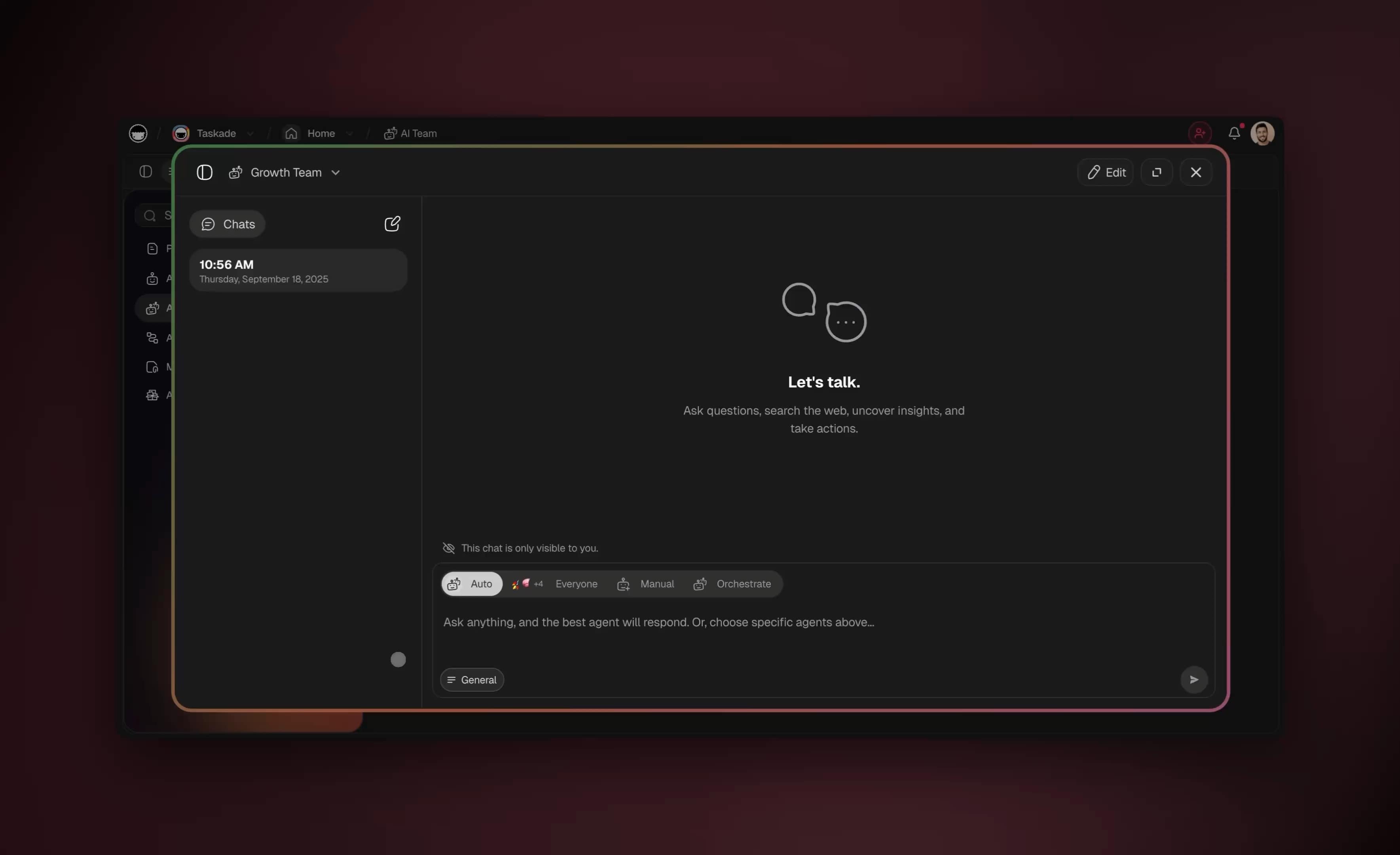
Every solopreneur should start with the same **four agents**, because they map to the four functions every business has: get attention, win customers, keep customers, and run the back office. You do not need all four on day one — build the one that eats the most of your week first, then add the rest. In [Taskade](https://www.taskade.com/agents) each agent ships with **built-in tools** (web search, file analysis, code execution, custom slash commands, and more) and routes across **frontier models from top AI labs**.
| Agent | Owns | What it does all day | Build it first if you |
|---|---|---|---|
| **Content agent** | Marketing | Drafts posts, repurposes one asset into many formats, schedules | Live or die by content |
| **Sales agent** | Pipeline | Enriches new leads, scores them, drafts personalized follow-ups | Capture form or inbound leads |
| **Support agent** | Customers | Answers from your docs and memory, routes hard cases to you | Field repeat questions daily |
| **Admin agent** | Back office | Generates invoices, books meetings, chases unpaid bills | Drown in busywork |
A good rule for a one-person business: **one agent, one job.** A narrow agent is reliable, easy to test, and easy to trust with autonomy. When a job spans two functions — say, "win a lead, then onboard them" — you do not build one giant agent. You let two agents **hand work to each other**, which is the real superpower of the solopreneur stack.
```mermaid
graph LR
LEAD[New lead
comes in] --> SA[Sales agent
enrich + qualify]
SA -->|won| ON[Onboarding agent
welcome + setup]
ON --> SUP[Support agent
answer questions]
SUP --> AD[Admin agent
invoice + renew]
AD -.->|new data.| MEM[(Shared memory
Projects, multiple views)]
MEM -.context.-> SA
MEM -.context.-> SUP
classDef pink fill:#2a1225,color:#ff8fa3,stroke:#ff2d60,stroke-width:2px;
classDef blue fill:#0d1b2a,color:#7dd3fc,stroke:#38bdf8,stroke-width:1.5px;
classDef green fill:#0d1a0e,color:#86efac,stroke:#22c55e,stroke-width:1.5px;
class LEAD pink;
class SA,ON,SUP blue;
class AD,MEM green;
```
This lead → onboard → support → renew chain is the backbone of a one-person company. Each agent finishes its job and passes the customer to the next, with full context, because they all read and write the same memory. Taskade supports this [multi-agent collaboration](https://www.taskade.com/agents) natively, and agents carry **persistent memory**, so the customer never has to repeat themselves and you never have to copy-paste between tools. Walk through building your first team in the [agent playbook](https://www.taskade.com/learn/agents/agent-playbook).
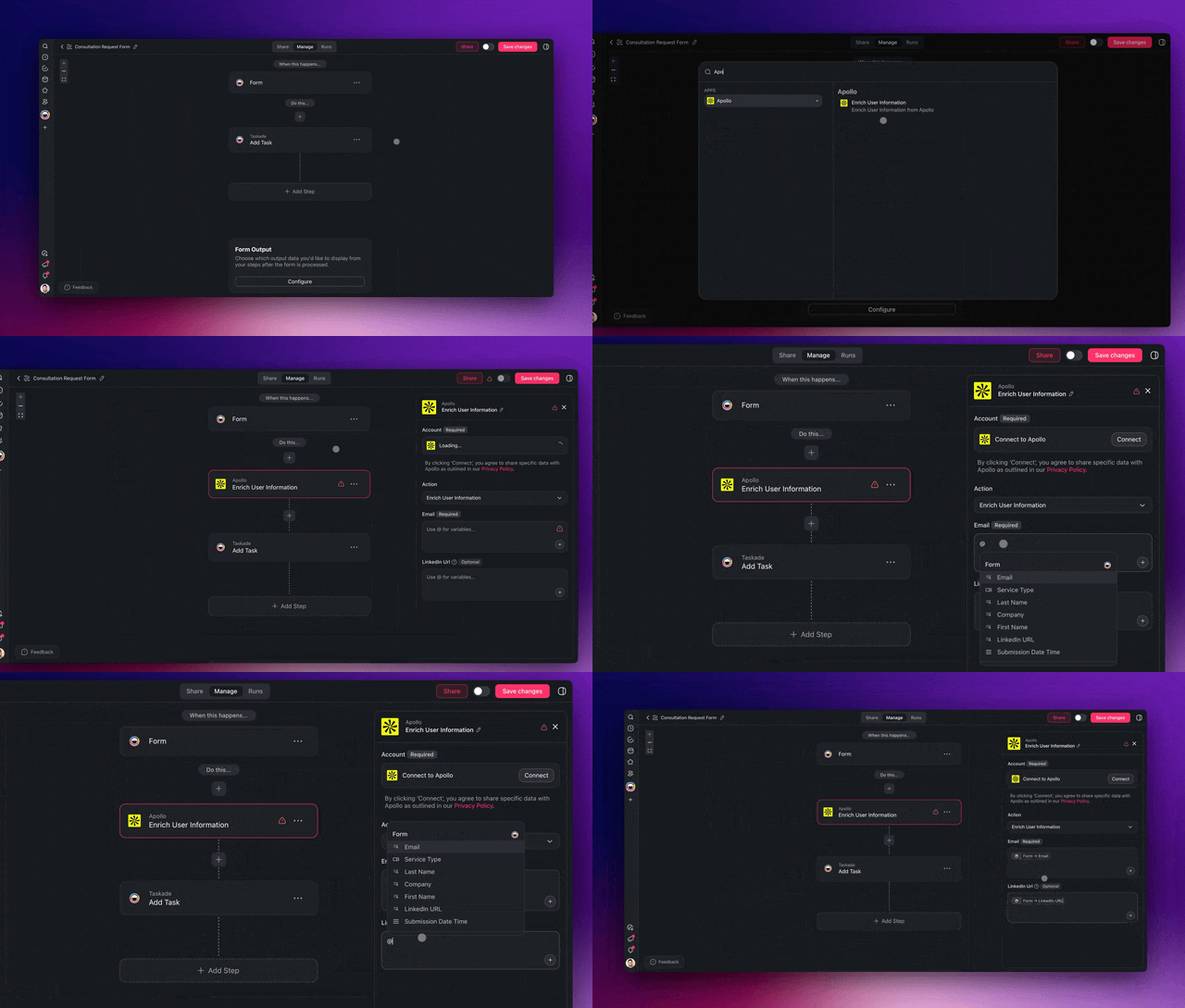
## How the agent team connects: the one-person-company map
A real one-person company has four moving parts, and they form a loop — not a line. **Memory** (your projects, customers, and brand data) feeds **Intelligence** (your agents), which drives **Execution** (your automations and integrations), which produces new data that flows back into Memory. This is Taskade's **Workspace DNA**, and it is what turns four disconnected agents into a company that gets smarter every week.
Below is the end-to-end map of how one customer travels through an agent-run company — from first touch to a paid, supported, renewing account — with agents and integrations doing every step and a human only on the decisions that matter.
```text
┌──────────────────────────────────────────────────────────────────┐
│ THE ONE-PERSON COMPANY │
│ (one prompt → one living app in Taskade) │
├──────────────────────────────────────────────────────────────────┤
│ │
│ INBOUND (triggers pull in) OUTBOUND (actions push out) │
│ ┌─────────────────┐ ┌──────────────────────┐ │
│ │ Form submitted │──┐ ┌─▶│ Invoice sent │ │
│ │ DM / email │ │ │ │ Reply delivered │ │
│ │ Support ticket │ │ │ │ Meeting booked │ │
│ │ Payment made │ │ │ │ Post published │ │
│ └─────────────────┘ │ │ └──────────────────────┘ │
│ ▼ │ │
│ ┌───────────────────────────────┐ │
│ │ INTELLIGENCE (agent team) │ │
│ │ ┌──────────┐ ┌────────────┐ │ │
│ │ │ Content │ │ Sales │ │ │
│ │ │ agent │ │ agent │ │ │
│ │ └──────────┘ └─────┬──────┘ │ │
│ │ ┌──────────┐ ┌─────▼──────┐ │ │
│ │ │ Admin │◀─│ Support │ │ │
│ │ │ agent │ │ agent │ │ │
│ │ └────┬─────┘ └────────────┘ │ │
│ └───────┼────────────────────────┘ │
│ ▼ │
│ ┌──────────────────┐ │
│ │ MEMORY (Projects)│ ◀── results flow back, company│
│ │ Views, history │ learns and compounds │
│ └──────────────────┘ │
│ │
└──────────────────────────────────────────────────────────────────┘
```
Notice there is no separate "writing tool," "CRM," "helpdesk," and "invoicing app" bolted together with tape. It is **one app**. That single-system design is exactly why a solopreneur can cut software spend dramatically — you are not paying four vendors and stitching their data by hand at 11pm. Each of the [100+ bidirectional integrations](https://www.taskade.com/automate) works in both directions, so a payment recorded in your processor can come back as a renewal task and an updated customer record without you copying a field.
## How Taskade does it differently
Here is the honest landscape. **n8n, Lindy, Zapier, and Make all do a genuinely good job at one thing: connecting apps.** You wire a trigger to an action, map the fields, and data moves between tools. For pure data plumbing, these are excellent — and to be fair, **Zapier's app catalog is unmatched** (thousands of connectors), **n8n is wonderfully cost-efficient** for high-volume technical flows, **Lindy ships polished prebuilt AI assistants** for specific roles, and **Make's visual canvas is a joy** if you love designing every branch by hand. If your only goal is to move data from A to B, any of them will serve a solo founder well.
But notice what they all hand you at the end: **an automation.** A flowchart. Wiring. You still need a separate place to store your customer data, a separate AI tool to write, a separate helpdesk to support, and a separate app to show a customer. As a solopreneur, *you* become the integration glue between five systems — which is exactly the job you were trying to escape.
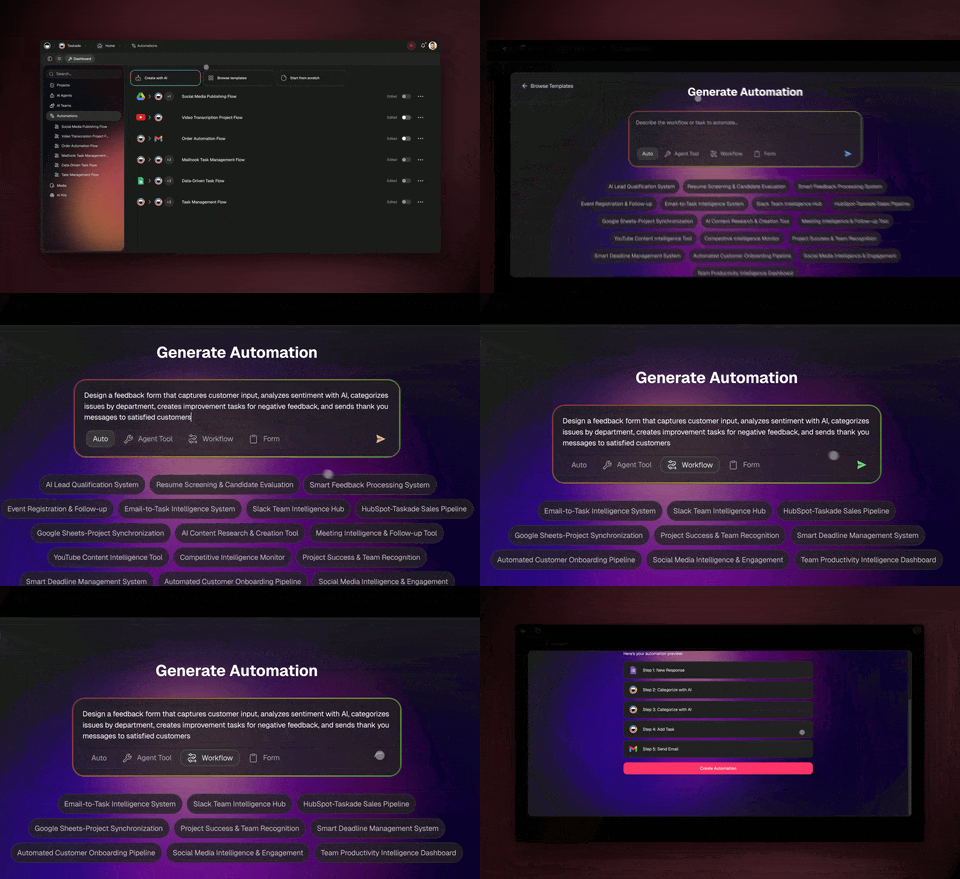
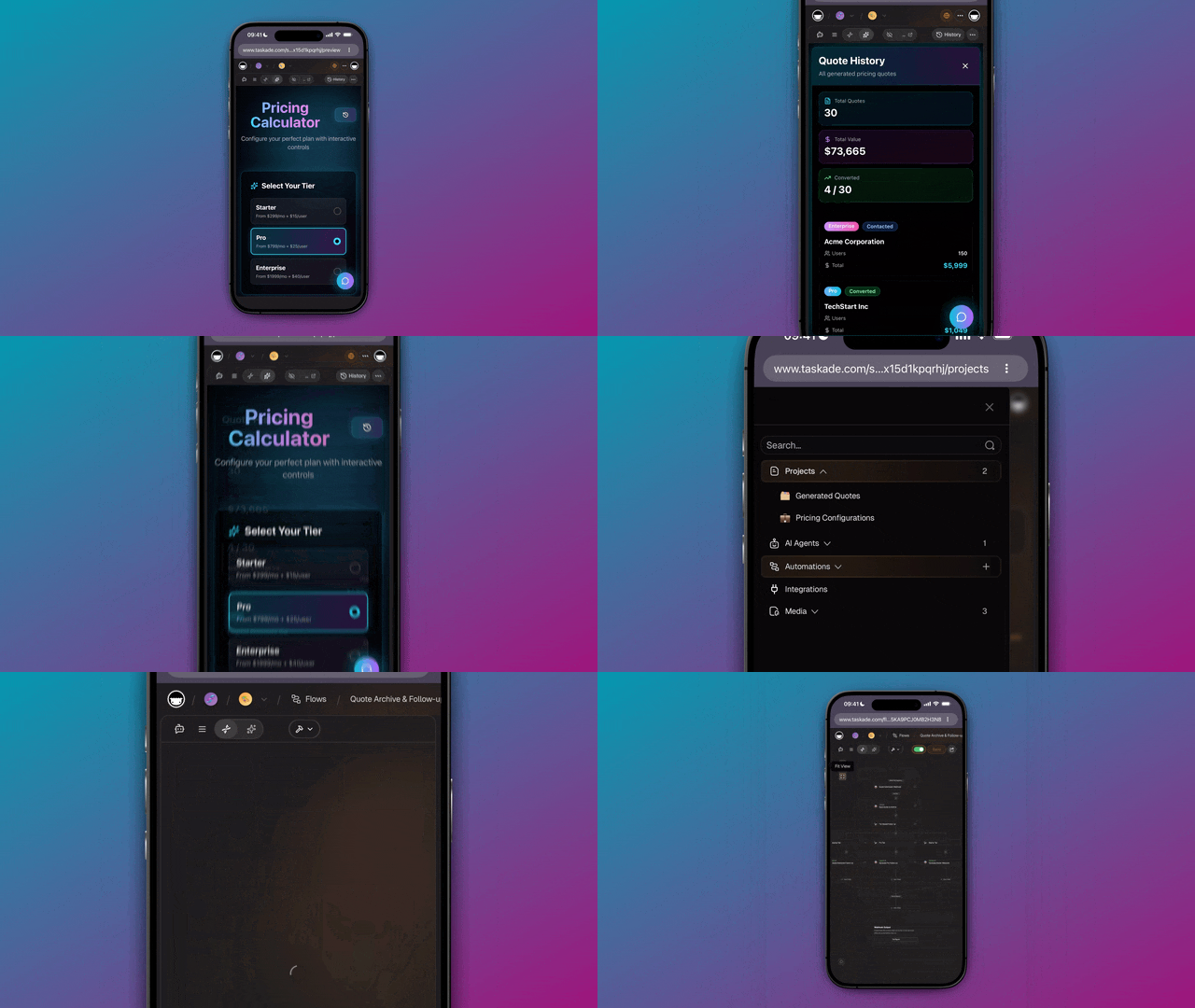
**Taskade Genesis takes a different altitude.** You do not wire nodes — you **describe the business you want to run**, and it ships a *living app*: a database, a team of AI agents, automations, and a shareable URL, all in one. That is the wedge.
| | Node-wirers (n8n, Lindy, Zapier, Make) | Taskade Genesis |
|---|---|---|
| **You build by** | Wiring triggers → actions on a canvas | Describing the business in plain English |
| **You get** | An automation (a flow) | A living app — data + agents + automations |
| **AI agents** | Add-on or single-role bot | A *team*, native, built-in tools, frontier models |
| **Customer data lives** | In another tool | In the app (Projects, multiple views) |
| **Agents hand off work** | You build the bridge | Native multi-agent collaboration |
| **Gets smarter over time** | No — static flow | Yes — Workspace DNA loop |
The mechanism behind that last row is **Workspace DNA** — the self-reinforcing loop where Memory feeds Intelligence, Intelligence drives Execution, and Execution creates new Memory.
```mermaid
stateDiagram-v2
direction LR
[*] --> Memory
Memory --> Intelligence: customers,
brand, history
Intelligence --> Execution: decisions,
drafts, actions
Execution --> Memory: new results,
new context
Execution --> LiveApp: shareable app
LiveApp --> [*]
note right of Intelligence
Team of AI agents,
built-in tools, frontier models,
multi-agent handoff
end note
```
A node-wirer cannot do this because a flowchart has no memory — every run starts cold, and your agents never learn your customers. A Taskade Genesis company *remembers* every customer, every conversation, every invoice, and each agent gets better because it works inside that accumulating memory. Add **multi-agent teams** that hand work to each other and the ability to **clone any live app** in seconds, and a solo founder gets a company that grows rather than a pile of automations to maintain. Explore the difference on the [AI apps page](https://www.taskade.com/ai/apps) and the [agents hub](https://www.taskade.com/agents).
## Taskade Genesis vs the alternatives for solopreneurs
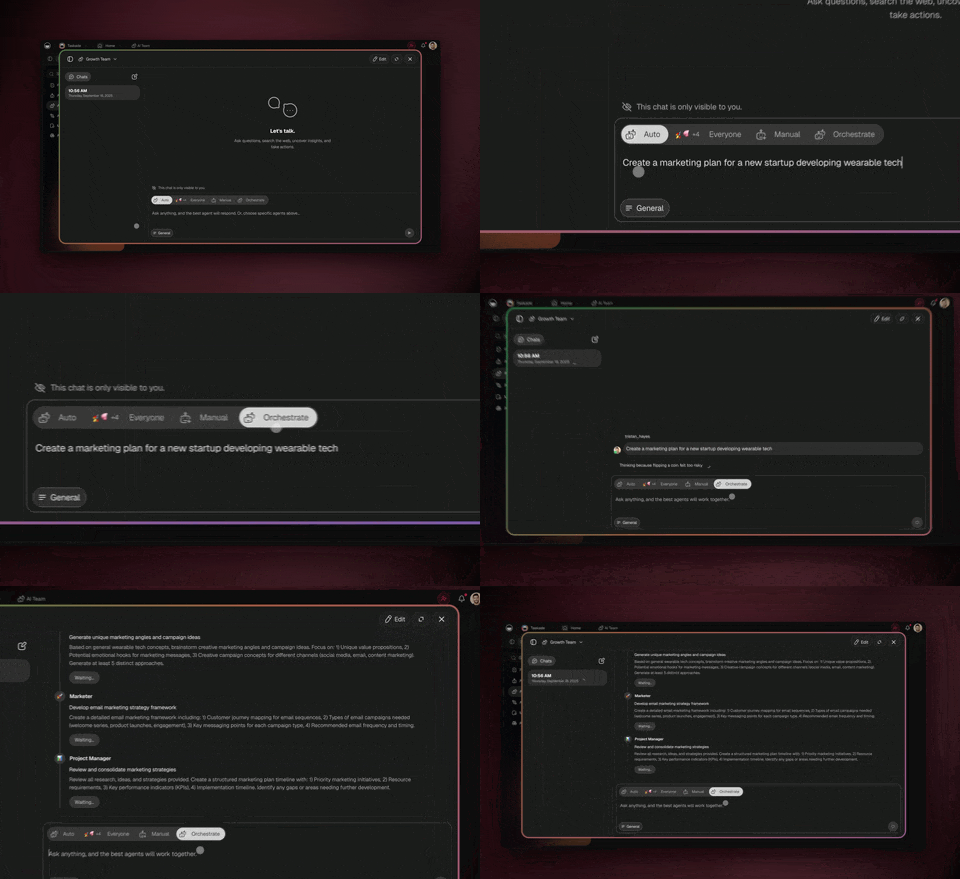
The best AI agent platform for a one-person business is the one that gives you a *whole company in one app* — a place to store data, a team of agents, and the automations that connect them — not a single assistant or a flow you still have to glue to four other tools. **Taskade Genesis is the only option below that ships memory, a multi-agent team, automations, and a shareable live app from one prompt.** The other tools each do one slice genuinely well, and a fair head-to-head should say so.
Here is the honest landscape for the names a solopreneur shortlists in 2026. Each row is the founder's real question; the columns are the five tools most often compared for this job.
| What a solo founder needs | **Taskade Genesis** | Lindy | Gumloop | Relevance AI | Manus |
|---|---|---|---|---|---|
| **You build by** | Describing the business in plain English | Configuring a prebuilt assistant | Wiring nodes on a visual canvas | Composing agents for data tasks | Setting a goal, agent self-plans |
| **What you get** | A living app — data + agent team + automations + URL | A capable single AI assistant | An AI-powered workflow | A research/analysis agent | An autonomous task runner |
| **Multi-agent handoff** | Native, shared workspace memory | Limited across assistants | Chain steps, not true agent handoff | Multi-agent for data flows | Single autonomous agent |
| **Where your data lives** | In the app (Projects, multiple views) | In connected tools | In connected tools | In its data layer | In its session |
| **Best at** | Running a whole one-person company | Inbox, scheduling, sales follow-up | Visual no-code workflows | Data analysis + research | Open-ended autonomous tasks |
**Where each competitor is genuinely strong — and who they fit:**
- **Lindy** ships the most polished prebuilt assistants for a single role. If you want an inbox triage or scheduling bot working *today* and do not need a shared system of record, Lindy is an excellent first hire. Its paid Team plan starts at $49.99 per user per month ([Lindy pricing](https://www.lindy.ai/pricing), checked 2026-11-07).
- **Gumloop** has a genuinely delightful visual canvas. If you *enjoy* designing each branch by hand and want to pick the model per step, Gumloop is one of the cleanest no-code builders in the category.
- **Relevance AI** leans hard into data analysis and research automation. For a founder whose bottleneck is enriching, scoring, and synthesizing large amounts of data, its agent tooling is purpose-built. Its pricing page now lists one Enterprise plan with sales pricing ([Relevance AI pricing](https://relevanceai.com/pricing), checked 2026-11-07).
- **Manus** is built for open-ended autonomy: hand it a fuzzy goal and it plans the subtasks itself. For one-off research sprints that do not need to live in a system, it shines.
- **Cognosys** pioneered natural-language objective hand-off. It renamed itself Ottogrid in late 2024, and Cohere acquired it in May 2025, after which Ottogrid said it would sunset its standalone product ([TechCrunch](https://techcrunch.com/2025/05/16/ai-startup-cohere-acquires-ottogrid-a-platform-for-conducting-market-research/)). That is a reminder that for a business you intend to *run for years*, platform durability matters as much as features.
The pattern: each tool hands a solopreneur **one capability**. Taskade Genesis hands you the **company** — the agents, the data they remember, the automations that move work between them, and a live app you can clone and share. That is the wedge, and it is why a founder consolidates four subscriptions into one. Compare the team-scaling angle in our [AI agents for startups](https://www.taskade.com/blog/ai-agents-startups) guide and the small-business automation playbook in [automate your small business](https://www.taskade.com/blog/automate-small-business).
### The cost math: one platform vs the solopreneur stack
By our estimate, most solopreneur AI stacks in 2026 cost between **$3,000 and $12,000 a year** once you add a writer tool, a CRM, a helpdesk, a scheduler, and an agent platform on top. That is still cheaper than the **$24,000 to $60,000 a year** a part-time or full-time virtual assistant runs. Consolidating onto one agent system collapses that line item. A full agent team on Taskade Genesis starts on Pro at **$10/month** on annual billing (prices checked 2026-11-07), a fraction of a single-purpose assistant, with the whole company in one place. On Free, you earn free AI credits with referrals and invites, and you can upgrade any time.
```mermaid
xychart-beta
title "Annual cost — solopreneur operations (2026, USD)"
x-axis [Human VA (part/full-time), Typical AI tool stack, Taskade Pro ($10/mo annual)]
y-axis "Cost per year ($)" 0 --> 60000
bar [42000, 7500, 120]
```
The chart is deliberately blunt: a single human assistant or a stitched-together tool stack costs orders of magnitude more than one consolidated agent platform — and the consolidated platform is the only one that *remembers* your business and gets smarter every week. Read the broader automation case in [AI agents that automate your work](https://www.taskade.com/blog/ai-agents-automate-work).
## Hire your first AI agent in 4 steps
You can ship a working agent in an afternoon — no engineer, no code. The pattern is always the same four moves, whether you are automating sales follow-up or customer support.
**Step 1: Pick the role that eats your week.** Choose the function that consumes the most of your time and needs the least judgment. For most solopreneurs that is content repurposing, lead follow-up, or first-line support. High frequency means the time savings show up on day one.
**Step 2: Describe the agent to [Taskade Genesis](https://www.taskade.com/create).** Write what you want in plain English: "When a lead fills out my form, enrich it, score it, draft a personalized follow-up in my voice, and add it to my pipeline." It builds the agent, the automation, and the app around it.
**Step 3: Connect your tools.** Wire in your form, inbox, calendar, and payment tool through the [100+ bidirectional integrations](https://www.taskade.com/automate). Triggers pull events in, actions push results out, in both directions, automatically synced. Premium integrations such as Gmail, Slack and Stripe need a paid plan, and the webhook trigger starts on Pro.
**Step 4: Keep yourself on the decisions.** Add a final approval step for anything that sends money, signs a customer, or speaks for your brand. The agents do the volume; you keep the judgment and the final yes.
```mermaid
graph LR
S1[1. Pick the role
that eats your week] --> S2[2. Describe the
agent in plain English]
S2 --> S3[3. Connect tools
100+ integrations]
S3 --> S4[4. You keep
the decisions]
S4 --> RUN([A live business
you direct])
classDef pink fill:#2a1225,color:#ff8fa3,stroke:#ff2d60,stroke-width:2px;
classDef orange fill:#1a140a,color:#ffb74d,stroke:#e65100,stroke-width:1.5px;
class RUN pink;
class S4 orange;
```
Then repeat. Hire the next agent, then the next. Because everything lives in one workspace, each new agent reinforces the last — your sales agent feeds your onboarding agent, which feeds your support agent, which feeds your admin agent. That compounding is the difference between a stack of bots and a *company*. Step-by-step walkthroughs live in [Learn Taskade](https://www.taskade.com/learn/automation/triggers) and the [agent playbook](https://www.taskade.com/learn/agents/agent-playbook).
## What Taskade Genesis can do for a one-person company
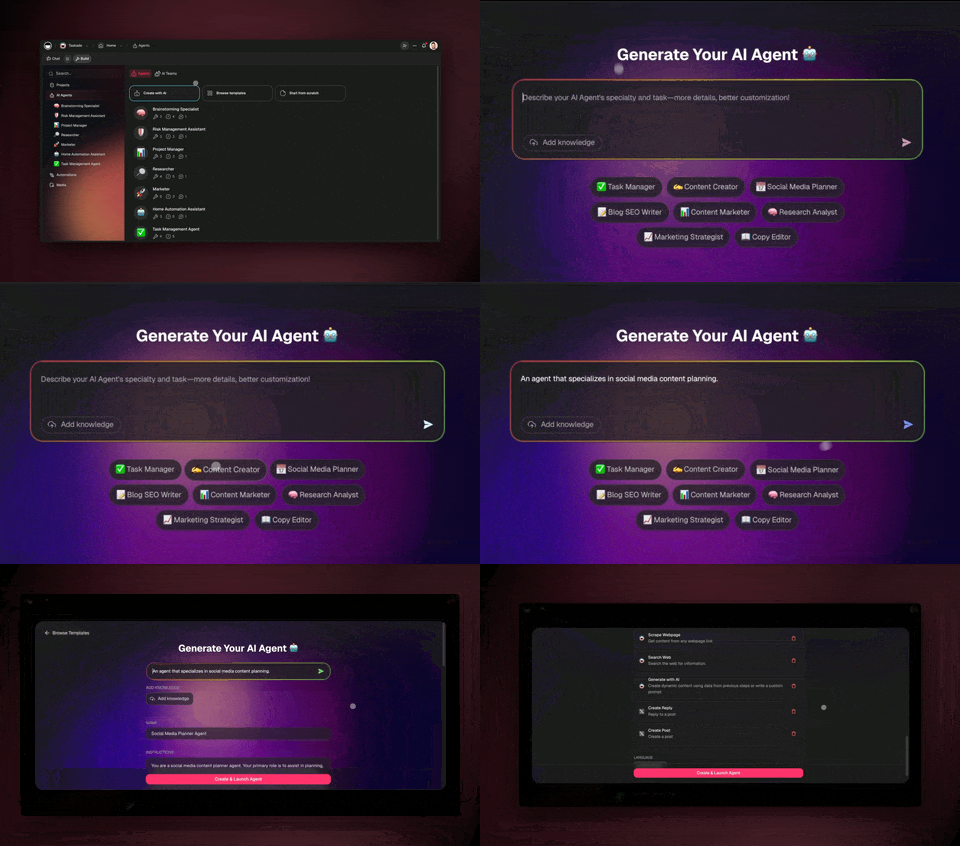
Taskade Genesis gives a solopreneur the full stack of a real company in one app: a place to store everything (**Memory**), a team of agents that reason over it (**Intelligence**), and the automations and integrations that do the work (**Execution**) — all from a plain-English prompt. The reason a single founder can operate like ten people is not any one feature; it is that these three layers form a **self-reinforcing loop**. Memory feeds the agents, the agents drive execution, and every result flows back into Memory so the whole company gets smarter each week. That loop is **Workspace DNA**, and it maps cleanly onto the four jobs of a one-person business.
```mermaid
graph TD
subgraph DNA["Workspace DNA — your one-person company"]
M[Memory
Projects, multiple views
customers + brand + history]
I[Intelligence
agent team, built-in tools
Frontier models]
E[Execution
automations + 100+ integrations
custom domains + live app]
end
M -->|context| I
I -->|decisions + drafts| E
E -->|new results| M
E -->|publish| APP([Shareable live app
clone + custom domain])
classDef pink fill:#2a1225,color:#ff8fa3,stroke:#ff2d60,stroke-width:2px;
classDef teal fill:#11111b,color:#cdd6f4,stroke:#00d4aa;
classDef green fill:#0d1a0e,color:#86efac,stroke:#22c55e,stroke-width:1.5px;
class M pink;
class I teal;
class E,APP green;
```
Here is what each capability actually does for *this* use case — running a company alone:
| Capability | What it is | What it does for a solopreneur |
|---|---|---|
| **Workspace DNA loop** | Memory feeds Intelligence feeds Execution, back to Memory | Your company compounds — every customer handled makes the next one faster |
| **built-in agent tools** | Web search, file analysis, code execution, custom slash commands, persistent memory | One agent can research a lead, read a contract, and run a calculation — no extra apps |
| **Multiple project views** | List, Board, Calendar, Table, Mind Map, Gantt, Org Chart (Gantt and Org Chart on paid plans) | The same customer data is a CRM table, a content calendar, and a pipeline board at once |
| **Multi-agent teams** | Agents hand work to each other with shared memory | Sales → onboarding → support → admin runs as one flow, no copy-paste |
| **100+ bidirectional integrations** | Triggers pull events in, actions push results out | Your form, inbox, calendar, and payment tool all feed the same brain |
| **Frontier models** | Models from top AI labs, picked per agent | Fast model for triage, a deeper model for the contract — you choose per job |
| **Custom domains + publishing** | Ship a live app on your own URL with Taskade Genesis (custom domains on Pro and up) | Hand customers a branded portal or chatbot, not a spreadsheet |
| **Role-based access** | Owner through Viewer permissions | Bring in a VA or contractor without handing over billing or brand |
The point is not that any one of these is unique — it is that a solopreneur gets **all of them in one prompt-built app**, instead of buying, wiring, and babysitting eight separate tools. You describe the company you want to run; Genesis assembles the layers. Explore the building blocks on the [agents hub](https://www.taskade.com/agents), the [automation hub](https://www.taskade.com/automate), and the [Taskade App Factory](https://www.taskade.com/apps).
## Meet the four agents, one at a time
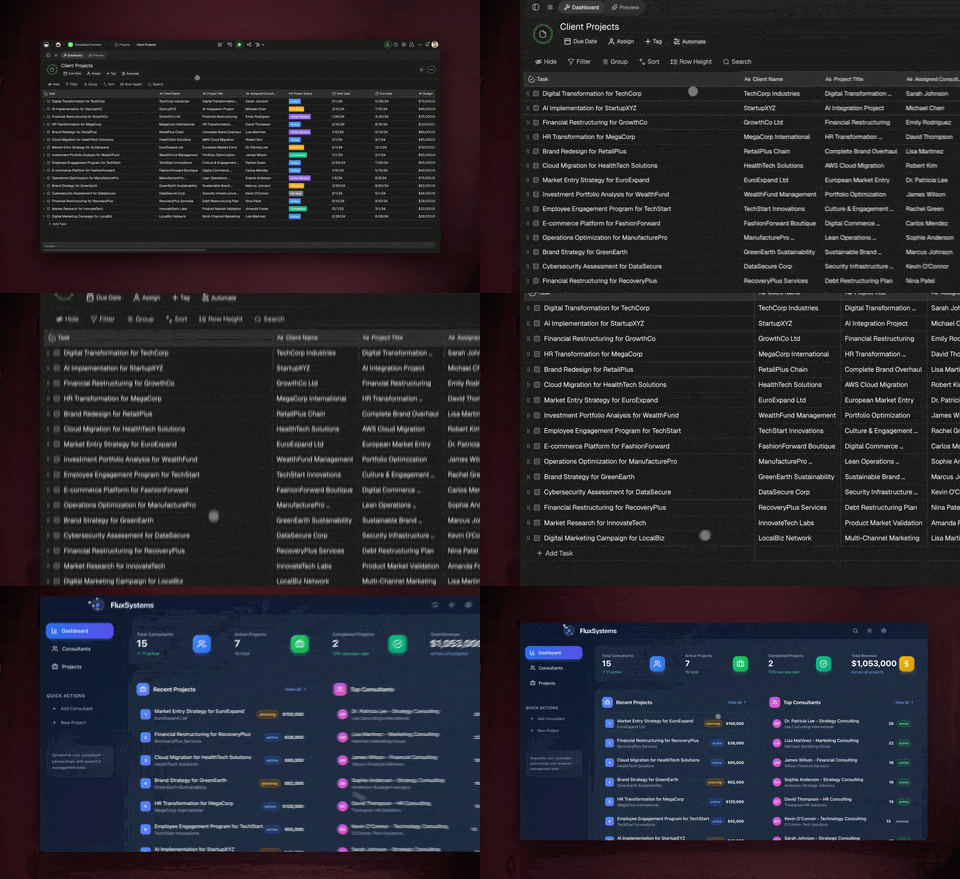
Below is what each member of your starter team actually does, with the trigger that wakes it and the integrations it leans on. Build them in this order and each one hands richer context to the next.
Before the prose, here is the at-a-glance wiring — the event that wakes each agent, the tools it leans on, and the concrete output it produces. Every integration below is one of the [100+ bidirectional integrations](https://www.taskade.com/automate), so the trigger pulls events in and the action pushes results out without you touching a field.
| Agent | Trigger that wakes it | Integrations it leans on | What it produces |
|---|---|---|---|
| **Content agent** | New idea, long asset, or scheduled slot | Docs, social channels, content calendar | Channel-ready posts queued for approval |
| **Sales agent** | Form submission or new inbound lead | Form tool, enrichment, inbox, pipeline board | Enriched, scored lead + drafted follow-up |
| **Support agent** | New customer message or ticket | Help docs, inbox/chat, memory | Drafted reply, routine ones auto-sent |
| **Admin agent** | Payment, meeting request, or due date | Calendar, payment tool, invoicing | Invoice sent, meeting booked, renewal nudged |
### The content agent — your marketing department
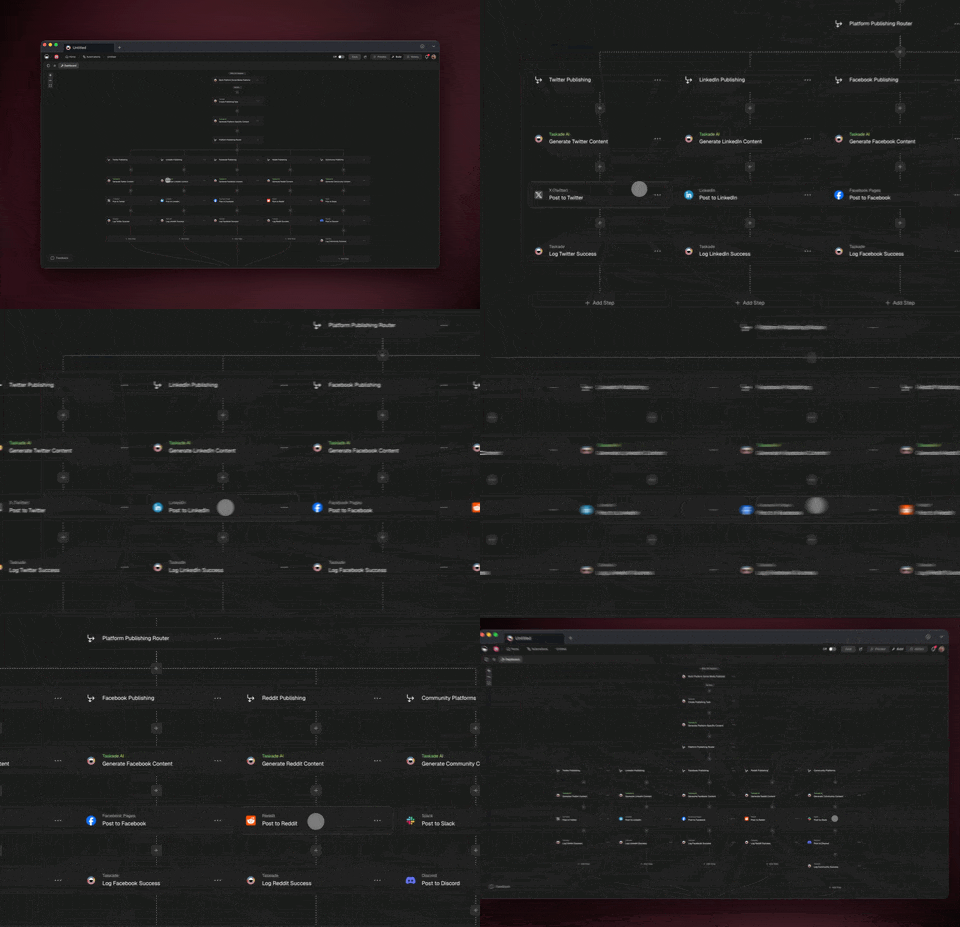
The content agent turns one idea into a week of marketing. You give it a topic or a long asset — say, a 2,000-word webinar transcript — and it drafts the post, repurposes it into channel-specific formats (a thread, three short posts, a newsletter blurb, five hooks), and queues it for your approval. It remembers your brand voice from past content stored in memory, so the tenth post sounds more like you than the first. This is the agent most solopreneurs build first, because content is the function that never stops asking for hours — typically **8 to 12 hours a week** for a solo founder. Pair it with a reviewer agent and you get a clean draft → review → publish loop without a marketing hire. The concrete win: one source asset becomes a week of channel-specific content in minutes instead of an afternoon.
### The sales agent — your pipeline that never sleeps
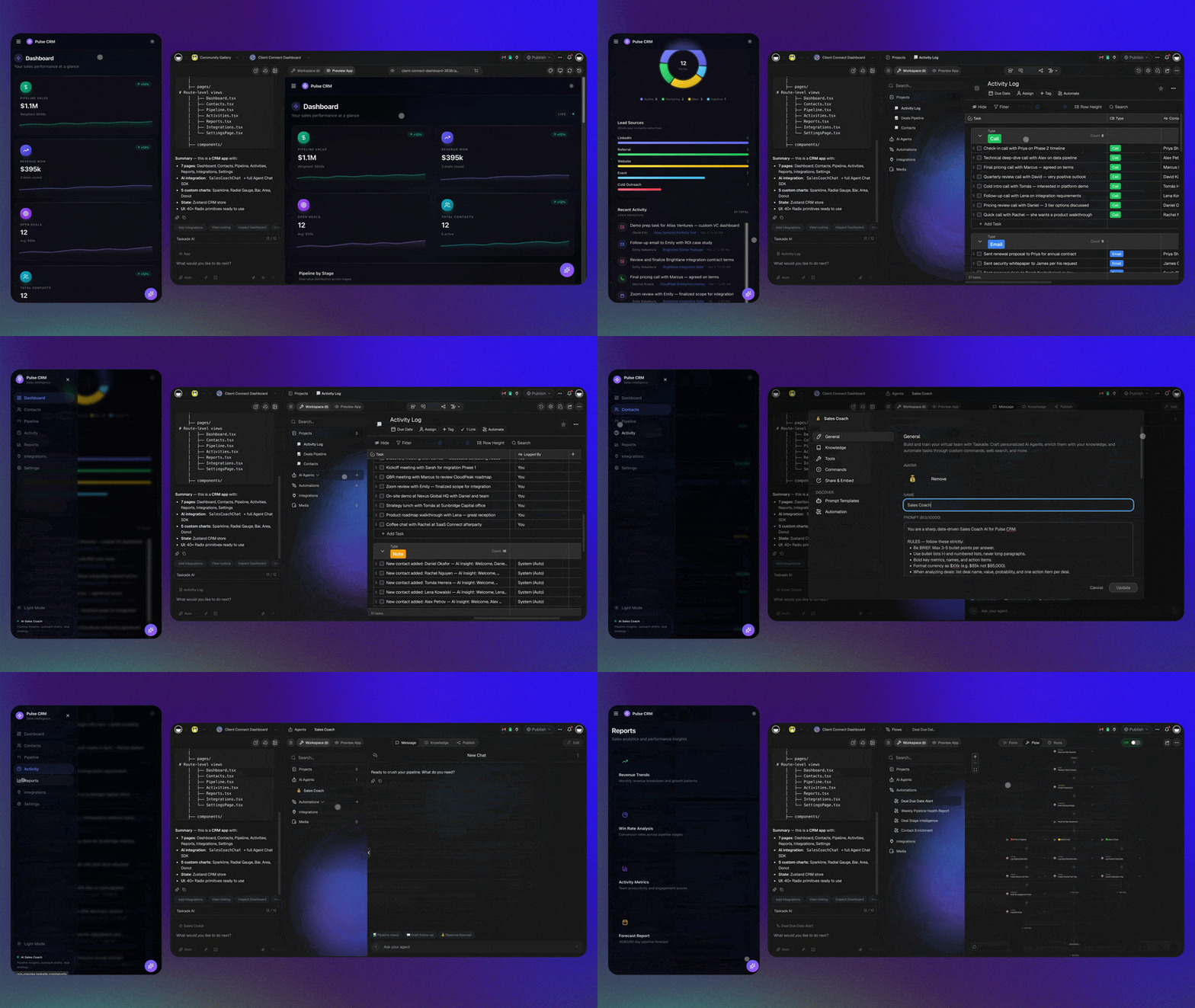
The sales agent works leads the instant they arrive. It enriches the new contact with company and role data, scores them so you focus on the hot ones, and drafts a personalized follow-up in your voice, then hands the qualified, contacted lead to your onboarding flow. A solo founder who used to lose leads in a cold inbox now has a pipeline that responds in seconds, and speed matters: in a study of 1.25 million sales leads, firms that tried to contact a lead within an hour were nearly seven times as likely to qualify it as firms that waited even an hour longer ([Harvard Business Review](https://hbr.org/2011/03/the-short-life-of-online-sales-leads), March 2011). Concretely, a consultant fielding **100 inquiries a month** goes from hours of manual triage to a board where every lead arrives already enriched, scored, and drafted. You just approve the hot ones. The whole pipeline lives in one of the [multiple project views](https://www.taskade.com/learn/projects/project-views), so the same data is a board, a table, and a calendar at once.
### The support agent — your help desk
The support agent reads incoming questions, pulls the answer from your docs and past conversations in memory, and drafts a reply in your tone. Routine questions it can answer automatically; the genuinely hard ones it routes to you with the context attached. The result is fast, consistent support without staffing a desk — and every resolved ticket teaches the agent for next time.
### The admin agent — your back office
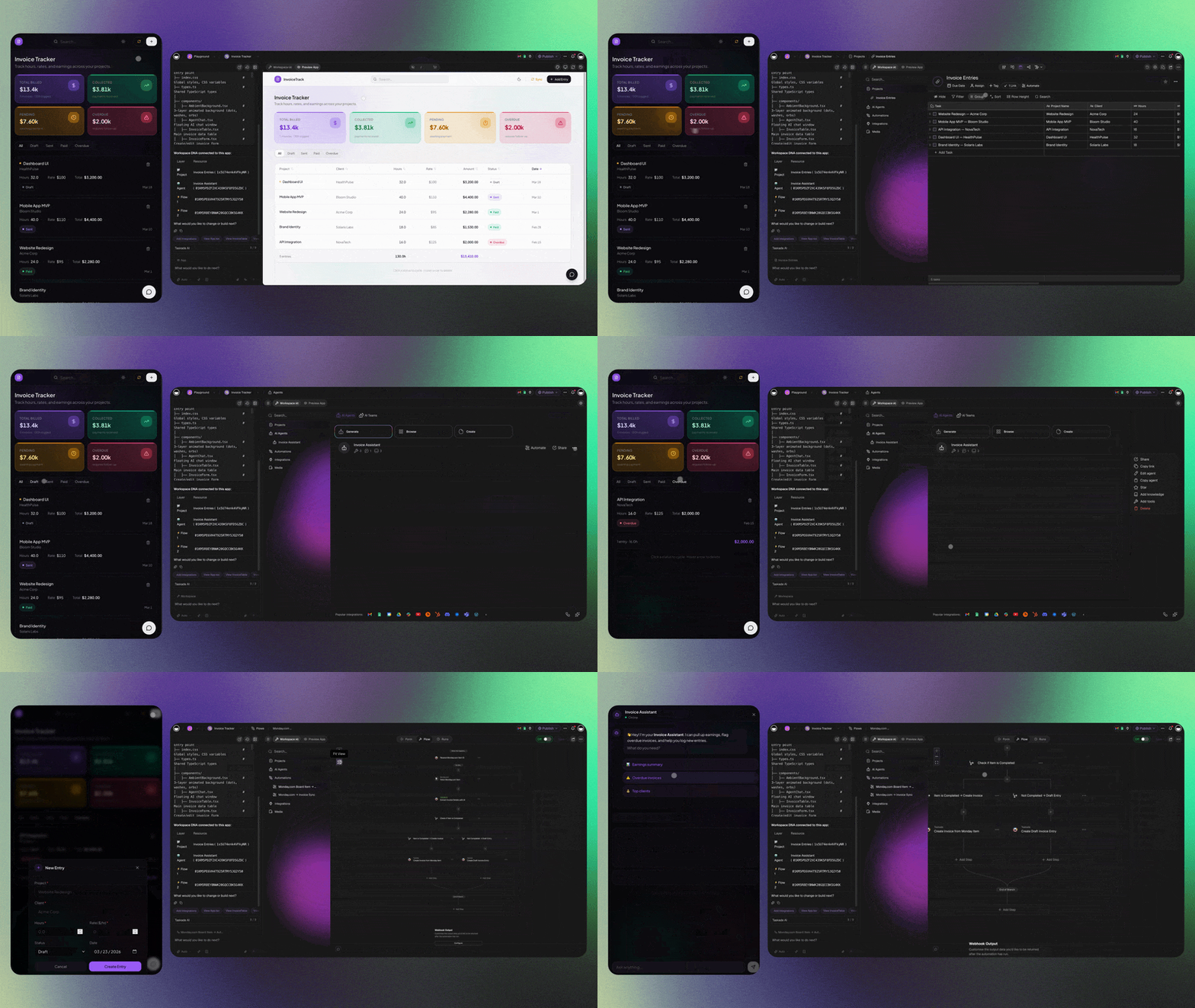
The admin agent handles the invisible work that quietly eats a solo founder's day: generating invoices, booking meetings, chasing unpaid bills, and keeping records in sync. When a customer pays, it updates the record and schedules the renewal nudge. When a meeting is requested, it offers times from your calendar. It is the agent that gives you back your evenings.
## A worked example: one customer, start to finish
Let us make this concrete with one complete journey — a customer who finds you, buys, gets supported, and renews, run entirely by your agent team with you on only the decisions. Done manually by a solopreneur, this journey is a chain of copy-paste, lookups, drafting, and follow-up spread across four tools and several late nights. Run by agents, it is **near-instant, end to end, with you on only the moments that need you.**
Picture a solo consultant who gets 100 inbound inquiries a month. Manually, qualifying, replying, onboarding, supporting, and invoicing each one is dozens of hours of context-switching. With an agent team, it is near-zero hours of busywork and faster response times — and response speed is one of the biggest predictors of whether an inquiry becomes a paying customer.
```mermaid
sequenceDiagram
participant C as Customer
participant SA as Sales agent
participant H as You
participant ON as Onboarding agent
participant SUP as Support agent
participant AD as Admin agent
C->>SA: Submits inquiry
SA->>SA: Enrich + score + draft reply
SA->>H: Send draft for approval
H->>C: Approve → personalized reply sent
C->>ON: Says yes
ON->>C: Welcome + setup, with full context
C->>SUP: Asks a question later
SUP->>C: Answers from memory + docs
SUP->>AD: Renewal due
AD->>C: Invoice + renewal nudge sent
```
Walk through what each agent does and why it matters for a one-person business:
| Stage | Agent / step | What happens | What you keep |
|---|---|---|---|
| Capture | Sales agent | Pulls the inquiry in, enriches and scores it instantly | Nothing — fully handled |
| First reply | Sales agent → you | Drafts a personalized reply; you approve and send | The relationship and tone |
| Onboard | Onboarding agent | Welcomes the new customer with full context from the handoff | The big setup calls |
| Support | Support agent | Answers questions from memory and docs, routes hard ones to you | The judgment calls |
| Renew | Admin agent | Sends the invoice and the renewal nudge on schedule | The pricing decision |
The magic is not any single step — it is that they run as **one continuous flow** inside one app, with the customer's context carried from agent to agent. No exporting a CSV to a CRM, no pasting into a separate helpdesk, no manually logging the invoice. The customer is qualified, replied to, onboarded, supported, and renewed without you stitching tools together at midnight. And because it all lives in [Taskade](https://www.taskade.com/automate), the next agent always picks up exactly where the last one left off.
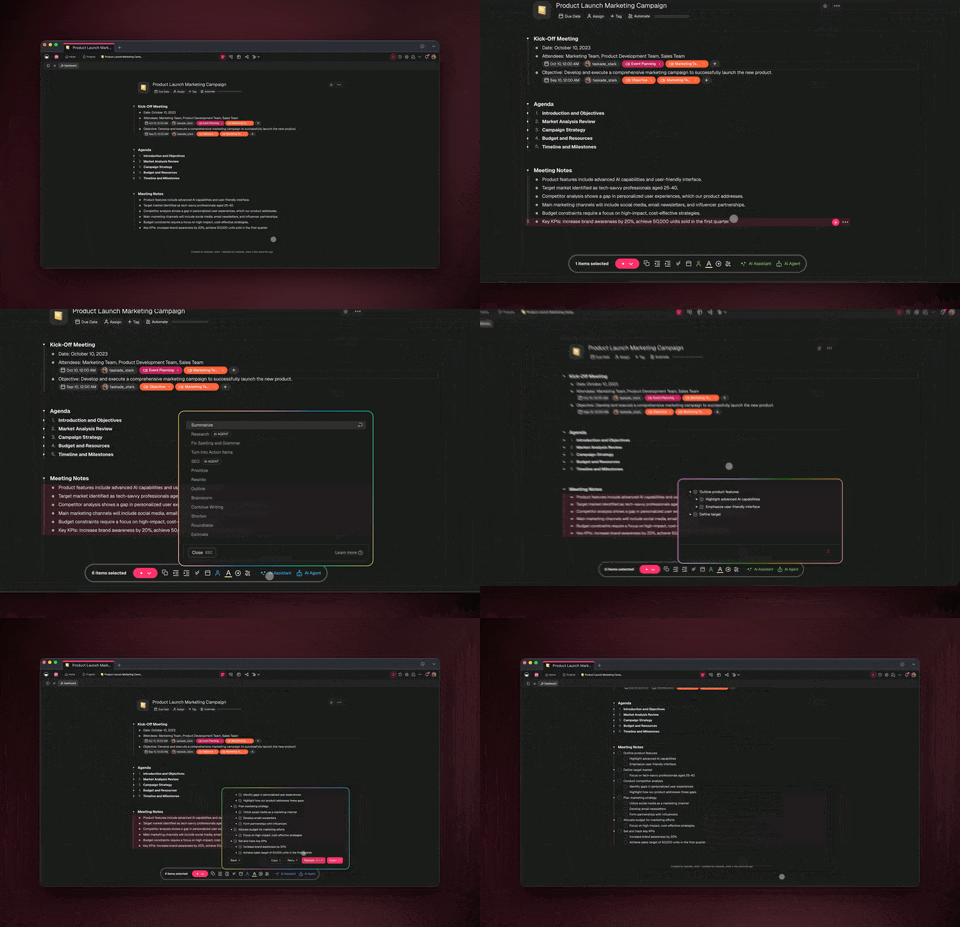
Build this once, then review it each week. Then point the same four-move pattern at your next workflow (abandoned-cart recovery, content distribution, churn-risk outreach), and your one-person company grows one agent at a time. The full step-by-step lives in the [agent playbook](https://www.taskade.com/learn/agents/agent-playbook) and the [forms trigger guide](https://www.taskade.com/learn/automation/triggers).
## What a solo founder should keep (the human 10-20%)
Hand the repeatable work to agents; keep the work that needs your taste, your relationships, and your name on it. The split is not about replacing yourself — it is about pointing yourself at the small slice that actually grows a one-person business.
| Give to your agents (the 80-90%) | Keep for yourself (the 10-20%) |
|---|---|
| Drafting content and repurposing | Brand strategy and positioning |
| Lead enrichment and scoring | High-stakes sales conversations |
| First-line support replies | The genuinely hard customer cases |
| Invoicing, scheduling, follow-ups | Pricing and offers |
| Weekly reporting | Reading the numbers and deciding |
A useful gut check: if you could explain the task to a sharp new hire in two sentences, an agent can do it. If it needs your years of context and judgment, keep it. Start with one agent on one role, measure the hours it gives back, then hire the next. The whole point of a one-person company is that *you* stay rare — the agents make the rest of the business run without you in every loop.
## Keep control as your agents take on more
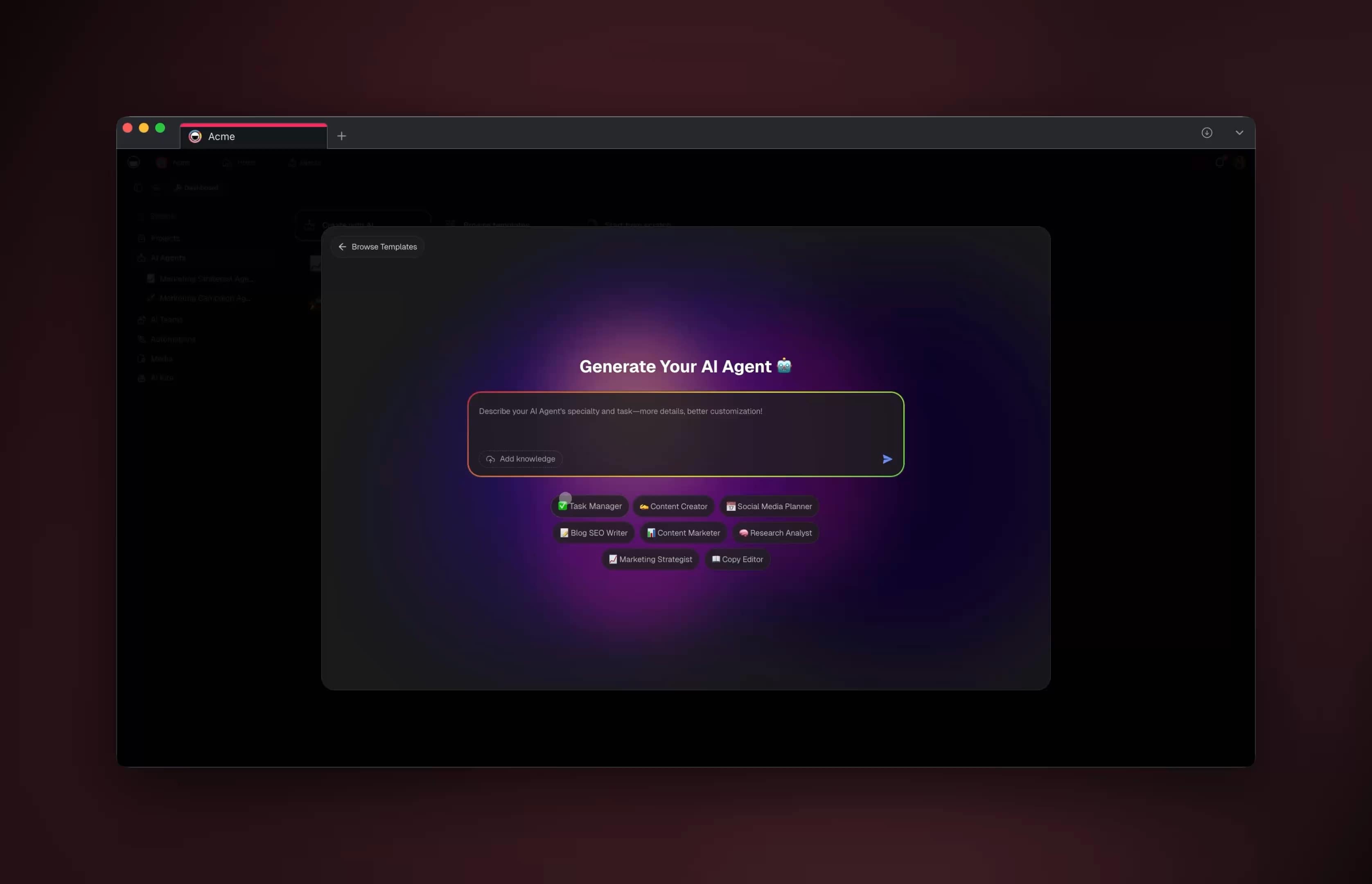
Running a company on agents does not mean losing control — it means setting the right guardrails. Taskade uses **role-based access** (Owner to Viewer) so that even as a solopreneur, you can bring in a contractor, a virtual assistant, or a future first hire without handing them the keys to everything. Your VA can be an Editor who drafts but cannot publish; a contractor can be a Checker who works assigned items but cannot touch billing.
That governance is what makes "run it on agents" safe as the business grows. The agents do the volume, the roles make sure nothing ships without the right sign-off, and the [Owner](https://www.taskade.com/learn/account/billing-faq) — you — keeps final say over money and brand. When you do eventually hire a human, they slot into a team and a memory that already knows how the business runs.
## The Managed AI Employee: A Service Model for Solo Operators
A managed AI employee is a service in which a solo operator runs an agent for a client and bills a monthly fee for the outcome, not a one-time fee for a build. The client does not buy software. The client buys follow-ups that go out, reports that arrive and an inbox that stays answered, with a person still approving each decision.
This is the same four-agent pattern from this guide, pointed at someone else's business. The demand is real. The US Chamber of Commerce reported on October 2, 2026 that [66% of small businesses use AI](https://www.uschamber.com/technology/2026-empowering-small-business-report), up from 58% a year earlier. Multi-location operators are a natural first market, because every location repeats the same work: FRANdata tracks about [9,000 active US franchise brands](https://frandata.com/report-downloads/franchising-economic-outlook-2026/), and the International Franchise Association forecasts about [845,000 franchise establishments](https://www.franchise.org/2026/02/ifa-predicts-steady-growth-for-franchising-in-2026-economic-outlook/) for 2026.
The build order matters more than the agent:
1. **Data first.** Pull the client's contacts, bookings and messages into one place. An agent that cannot see the business makes decisions with no context.
2. **Scoped skills second.** Give each agent one recurring job, such as daily follow-ups or the weekly report, and have it write its result back to the shared record.
3. **An approval queue third.** The agent drafts and a person decides. Agent frameworks name this pattern human-in-the-loop, with [approve, edit and reject](https://docs.langchain.com/oss/python/langchain/human-in-the-loop) among the decisions a person can make.
```mermaid
sequenceDiagram
participant C as Client data
participant A as Agent
participant H as Human approver
participant X as Action
participant M as Memory
C->>A: Contacts, bookings and messages in one place
A->>H: Drafts the follow-up and asks for a decision
H->>X: Approves, and the message goes out
H->>M: Rejects, and the reason is recorded
X->>M: The result is written back
M->>A: The next draft starts with more context
```
Every approval and every rejection teaches the system the client's voice and priorities. After six months, that accumulated context is the switching cost: a new provider can copy the agents in a day, but not the record of what the client said yes and no to. That is also where your judgment shows, a point we expand in [taste and moats in the AI era](https://www.taskade.com/blog/taste-moat-explained).
| Layer | What you set up in Taskade Genesis | Plan fact to check |
|---|---|---|
| Client data | A client workspace with projects for contacts, jobs and messages | Each approver must be a member of that workspace |
| Scoped skills | [Agents with instructions and knowledge](https://www.taskade.com/learn/agents/knowledge), one job each | The Free plan holds 1 AI agent |
| Approval queue | An automation with a [Wait for approval](https://www.taskade.com/learn/automation/approval-step) step, which offers Approve and Reject | Automations run on every plan, and Free includes 10 runs a billing period |
| Connected tools | Automation steps for the client's email, chat and CRM | Premium integrations need a paid plan |
| Client view | A client portal app with App User sign-in | Sign-in works on every plan, and a custom domain is Pro and up |
One note on the client view: sign-in confirms who the visitor is. You match each client's records to that login, and you test it with a second account before a client sees it.
Three honest caveats before you sell this:
- **No independent retention data exists** for AI-employee vendors. The outcome numbers in the market come from the vendors themselves.
- **An outcome guarantee is a liability.** If you promise a result in 90 days, price the refund risk into the retainer and define the outcome in writing.
- **Runtime is not the whole cost.** Anthropic lists Claude Managed Agents at [$0.08 per session-hour](https://platform.claude.com/docs/en/about-claude/pricing#claude-managed-agents-pricing) of running time, and tokens are billed on top at standard rates. Measure a real month before you quote a margin.
For the company-level view of this model, read [one-person companies](https://www.taskade.com/blog/one-person-companies).
## Where this is heading
The direction is clear: every solopreneur will run on a self-reinforcing **Memory + Intelligence + Execution** loop, where a single prompt becomes a living, self-improving company. Today you hire agents one at a time; tomorrow you describe the outcome — "run my consulting business" — and the system stands up the team, the data, and the automations, then *improves itself* as it learns your customers. The one-person company stops being a person juggling tools and becomes a founder directing a workspace that remembers everything, reasons over it, and acts on it around the clock.
That is the Taskade vision: the gap between *having an idea for a business* and *running it* collapses to a sentence. The rare, human part — taste, relationships, the final yes — stays with you. Everything repeatable runs on agents that get smarter every week. The solopreneurs who start building that loop now will compound a year of advantage before the rest of the market catches up. Start the loop from a single prompt on [Taskade Genesis](https://www.taskade.com/create).
## Clone a working agent app and start today
You do not have to build from a blank page. The Taskade App Factory is full of cloneable agent apps you can drop into your workspace and point at your own business in minutes.
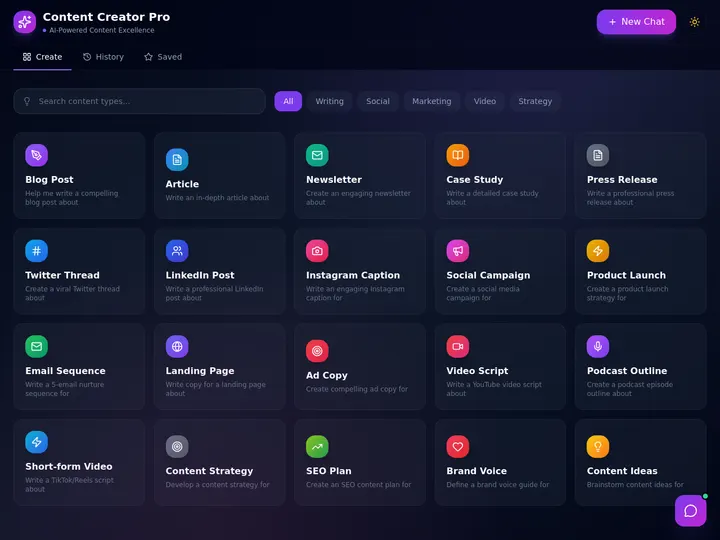
*The Content Agent: clone it from the Taskade App Factory and point it at your brand. It is a strong first hire for a one-person company. Cloning it needs a paid plan.*
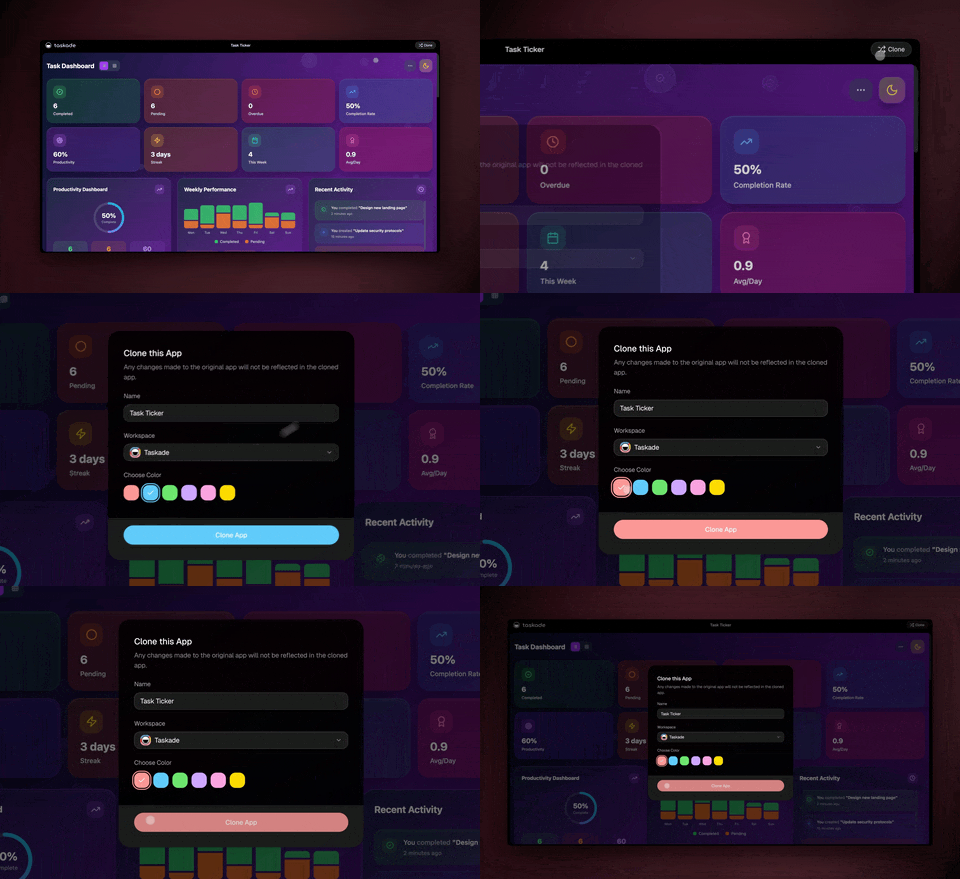
The Content Agent Chatbot kit has no price, but it holds 1 AI agent and 3 automations, so a clone needs a paid plan. On Free, you can describe a similar agent at [/create](https://www.taskade.com/create) instead once you have AI credits, which you earn with referrals and invites, or you can upgrade to [Pro](https://www.taskade.com/pricing). Clone an agent, give it your brand guidelines and past work as memory, and it becomes a tireless coworker that already knows your voice. From there, add a sales agent, a support agent, and an admin agent, one at a time, and you have the full lead → onboard → support → renew company from earlier, built one piece at a time. Browse more [cloneable agent apps](https://www.taskade.com/apps) or [start your own from a prompt](https://www.taskade.com/create).
## Frequently asked questions
### Can AI agents really run a one-person company in 2026?
Yes, for much of the repeatable work, with the founder on the decisions. A solopreneur builds a small team of AI agents where each agent owns one job: a content agent drafts and repurposes, a sales agent enriches and follows up on leads, a support agent answers customers, and an admin agent handles invoices and scheduling. The agents keep persistent memory and hand work to each other, and the founder approves anything that sends money, signs a customer or speaks for the brand. In Taskade Genesis you describe the business outcome in plain English and it builds the agents, the automations, and a live app to run them. Free holds 1 agent, and a full four-agent team starts on Pro at 10 dollars per month billed annually.
### How do I start running my business on AI agents today?
Pick the single role that eats the most of your week, then describe the outcome to [Taskade Genesis](https://www.taskade.com/create) in plain English. It builds the agent, the automation, and a live app, with no code and no wiring. The Free plan holds 1 AI agent, but a prompt build needs AI credits. On Free, you earn free AI credits with referrals and invites, or you can upgrade to [Pro](https://www.taskade.com/pricing), which adds monthly AI credits and unlimited agents that hand work to each other. Within a few weeks you can have a four-agent team for content, sales, support, and admin.
### What jobs should a solopreneur give to AI agents first?
Start with the highest-frequency, lowest-judgment work you do every week, usually content repurposing, lead follow-up, or customer support replies. Build one [agent](https://www.taskade.com/agents) for one job, measure the hours it gives back, then add the next. The common four-agent starter team for a one-person business is a content agent, a sales agent, a support agent, and an admin agent. Each Taskade agent ships with built-in tools, including web search, file analysis, and code execution.
### What is the best AI for a one-person business in 2026?
The best fit combines reasoning agents, reliable automations, and a place to store your customer data, not a single chat tool or an app connector alone. [Taskade Genesis](https://www.taskade.com/ai/apps) does all three from one prompt, with built-in agent tools and frontier models from top AI labs. You describe the business you want to run, and it builds the team of agents that runs the repeatable work.
### Will AI agents replace solopreneurs?
No. Agents replace the repeatable work, such as drafting, enrichment, scheduling, first-line support, and reporting, so the founder keeps the part that needs a human: strategy, taste, relationships, and the final yes. The solopreneur moves from doing every task to directing a team of [agents](https://www.taskade.com/agents) and deciding where time and money go. The business runs on agents, but the judgment that makes it valuable stays human.
### How do AI agents hand work to each other?
In a multi-agent team, one agent finishes its job and passes the result to the next agent in the workflow. A sales agent qualifies a lead and hands it to an onboarding agent, which hands the customer to a support agent. Taskade supports [multi-agent collaboration](https://www.taskade.com/agents) natively, and because every agent shares the same workspace memory, the handoff carries full context with no copy-paste between tools.
### How is this different from AI agents for startups?
AI agents for startups assume a small team of humans who delegate work to agents and review the output together. The solopreneur model assumes one person who is the entire team, so the agents must cover the seams between roles, for example handing a qualified lead from the sales agent to the onboarding agent. The architecture is the same multi-agent pattern, but the goal is coverage of every business function rather than scaling an existing team. Read the startup angle in our [AI agents for startups](https://www.taskade.com/blog/ai-agents-startups) guide.
### How is this different from making money with vibe coding?
Vibe coding is about shipping apps, often for clients, from a prompt. Our guide on [how to make money vibe coding](https://www.taskade.com/blog/vibe-coding-money) covers that path. This guide is about running your own one-person company on a team of agents that handle content, sales, support, and admin. Different goal, same Taskade Genesis engine.
### Do AI agents for solopreneurs need coding skills?
No. Taskade Genesis is no-code. You describe the agent team and the workflows you want in plain English, and it builds the agents, the automations, the database, and a shareable app. There is nothing to host or deploy. A solo founder with no engineering background can ship a working sales follow-up or customer support system in an afternoon.
### Can I try a real agent app before building my own?
Yes. Open a live agent app in the [Taskade App Factory](https://www.taskade.com/apps) and try it in your browser, or [start from a prompt](https://www.taskade.com/create). The Content Agent Chatbot embedded in this guide has no price, but it holds 1 AI agent and 3 automations, so cloning it into your workspace needs a paid plan. On Free, you can build a similar content agent from a prompt once you have AI credits, which you earn with referrals and invites, or you can upgrade to Pro.
### How much does it cost to run a company with AI agents?
Taskade Genesis is free to start. [Paid plans](https://www.taskade.com/pricing) on annual billing are Pro at 10 dollars per month, Business at 25 dollars per month, Max at 100 dollars per month, and Enterprise at 250 dollars per month. On Free, you earn free AI credits with referrals and invites, and you can upgrade any time. Because one platform can replace a separate writer tool, CRM, helpdesk, and scheduler, a solopreneur can cut total software spend after consolidating onto one agent system. Prices checked on 2026-11-07.
### How do AI agents remember my business and customers?
Each agent carries persistent memory, and the whole system stores its data in Projects across [multiple views](https://www.taskade.com/learn/projects/project-views), including List, Board, Calendar, Table, Mind Map, Gantt, and Org Chart, with Gantt and Org Chart on paid plans. An agent that handled a customer last week remembers the context this week. This is Taskade Workspace DNA, where Memory feeds the agents, the agents drive Execution, and every result flows back into Memory.
### What does an AI solopreneur do?
An AI solopreneur is a one-person business owner who hands the repeatable work to AI agents and automations and keeps the decisions. The daily job is three things: set the goal for each agent, review and approve what the agents send back, and decide where to spend time and money next. Agents draft, route and report. The solopreneur approves anything that sends money, signs a customer or speaks for the brand. See [the week in a table](#what-does-an-ai-solopreneur-do) above.
### How do I run a one-person business with AI automation?
Put every customer record in one workspace, then give each recurring job to one agent or automation: content, lead follow-up, support replies and invoicing. Add a [Wait for approval](https://www.taskade.com/learn/automation/approval-step) step in front of every action that sends mail, posts in public or moves money. Start with the single job that takes most of your week, measure the hours it gives back, then add the next. In Taskade, automations run on every plan, and the Free plan includes 10 runs a billing period.
---
**Ready to run your one-person company on a team of AI agents?** [Start free with Taskade Genesis](https://www.taskade.com/create) — describe the business you want to run, and watch it build the agents, connect your tools, and ship a live app you can run today. Explore the [agents hub](https://www.taskade.com/agents), browse [cloneable agent apps](https://www.taskade.com/apps), the [automation hub](https://www.taskade.com/automate), or read the [AI agents for startups](https://www.taskade.com/blog/ai-agents-startups) guide for the team-scaling angle.
▲ ■ ● Memory, Intelligence, Execution. Describe the company you want to run, and Taskade Genesis remembers your customers, reasons over your business, and runs the work across every function. That is the difference between a solopreneur drowning in hats and a one-person company you direct.